
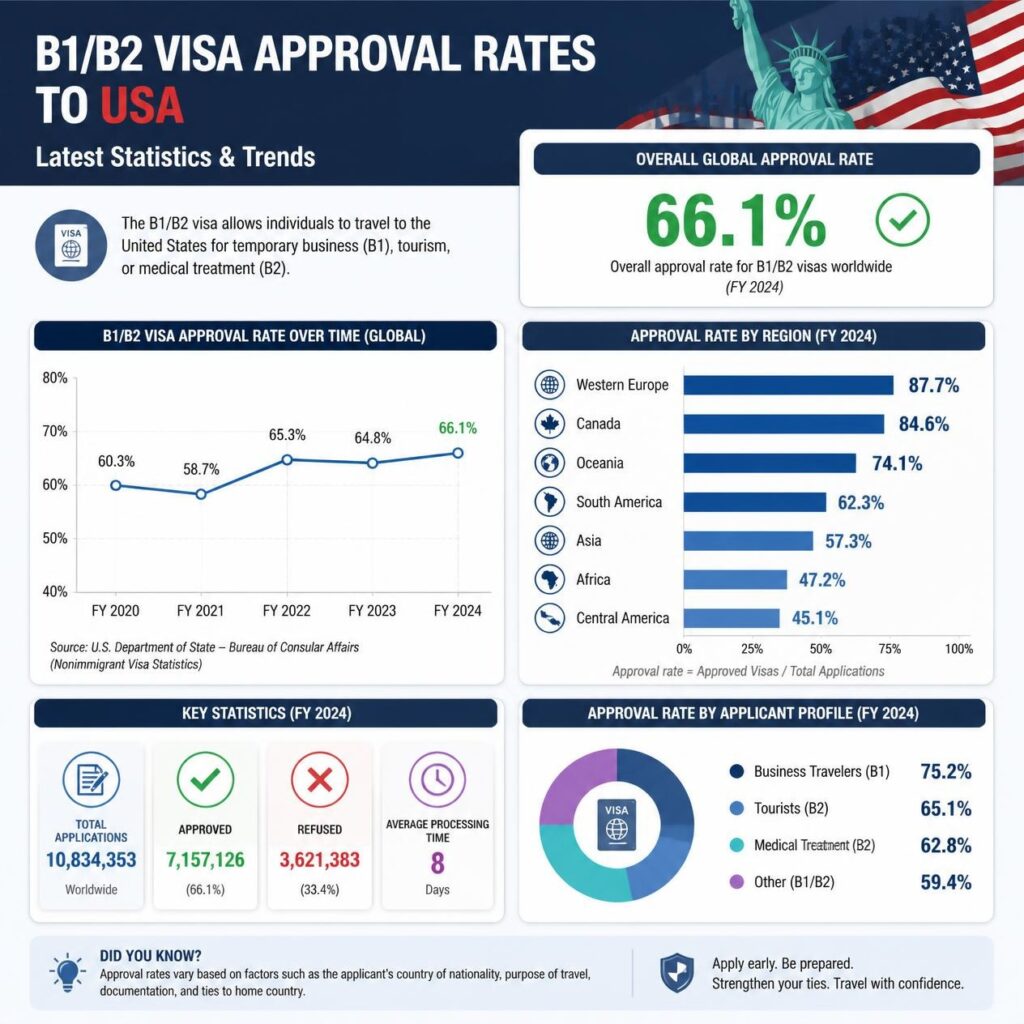
For applicants from Bangladesh, the latest official U.S. Department of State statistics show that the FY2025 adjusted refusal rate for B visas was 61.45%. Because the adjusted refusal rate is calculated using a specific government methodology, it should not be treated as a guaranteed individual approval or rejection percentage. In simple terms, the statistics show that approval outcomes vary significantly by nationality and that a strong, credible application is extremely important.
In this detailed guide, we will explain how often B1/B2 visas are approved, what the official statistics mean, why some applications are refused, how Section 214(b) affects visitor visa decisions, and what applicants can do to prepare a more credible and consistent application.
What Is a B1/B2 Visa?
A B1/B2 visa is a temporary U.S. visitor visa that combines two common purposes of travel:
- B1 visa: Temporary business-related activities.
- B2 visa: Tourism, vacation, visiting relatives or friends, and certain medical treatment.
Many travelers receive a combined B1/B2 visa because their travel plans may involve both business and tourism. For example, a business owner may travel to the United States to attend a conference and then spend several days sightseeing.
According to the U.S. Department of State, visitor visas are intended for temporary travel. Permitted activities may include tourism, vacation, visiting family or friends, attending certain business meetings or conferences, negotiating contracts, and receiving medical treatment, depending on the applicable visa classification and circumstances.
A B1/B2 visa does not provide permission to permanently live or work in the United States. It is a temporary nonimmigrant visa, and the applicant must demonstrate that the planned visit is consistent with the purpose of the visa.
How Often Does a B1/B2 Visa Get Approved to the USA?
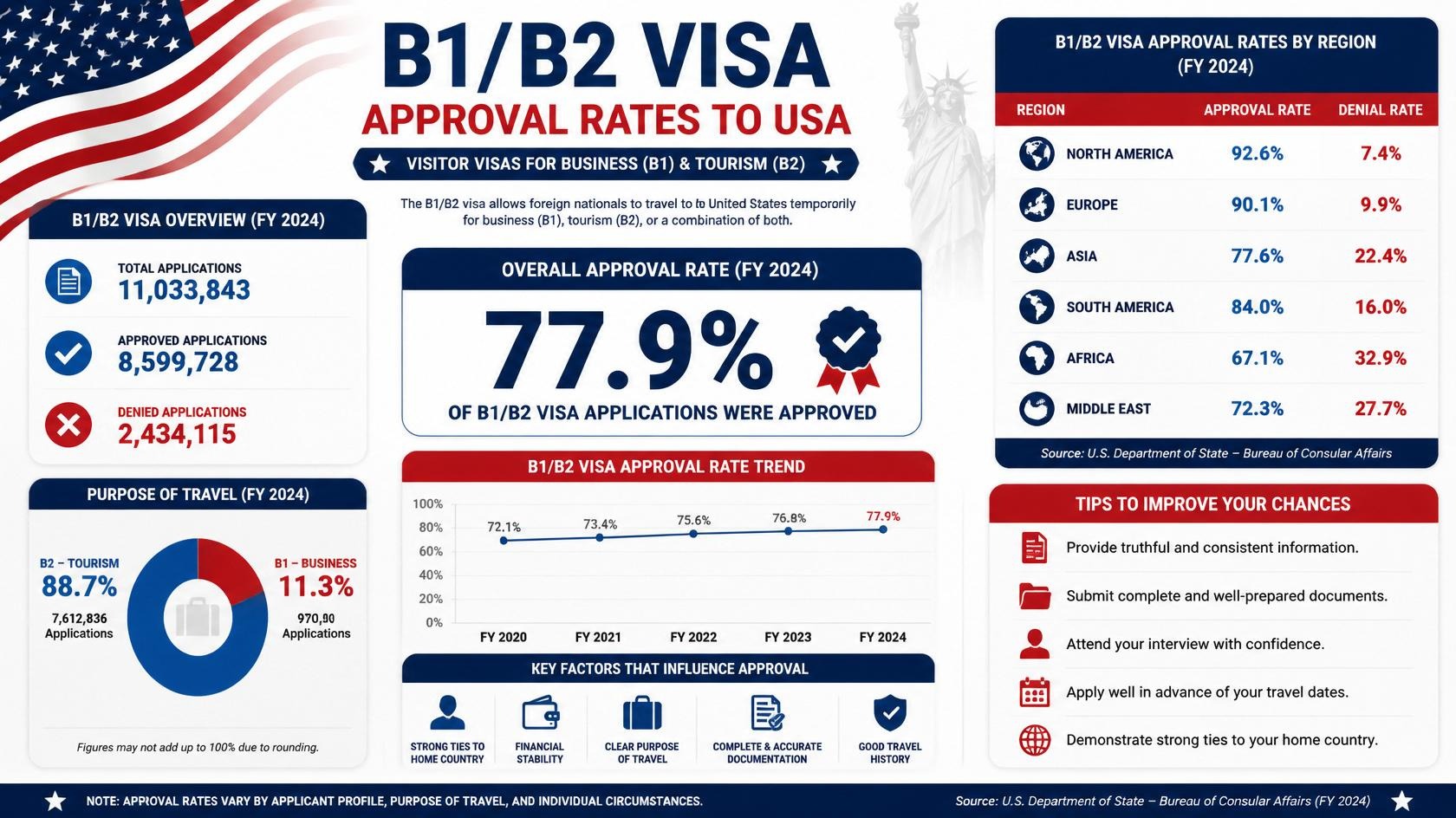
The answer depends primarily on the applicant’s nationality and individual circumstances. The U.S. Department of State publishes annual statistics showing adjusted refusal rates for B visas by nationality.
For FY2025, the adjusted refusal rate for Bangladeshi nationals applying for B visas was 61.45%. The adjusted refusal rate was 46.09% in FY2024. This represents a substantial year-to-year change, but it is important not to interpret the figure as a guaranteed individual probability.
Government statistics are calculated using a specific methodology that accounts for applicants who may have initially been refused but later overcome that refusal. Therefore, the published adjusted refusal rate is a statistical measure for a nationality and fiscal year—not a personal prediction for an individual applicant.
What Does a 61.45% Refusal Rate Mean?
In simple terms, a 61.45% adjusted refusal rate means that the official statistical calculation recorded a refusal rate of approximately 61 out of every 100 relevant B visa applicants from that nationality under the Department of State’s methodology.
However, this does not mean that exactly 61.45% of every group of applicants will be refused. Your individual result may be very different because the consular officer evaluates your own circumstances.
For example, two applicants from the same country may have completely different outcomes:
- Applicant A has stable employment, a clear travel plan, strong financial evidence, a history of international travel, and compelling reasons to return home.
- Applicant B has unclear finances, inconsistent information, limited employment or business ties, and an unexplained travel purpose.
Both applicants may be from the same country, but their cases are not identical. A nationality-level statistic cannot determine the outcome of either individual application.
Why Is There No Guaranteed B1/B2 Visa Approval Rate?
Many applicants search online for phrases such as “B1/B2 visa approval rate,” “B1/B2 visa success rate,” or “how often does B1/B2 visa get approved to USA.” These searches are understandable, but visa decisions are not made using a simple universal formula.
Consular officers generally evaluate whether the applicant:
- Qualifies for the requested visa category.
- Has a legitimate and credible temporary travel purpose.
- Can explain how the trip will be funded.
- Has sufficient reasons to return to their home country.
- Has provided truthful and consistent information.
- Has no applicable legal or immigration ineligibility.
The interview may be brief, but the decision can involve consideration of the information in the DS-160 application, interview responses, travel history, personal circumstances, and other relevant factors.
The Importance of Section 214(b) in B1/B2 Visa Decisions
One of the most common reasons for a B1/B2 visa refusal is Section 214(b) of the U.S. Immigration and Nationality Act.
Under U.S. immigration law, applicants for most nonimmigrant visas are presumed to be intending immigrants until they demonstrate to the satisfaction of the consular officer that they qualify for temporary admission.
For a B1/B2 applicant, this means the applicant must establish that the proposed trip is temporary and that they have sufficient ties or circumstances supporting their intention to leave the United States after the visit.
When an applicant cannot establish eligibility, the application may be refused under Section 214(b).
What Are “Strong Ties”?
Strong ties are the circumstances that connect you to your home country and provide genuine reasons to return after a temporary trip to the United States.
Examples may include:
- Stable employment.
- Ownership or management of a legitimate business.
- Ongoing professional responsibilities.
- Educational commitments.
- Close family responsibilities.
- Property or financial obligations.
- Long-term professional or personal commitments.
There is no official checklist stating that an applicant must own a house, have a specific bank balance, or earn a particular salary. The importance of each factor depends on the applicant’s overall circumstances.
A strong application is not necessarily the one with the largest bank account. Instead, it is usually the application that presents a credible, consistent, and believable explanation of the applicant’s life, travel purpose, financial circumstances, and plans to return.
Does Having a Lot of Money Guarantee B1/B2 Visa Approval?
No. Financial strength alone does not guarantee approval.
Many applicants believe that showing a large bank balance automatically improves their chances. However, a consular officer may consider whether the financial information is credible and consistent with the applicant’s employment, business activities, income, and travel plans.
For example, an applicant may have a large recent deposit in a bank account but no clear explanation of where the money came from. In such a situation, the balance alone may not establish that the applicant can genuinely fund the trip.
A more convincing financial profile may include:
- Regular income.
- Consistent bank transactions.
- Employment or business income that matches the financial information.
- A realistic travel budget.
- A clear explanation of who will pay for the trip.
The key issue is not simply “How much money do I have?” The more important question is whether the overall financial story is logical and credible.
Does an Invitation Letter Guarantee a B1/B2 Visa?
No. An invitation letter does not guarantee approval.
An applicant may be invited by a relative, friend, business partner, or organization in the United States. However, the invitation itself does not replace the applicant’s responsibility to qualify for the visitor visa.
A consular officer may still consider:
- Why the applicant wants to travel.
- How long the applicant plans to stay.
- Who will pay for the trip.
- Whether the applicant has strong reasons to return home.
- Whether the relationship with the U.S. host is genuine and consistent.
An invitation letter can help explain the purpose of a visit when relevant, but it should not be treated as a guarantee of approval.
What Factors Can Improve the Chances of B1/B2 Visa Approval?
Although no one can guarantee approval, careful preparation can help an applicant present a clearer and more credible case.
1. Have a Clear Travel Purpose
You should be able to explain why you want to visit the United States.
Examples include:
- Vacation and tourism.
- Visiting family members.
- Attending a business conference.
- Participating in permitted business meetings.
- Receiving medical treatment.
Your explanation should be simple and truthful. You do not need to give a long speech. In many cases, a direct and accurate answer is more effective than a complicated explanation.
2. Prepare a Realistic Travel Plan
A realistic itinerary can help demonstrate that your trip is temporary and logically planned.
For example, you may be able to explain:
- Which cities you plan to visit.
- How long you expect to stay.
- What your primary purpose of travel is.
- Where you expect to stay.
- Who will pay for the trip.
You should not create a fictional itinerary simply to make your application appear stronger. The information should reflect your genuine travel plans.
3. Demonstrate Genuine Professional or Business Ties
Employment and business responsibilities can be important parts of an applicant’s overall circumstances.
Depending on your situation, relevant evidence may include:
- Employment confirmation.
- Job position and length of employment.
- Approved leave information.
- Business registration documents.
- Tax documents.
- Professional licenses.
- Evidence of ongoing business operations.
Documents are useful only when they accurately support the information you provide. Bringing a large volume of documents does not automatically improve an application.
4. Explain Your Financial Situation Clearly
Your financial situation should make sense in relation to your planned trip.
For example, if you plan to travel for two weeks, you should have a reasonable explanation of how the trip will be funded. If someone else is paying for your travel, you should be able to explain your relationship with that person and the reason they are covering the costs.
Financial preparation may include:
- Bank statements.
- Proof of regular income.
- Salary documentation.
- Business income records.
- Tax records where applicable.
- Evidence of financial obligations.
5. Be Consistent With Your DS-160 Application
One of the most important aspects of a visa interview is consistency.
Your interview answers should not contradict important information submitted in your DS-160 form.
Potential inconsistencies may involve:
- Employment history.
- Travel purpose.
- Previous visa refusals.
- Family information.
- Travel history.
- Financial circumstances.
Always review your application carefully before the interview. If a mistake exists, do not attempt to hide it. Explain the situation truthfully when appropriate.
Why Are Some B1/B2 Visa Applications Refused?
There can be several reasons for a refusal. The exact reason depends on the individual case.
Insufficient Evidence of Temporary Intent
If the consular officer is not convinced that you will return home after your trip, the application may be refused.
This does not necessarily mean the applicant has done anything wrong. It means the officer was not satisfied that the applicant had demonstrated eligibility for the temporary visa based on the information available at the time of the decision.
Unclear Travel Purpose
If an applicant cannot clearly explain why they want to travel to the United States, the officer may have concerns about the application.
A travel purpose should be truthful, specific, and consistent with the information provided in the DS-160.
Inconsistent Answers
Contradictions between the DS-160 and interview responses may create concerns about the accuracy of the application.
Applicants should never memorize false answers. Instead, they should understand their own application and answer honestly.
Unconvincing Financial Circumstances
If the financial information does not reasonably support the proposed trip, questions may arise about how the travel will be funded.
Again, there is no universal minimum bank balance for all B1/B2 applicants. Financial circumstances are evaluated in context.
Previous Immigration Problems
Previous overstays, visa violations, unauthorized employment, misrepresentation, or other immigration issues may affect eligibility.
Applicants should provide truthful information about their immigration and travel history.
How Important Is the B1/B2 Visa Interview?
The visa interview is an important part of the application process for many applicants.
During the interview, the consular officer may ask questions about:
- Your purpose of travel.
- Your occupation or business.
- Your income.
- Your family circumstances.
- Your previous international travel.
- Your relationship with people in the United States.
- Your intended length of stay.
Interviews can be short. A short interview does not automatically mean approval or refusal. The officer may already have enough information to make a decision based on the application and the answers provided.
How Should You Answer Interview Questions?
Answer directly and honestly.
For example, if asked, “Why do you want to visit the United States?” a clear answer may be:
“I plan to visit New York and Washington, D.C. for approximately two weeks for tourism. I will pay for the trip myself and return to Bangladesh because I have ongoing responsibilities in my business.”
The exact answer must reflect your real circumstances. Never copy another applicant’s answer.
How Long Does It Take to Get a B1/B2 Visa Decision?
The timing can vary.
Some applications may receive a decision shortly after the interview. Other applications may require additional administrative processing.
Applicants should also consider:
- Interview appointment availability.
- Seasonal demand.
- Embassy or consulate workload.
- Administrative processing.
- Passport return arrangements.
The U.S. Department of State advises applicants to apply early because interview wait times can vary by location, season, and visa category.
Approval at the interview does not always mean the passport is immediately returned. Additional processing may sometimes be required.
Can You Reapply After a B1/B2 Visa Refusal?
Yes, in many situations an applicant may apply again after a refusal.
However, simply submitting the same application again without addressing the circumstances that affected the previous application may not improve the result.
Before reapplying, consider:
- What was the reason for the previous refusal?
- Have your circumstances changed?
- Can you now explain your travel purpose more clearly?
- Is your employment or business situation different?
- Can you provide more accurate or relevant information?
A new application should always be truthful. Applicants should never create fake documents or invent changes in circumstances.
Common Mistakes That Can Hurt a B1/B2 Visa Application
Applying With a False Purpose
One of the most serious mistakes is providing false information about the purpose of travel.
For example, applying for a tourist visa while secretly intending to work or remain permanently in the United States can create serious immigration problems.
Using Fake Documents
False bank statements, employment letters, business documents, or other fraudulent evidence can have serious consequences.
All information submitted in a visa application should be truthful and verifiable.
Memorizing Scripted Answers
Applicants sometimes memorize answers from online videos or other people’s interview experiences.
While preparation is useful, memorized answers can sound unnatural or may not match the applicant’s actual circumstances.
Giving Too Much Unnecessary Information
Applicants should answer the question asked. Providing long, unrelated explanations may make the conversation less clear.
Clear, concise, truthful answers are generally preferable.
Assuming an Invitation Guarantees Approval
A U.S. invitation is not a guarantee of a visa. The applicant must still independently qualify for the requested visa.
Does Previous International Travel Help With B1/B2 Visa Approval?
Previous international travel can be one factor in an overall application, but it does not guarantee approval.
A history of lawful international travel and returning to your country of residence may help demonstrate a pattern of complying with immigration rules.
However, an applicant without extensive travel history can still qualify for a B1/B2 visa. A lack of previous international travel does not automatically result in refusal.
The key is the overall credibility and consistency of the applicant’s circumstances.
Does Having Family in the USA Hurt Your Chances?
Not automatically.
Many legitimate visitors travel to the United States to visit relatives. Having family in the United States does not automatically mean that a B1/B2 visa will be refused.
However, applicants should be truthful about their family relationships and travel plans. If the purpose of the visit is to see a relative, the applicant should not falsely claim that the trip is exclusively for tourism.
The applicant must still demonstrate that the visit is temporary and that the applicant qualifies for the requested nonimmigrant visa.
Is There a Minimum Bank Balance for a B1/B2 Visa?
No universal minimum bank balance applies to every B1/B2 applicant.
The appropriate financial resources depend on factors such as:
- Length of the planned trip.
- Travel destinations.
- Accommodation arrangements.
- Who is paying for the trip.
- Applicant’s regular income.
- Overall financial circumstances.
A reasonable, consistent financial profile is generally more meaningful than an unexplained large deposit shortly before the interview.
How Can Professional Document Preparation Help?
Preparing a U.S. visitor visa application can involve several important details. Errors or inconsistencies in application forms, supporting documents, translations, or personal information may create unnecessary complications.
Professional document preparation services may help applicants with tasks such as:
- Reviewing personal information for consistency.
- Organizing supporting documentation.
- Preparing certified translations when required.
- Reviewing document completeness.
- Assisting with document legalization or apostille services where applicable.
- Helping applicants understand general documentation requirements.
However, no legitimate document preparation service can guarantee that a U.S. consular officer will approve a visa. The final decision belongs to the U.S. government and the authorized consular officer.
Applicants should be cautious of anyone who promises guaranteed approval, guaranteed interview results, or special access to a visa decision.
How to Prepare for a B1/B2 Visa Interview: A Practical Checklist
Before your interview, review the following:
- Confirm that your passport is valid.
- Review your DS-160 information carefully.
- Understand your travel purpose.
- Know who will pay for your trip.
- Be prepared to explain your employment or business.
- Review your previous travel and visa history.
- Prepare truthful answers to likely questions.
- Bring relevant documents according to official instructions.
- Do not submit false or altered documents.
- Do not purchase non-refundable travel arrangements based solely on the expectation of visa approval.
What Is the Biggest Factor in B1/B2 Visa Approval?
There is no single factor that guarantees approval.
Instead, the strength of an application often depends on whether the complete situation appears credible and consistent.
Consider the following example.
Example of a Consistent Application
An applicant has worked for the same company for several years. The applicant has approved vacation leave, regular income, a realistic two-week itinerary, sufficient funds for the planned trip, and clear professional responsibilities to resume after returning home.
This type of information may present a coherent temporary travel story.
Example of an Unclear Application
Another applicant says they want to visit for tourism but cannot explain the itinerary, has no clear source of funding, provides inconsistent employment information, and gives conflicting answers about relatives in the United States.
These inconsistencies may create concerns even if the applicant has a substantial bank balance.
The difference is not simply money. The overall credibility and consistency of the application matter.
Frequently Asked Questions About B1/B2 Visa Approval
1. How often does a B1/B2 visa get approved to the USA?
Approval rates vary by nationality and individual circumstances. For FY2025, the U.S. Department of State reported a 61.45% adjusted refusal rate for B visas for Bangladeshi nationals. This statistical figure does not predict the result of any individual application.
2. What is the most common reason for B1/B2 visa refusal?
Many refusals involve the applicant’s inability to establish eligibility for the temporary visitor visa, often under Section 214(b). The exact reason depends on the individual case.
3. Does a high bank balance guarantee B1/B2 visa approval?
No. Financial resources are only one part of the overall application. The applicant must also demonstrate a credible travel purpose and circumstances consistent with temporary travel.
4. Can I apply again after a B1/B2 visa refusal?
Yes, applicants may generally apply again, but they should carefully consider the previous refusal and whether meaningful information or circumstances have changed before submitting a new application.
5. Does an invitation letter guarantee a U.S. visitor visa?
No. An invitation letter may explain the purpose of a visit but does not guarantee approval. The applicant must independently qualify for the requested visa.
Final Thoughts: How Often Does a B1/B2 Visa Get Approved to the USA?
So, how often does a B1/B2 visa get approved to the USA? The answer depends on the applicant’s nationality, personal circumstances, travel purpose, financial situation, travel history, and ability to demonstrate genuine temporary intent.
Official statistics can provide useful background, but they should never be treated as a personal guarantee. For Bangladeshi applicants, the FY2025 adjusted refusal rate for B visas was 61.45%, but individual applications can have very different outcomes.
The most important approach is to submit accurate information, explain a genuine temporary travel purpose, maintain consistency between your DS-160 and interview answers, and provide truthful supporting documentation where appropriate.
If you need help organizing immigration documents, preparing supporting paperwork, arranging certified translations, or handling document legalization and related government documentation, professional assistance can help you avoid preventable errors and present your documents in a clear and organized manner.
Ready to prepare your documents with greater confidence? Visit ELIT Documents for professional assistance with document preparation, certified translation, legalization, apostille-related services, and other documentation needs.