
Wondering how to get an Australian passport? The first thing to understand is that an Australian passport is not simply a travel document that anyone can apply for. You must generally be an Australian citizen, and you need to prove your identity, citizenship, and other required details before your application can be approved.
For someone applying for their first Australian passport, the process may seem complicated. You may need to gather citizenship evidence, birth or identity documents, passport photographs, a referee or guarantor, and other supporting documents. If you are applying for a child, the requirements can be different. If you are applying from outside Australia, you may also need to deal with an Australian embassy or consulate.
The good news is that the process becomes much easier when you understand the correct order of steps. This guide explains how to get an Australian passport from start to finish, including who can apply, what documents are needed, how first-time applications work, how child passports differ, what to do after becoming an Australian citizen, how long the process may take, and common mistakes that can cause delays.
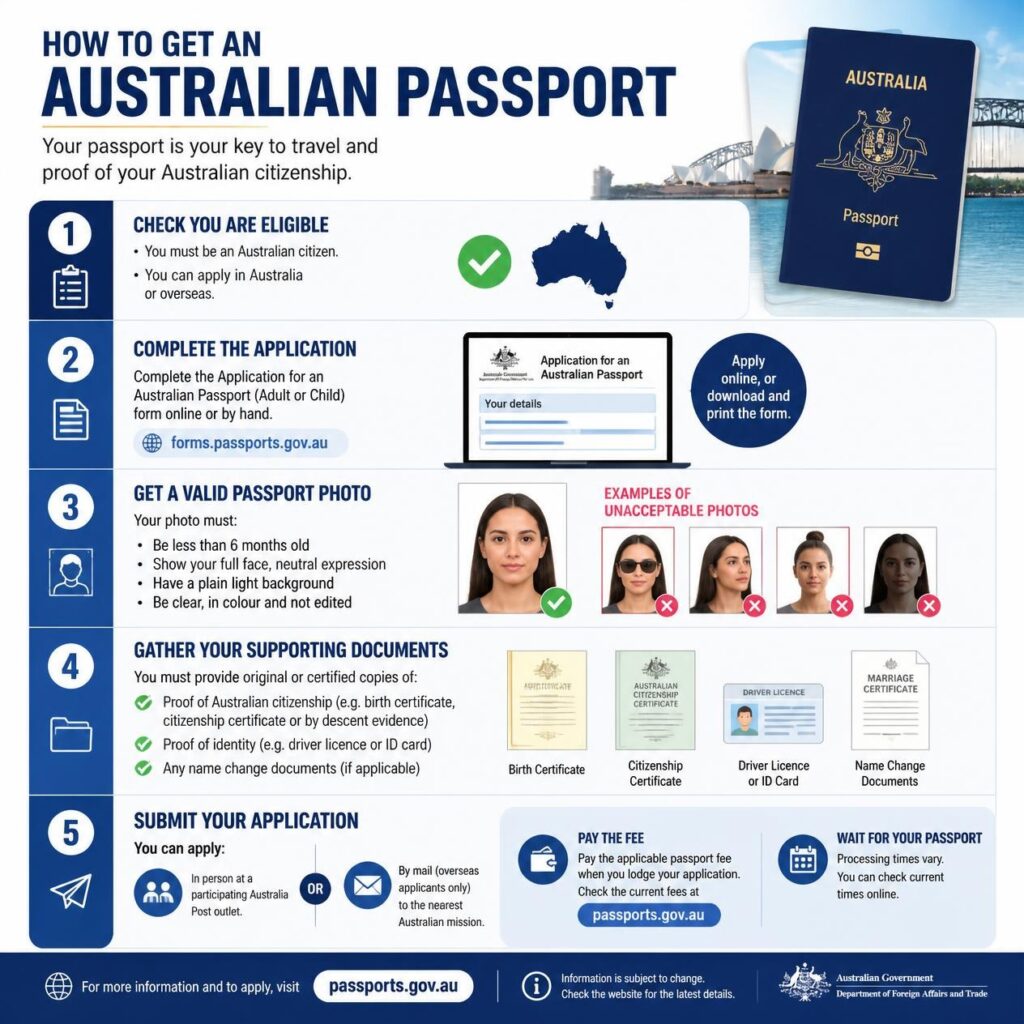
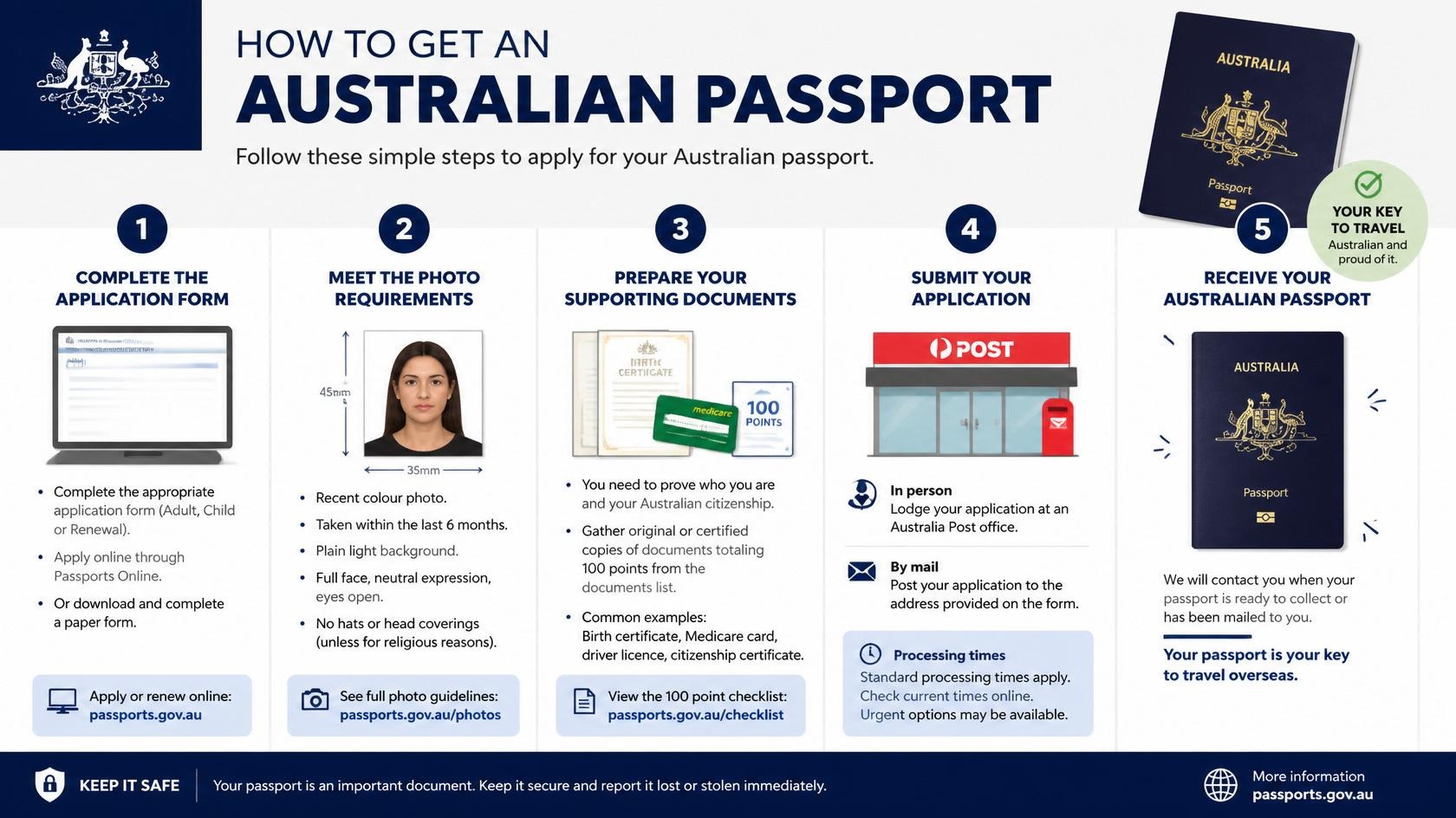
To get an Australian passport, you must generally be an Australian citizen, prepare the required identity and citizenship documents, complete the appropriate passport application, provide compliant passport photos, meet the referee or guarantor requirements where applicable, pay the relevant fee, and lodge the application through the correct Australian Passport Office process.
Quick Answer: How to Get an Australian Passport
The basic process is:
- Confirm your Australian citizenship.
- Choose the correct application type. A first adult passport, renewal, child passport, or replacement application may have different requirements.
- Gather your original or accepted supporting documents.
- Obtain compliant passport photographs.
- Complete the appropriate application.
- Arrange a referee or guarantor if your application requires one.
- Lodge the application through the correct channel.
- Pay the applicable passport fee.
- Wait for processing and delivery or collection.
For a first adult passport, the application normally requires more evidence than a straightforward renewal. The Australian Passport Office states that adult applicants who were born overseas generally need evidence of Australian citizenship and evidence of their gender and place of birth.
Who Is Eligible for an Australian Passport?
The most important eligibility requirement is Australian citizenship. An Australian passport is issued to Australian citizens who satisfy the passport application requirements.
Being a permanent resident of Australia does not automatically make you eligible for an Australian passport. Permanent residence and citizenship are different legal statuses. If you are a permanent resident but not an Australian citizen, you may have other travel-document options, but you should not assume that you can apply for an Australian passport.
Australian citizenship may be acquired in different ways, including:
- By birth in Australia in circumstances where citizenship requirements are met
- By descent from an Australian citizen parent
- By conferral after meeting citizenship requirements
- By resuming Australian citizenship in certain circumstances
- Through other legally recognised citizenship pathways
If you became an Australian citizen through a citizenship application, you generally need to have received evidence of your citizenship before applying for an Australian passport. The Australian Department of Home Affairs specifically explains that a person cannot apply for an Australian passport until the relevant citizenship application has been approved and evidence of citizenship has been received.
Can a Permanent Resident Get an Australian Passport?
Usually, no. Permanent residency by itself is not the same as Australian citizenship.
A permanent resident may become eligible to apply for Australian citizenship if they meet the relevant legal requirements. For example, the general residence requirements for citizenship by conferral can include living in Australia on a valid visa for the required period and meeting absence limits. The exact rules depend on the applicant’s circumstances and the applicable citizenship pathway.
Once citizenship is approved and the applicant has the required evidence of Australian citizenship, they can then move on to the passport application process.
Do You Need Australian Citizenship Before Applying?
Yes, citizenship is central to the Australian passport application process.
For example, a person who has recently become an Australian citizen should not assume that a citizenship approval notice alone is enough for a passport application. You should follow the Australian Government’s instructions regarding evidence of citizenship and identity.
If you were born outside Australia, the Australian Passport Office says that adult applicants generally need to provide an Australian citizenship certificate and acceptable evidence of gender and place of birth. Depending on the circumstances, this may include a citizenship certificate, an original foreign birth certificate translated into English, or another accepted official document.
The passport application and citizenship application are separate processes. If you are not yet an Australian citizen, determine your citizenship pathway first rather than starting with a passport application.
What Documents Do You Need to Get an Australian Passport?
The exact documents depend on your circumstances, including whether you are applying for your first passport, renewing an existing passport, applying for a child, or applying from overseas.
Common Documents for a First Adult Passport
A first adult passport application may require documents that establish:
- Your Australian citizenship
- Your identity
- Your date and place of birth
- Your current name
- Any legal change of name
- Your current residential details where required
- Your identity through a referee or guarantor, depending on the application method
- Your compliance with passport photo requirements
For an adult applicant born overseas, citizenship evidence is particularly important. The Australian Passport Office explains that applicants may need an Australian citizenship certificate and additional evidence of gender and place of birth.
Documents That May Be Relevant
| Document Type | Why It May Be Needed |
|---|---|
| Australian citizenship certificate | Evidence of Australian citizenship |
| Birth certificate | Evidence of birth details and identity |
| Foreign birth certificate | May help establish place and date of birth for overseas-born applicants |
| Change-of-name evidence | Links your current name with earlier legal names |
| Current or previous passport | May support identity or renewal applications |
| Passport photographs | Required in the format specified by the Passport Office |
| Additional supporting documents | May be requested depending on your individual circumstances |
Do not assume that a document will be accepted simply because it is official. Passport authorities may require particular document types, original documents, certified copies, translations, or additional evidence depending on the situation.
What If Your Documents Are Not in English?
If a document is issued in another language, an English translation may be required. Translation requirements can vary depending on the document and the authority handling the application.
This is one reason applicants should check the official requirements before submitting documents. A poorly prepared translation, incomplete document, or inconsistent name spelling can create additional questions and delay processing.
How to Apply for Your First Australian Passport
If you have never held an Australian passport before, your application may require more evidence than a simple renewal. The following step-by-step process provides a practical overview.
Step 1: Confirm Your Citizenship Status
Before preparing the passport application, confirm that you are an Australian citizen and that you have appropriate evidence of citizenship.
If you recently became an Australian citizen, make sure you have received the required evidence before moving to the passport application stage.
Step 2: Identify the Correct Application Type
Determine whether you are applying for:
- A first adult passport
- A child passport
- A passport renewal
- A replacement for a lost or stolen passport
- A replacement for a damaged passport
- An urgent travel document or another travel document in special circumstances
Choosing the wrong application pathway can result in incomplete documentation or the need to restart part of the process.
Step 3: Gather Your Supporting Documents
Prepare your citizenship evidence, identity documents, birth information, name-change evidence if applicable, and any other documents required for your application.
Make sure names, dates of birth, and other personal details are consistent across your documents. If there are differences, prepare evidence explaining the difference rather than hoping it will not be noticed.
Step 4: Obtain Passport Photos
Passport photos must meet the applicable Australian requirements. Do not use an ordinary selfie or a casual photograph. Passport photographs are subject to specific requirements relating to the image, facial position, background, lighting, and other technical factors.
It is usually safer to use a professional passport-photo service that understands Australian passport photo requirements.
Step 5: Complete the Application
Complete the appropriate application carefully. Check every spelling, date, address, and document detail before submitting.
Small errors can cause unnecessary delays, particularly when the information does not match your identity documents.
Step 6: Arrange Your Referee or Guarantor if Required
Depending on how you apply and the type of application, you may need a referee or guarantor to confirm your identity.
The Australian Passport Office explains that a new passport application may require a guarantor or referee, while a passport renewal generally does not require one.
Step 7: Lodge the Application and Pay the Fee
Submit the application through the correct channel and pay the applicable fee. Keep copies or records of your submitted information and supporting documents where appropriate.
Step 8: Monitor the Application
After submission, the Passport Office may process the application, request further information, or contact you if clarification is needed.
Do not book an important international trip based on an assumed passport delivery date unless you have allowed sufficient time for processing and possible complications.
How Australian Passport Renewal Works
Renewing an Australian passport is often simpler than applying for a first passport, provided you meet the renewal requirements.
One important difference is that a renewal application generally does not require a referee or guarantor. The Australian Passport Office also explains that applicants should provide their current passport and other required materials when lodging a renewal application.
Before You Renew
Check:
- Whether your passport is eligible for renewal
- Whether your personal details have changed
- Whether you need to provide additional documents
- Whether your passport has enough validity for your upcoming trip
- Whether your destination requires a minimum period of passport validity
Many countries require a passport to be valid for at least six months for entry or transit, although the exact rule depends on the destination. Australian Government travel advice recommends checking passport validity and destination entry requirements before travelling.
How to Get an Australian Passport for a Child
Children have different passport requirements from adults.
Under Australian passport rules, a child is generally a person under 18 who has never been married. Children aged 0 to 15 may receive a passport valid for up to five years, while children aged 16 or 17 may receive a passport valid for up to ten years.
Documents for a Child Passport
A child passport application may require:
- The child’s full original birth certificate
- Evidence of the child’s Australian citizenship
- Two passport photographs
- Evidence of any change of name
- Relevant court orders, where applicable
- Documents relating to parental responsibility where required
- Parental consent
Each application should be reviewed carefully because family circumstances can affect the required documentation.
Parental Consent
Parental consent requirements can be particularly important. If the circumstances are complicated—for example, where a parent cannot provide consent or there are court orders—additional documents or procedures may apply.
The Australian Passport Office explains that consent signatures may need to be witnessed and that specific restrictions apply to who can act as a witness.
How to Apply for an Australian Passport Overseas
Australian citizens living or travelling overseas may be able to apply for or renew an Australian passport through an Australian embassy or consulate, depending on the location and the type of application.
The process may involve:
- Checking the requirements of the relevant Australian diplomatic mission
- Preparing the required application form
- Gathering citizenship and identity documents
- Obtaining compliant photographs
- Paying the applicable overseas passport fee
- Attending an appointment or lodging the application as instructed
Australian Government travel guidance states that Australians living overseas can have passport renewal applications processed through an Australian embassy or consulate, and that assistance is available for certain lost, stolen, or damaged passport situations.
If you are applying from the United Kingdom, the United States, Bangladesh, or another country, always check the instructions for the specific Australian diplomatic mission responsible for your location.
Australian Passport Photo Requirements
Passport photographs are one of the most common sources of avoidable application problems.
A compliant passport photo should meet the current official requirements. Common issues include:
- Incorrect background
- Shadows on the face or background
- Incorrect facial position
- Glasses or accessories that interfere with the image
- Poor lighting
- Low image quality
- Incorrect size or format
- Expressions or positioning that do not meet requirements
For the safest result, use a professional passport photo service and verify that the photographs are specifically suitable for an Australian passport application.
Australian Passport Referee and Guarantor Requirements
For a new passport application, the person confirming your identity may be a referee or guarantor depending on the application process.
The Australian Passport Office states that the person must generally be an adult Australian citizen who has known the applicant for more than 12 months, with special rules for children under one year of age. Certain relationships and living arrangements may disqualify someone from acting as the referee or guarantor.
Important Restrictions May Include
- They may need to be an Australian citizen.
- They may need to have known you for the required period.
- They may not be a close relative.
- They may not live at the same address as you.
- They may need to satisfy passport or electoral-roll requirements.
Do not choose a referee or guarantor at random. Check that the person meets the current requirements before including their details.
How Long Does It Take to Get an Australian Passport?
Processing times can change, and the actual timeframe depends on the type and complexity of the application.
As of the Australian Passport Office’s May 2026 processing information, more than 98% of travel documents were available within six weeks. The six-week period begins when the application is lodged and paid, and complex applications may take longer.
This means applicants should avoid leaving their passport application until the last minute.
Factors That Can Cause Delays
- Missing documents
- Incorrect application information
- Unclear identity history
- Unresolved name changes
- Problems with citizenship evidence
- Non-compliant passport photographs
- Complex child or parental-responsibility circumstances
- Additional checks or requests for information
- High application volumes
Best practice: Apply well before your planned travel date. A passport application is not the only part of international travel preparation; you may also need visas, transit permissions, destination-specific validity, and other travel documents.
How Much Does an Australian Passport Cost?
Passport fees can change, so applicants should check the current official Australian Passport Office fee schedule before submitting an application.
The cost may depend on factors such as:
- Adult or child application
- Standard or urgent service, where available
- Application location
- Passport type
- Additional services or special circumstances
Do not rely on an old blog post or an outdated fee table when planning your application. Official fees are subject to change.
Australian Passport Application Comparison Table
| Application Type | Typical Documentation Level | Referee/Guarantor | Key Consideration |
|---|---|---|---|
| First adult passport | Higher | May be required | Citizenship and identity evidence are especially important |
| Adult renewal | Usually simpler | Generally not required | Existing passport and renewal eligibility matter |
| Child passport | Varies | May be required | Birth, citizenship, parental consent and responsibility may matter |
| Lost or stolen passport replacement | Case-specific | May vary | Report and replacement procedures may apply |
| Overseas application | Case-specific | Depends on application | Follow the relevant embassy or consulate process |
Common Australian Passport Application Mistakes
1. Applying Before You Have Citizenship Evidence
If you have recently become an Australian citizen, make sure you have the required evidence of citizenship before starting the passport application.
2. Using the Wrong Application Type
A first passport, renewal, child passport, and replacement application are not necessarily interchangeable.
3. Submitting Incorrect Photos
Even a good-quality photograph may be rejected if it does not meet the specific passport photo requirements.
4. Ignoring Name Differences
If your name appears differently on different documents, prepare the appropriate legal evidence explaining the change.
5. Waiting Until the Last Minute
Even when most applications are processed within the published timeframe, complex cases can take longer. Apply early.
6. Assuming a Travel Booking Guarantees Urgent Processing
Having a flight booked does not automatically mean an application will be processed immediately. Check the available official services and requirements.
7. Relying on Outdated Information
Fees, forms, processing times, and requirements can change. Always verify the current rules before lodging an application.
Pros and Cons of Applying for an Australian Passport
Pros
- Provides an internationally recognised Australian travel document.
- Allows Australian citizens to travel internationally using an Australian passport.
- Can support international travel planning and identity verification.
- May be especially important for Australians living overseas.
- Can be renewed when eligible rather than applying from scratch every time.
Cons and Challenges
- The first application can require substantial documentation.
- Citizenship evidence may be necessary.
- Passport photos must meet specific requirements.
- Complex applications can take longer to process.
- Fees and processing requirements may change.
- Child applications may involve additional consent and parental-responsibility requirements.
Australian Passport Application Checklist
Before submitting your application, use this checklist:
- I have confirmed my Australian citizenship status.
- I have selected the correct application type.
- I have checked the current official document requirements.
- I have prepared my citizenship evidence if required.
- I have prepared identity and birth documents where required.
- I have gathered legal name-change documents if applicable.
- I have obtained compliant passport photos.
- I have arranged a qualified referee or guarantor if required.
- I have checked whether translations are required.
- I have reviewed every application detail for accuracy.
- I have checked the current passport fee.
- I have allowed sufficient processing time before travelling.
Expert Tips for a Smoother Application
Keep Your Name History Consistent
If you have changed your name through marriage, divorce, adoption, or another legal process, keep the documents that connect your previous name to your current name.
Prepare Translations Early
If your supporting documents are not in English, determine the translation requirements early. Waiting until the last minute can delay the application.
Do Not Send Unrequested Documents Without Understanding the Process
More documents are not always better. The goal is to provide the correct documents in the format and manner required by the relevant authority.
Check Travel Requirements Separately
Having an Australian passport does not automatically mean you can enter every country without a visa. Always check the name changes for your destination.
Apply Before Your Passport Becomes a Travel Problem
Some countries require several months of remaining passport validity. Check your destination’s rules before travelling, especially if your passport is close to expiry.
Frequently Asked Questions
1. How do you get an Australian passport?
To get an Australian passport, you generally need to be an Australian citizen, provide the required citizenship and identity evidence, complete the correct application, provide acceptable passport photos, meet referee or guarantor requirements where applicable, pay the required fee, and lodge the application through the appropriate Australian Passport Office process.
2. Can a permanent resident apply for an Australian passport?
Permanent residency alone does not generally qualify someone for an Australian passport. Australian citizenship is normally required. A permanent resident may need to become an Australian citizen first.
3. Can I get an Australian passport after becoming a citizen?
Yes. Once your Australian citizenship has been approved and you have received the required evidence of citizenship, you can apply for an Australian passport through the Australian Passport Office process.
4. Do I need a guarantor for an Australian passport?
It depends on the application type and application method. New passport applications may require a referee or guarantor, while an eligible renewal generally does not.
5. How long does it take to get an Australian passport?
Processing times vary. The Australian Passport Office reported that more than 98% of travel documents were available within six weeks based on its May 2026 processing information, although complex applications may take longer.
6. Can a child get an Australian passport?
Yes. Children can apply for an Australian passport, but the application may require birth evidence, citizenship evidence, photographs, parental consent, and other documents depending on the circumstances.
7. Can I apply for an Australian passport from outside Australia?
Australian citizens overseas may be able to apply for or renew a passport through the relevant Australian embassy or consulate. The exact process depends on the location and application type.
8. What if my documents are not in English?
You may need an English translation that meets the relevant requirements. Check the current instructions for your specific application before submitting translated documents.
9. Can I travel if my Australian passport has less than six months left?
It depends on the destination. Many countries require at least six months of passport validity, but the rules vary. Check the entry and transit requirements for the country or countries you plan to visit.
10. Should I apply for my passport before booking international travel?
If you do not already have a valid passport, it is generally sensible to allow adequate time for the passport application before making important international travel arrangements. Processing times can vary, and complex applications may take longer.
Important: The suggested internal-link phrase “how do you make fake credit cards” is unrelated to Australian passport services and should not be used as an internal link. It is also inappropriate for a legitimate government-documentation website.
Recommended External Resources
- Australian Passport Office — official passport application, document, photo, fee, and processing guidance.
- Australian Department of Home Affairs — official Australian citizenship eligibility and application information.
- Smartraveller — Australian Government travel advice, passport validity, and overseas assistance guidance.
- Australian embassies and consulates — overseas passport application and assistance information.
For the most current requirements, applicants should rely on official Australian Government sources rather than outdated third-party articles.
Conclusion: Getting an Australian Passport Starts with the Right Documents
Understanding how to get an Australian passport is much easier when you break the process into clear steps. First, confirm that you are an Australian citizen or have the required citizenship evidence. Next, identify the correct passport application type, gather the required identity and supporting documents, prepare compliant photographs, arrange a referee or guarantor where necessary, complete the application carefully, pay the applicable fee, and allow enough time for processing.
The biggest mistakes are usually avoidable. Missing documents, inconsistent names, unsuitable photographs, incorrect application types, and last-minute applications can all create unnecessary complications.
If your application involves documents issued in another country, a legal name change, citizenship evidence, certified translation, apostille, legalization, or other government documentation, professional document support can help you prepare your paperwork more carefully before submission.
Need help preparing your documents for an international passport or government documentation process? Explore the document preparation, certified translation, apostille, legalization, and government documentation services available through Elit Documents.