
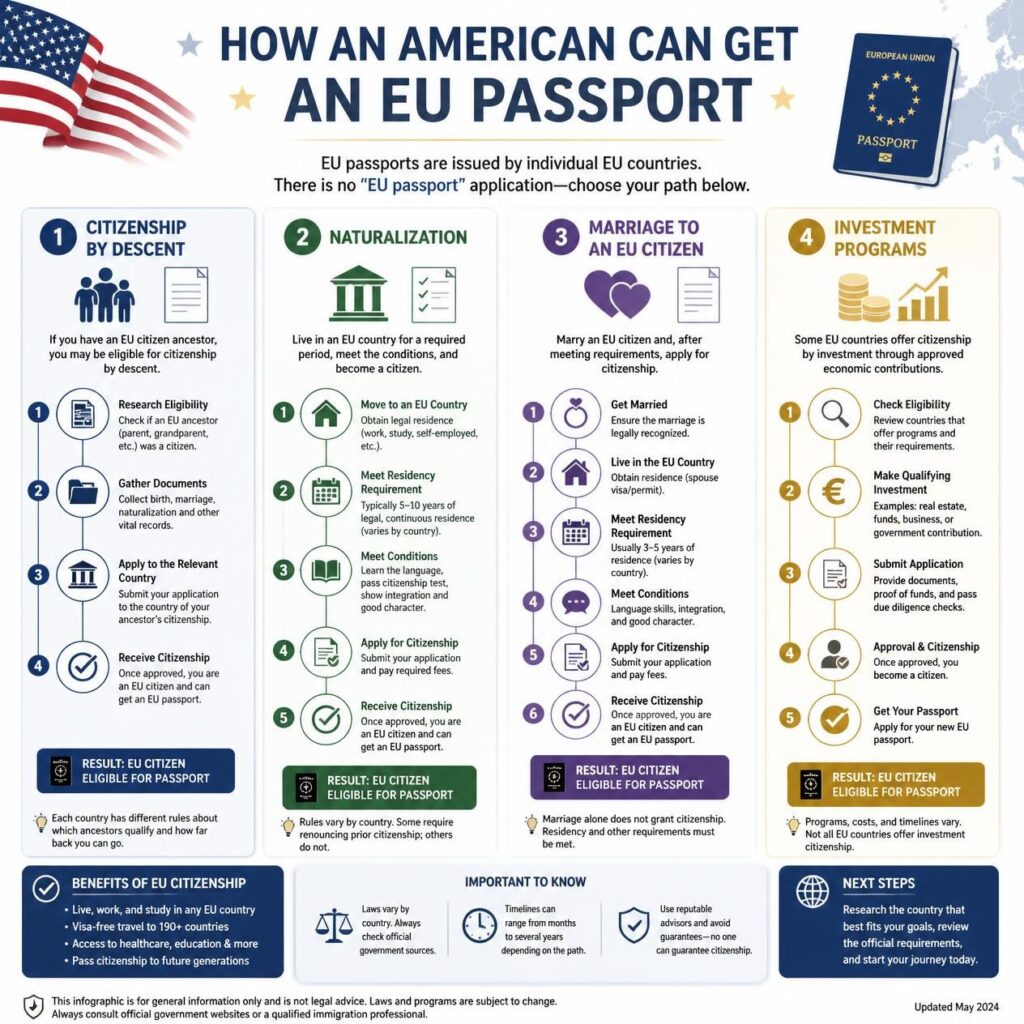
Many Americans search for ways to obtain an “EU passport” because European citizenship can offer opportunities to live, work, study, and travel across the European Union. But there is an important distinction to understand first: the European Union does not issue a single EU passport. You must become a citizen of a specific EU member country, such as Ireland, Italy, Portugal, Germany, France, Spain, or another member state. Once you become a citizen of that country, you automatically become an EU citizen and may then apply for its national passport.
For Americans, the best route depends on personal circumstances. You may qualify through a parent or grandparent, marriage or family connection, legal residence, or naturalization. Some people may discover that they already have a potential citizenship claim through ancestry, while others must first live legally in an EU country for several years.
This guide explains how to get an EU passport as an American, the most common routes, the documents you may need, how the process generally works, and what to consider before choosing a country.
An American cannot apply directly for an “EU passport.” You must first qualify for citizenship in a specific EU country. After citizenship is approved or recognized, you can apply for that country’s passport.
What Is an EU Passport?
An EU passport is generally understood as a passport issued by one of the European Union’s member states. Examples include an Irish passport, Italian passport, Portuguese passport, French passport, German passport, or Spanish passport.
There is no separate passport application that an American can submit to “the EU.” Instead, the process normally follows this sequence:
- Identify an EU country where you may qualify for citizenship.
- Meet that country’s nationality requirements.
- Apply for citizenship or have citizenship recognized, depending on the route.
- Receive proof of citizenship.
- Processing times issued by that country.
Once you become a citizen of an EU member state, you are generally also an EU citizen. EU citizenship can provide important rights, including the ability to live and work in other EU countries under applicable EU free-movement rules. However, the exact process and rights can depend on your status and the relevant laws.
The EU’s official guidance explains that naturalization conditions differ from one country to another. Common routes include residence, marriage, and descent.
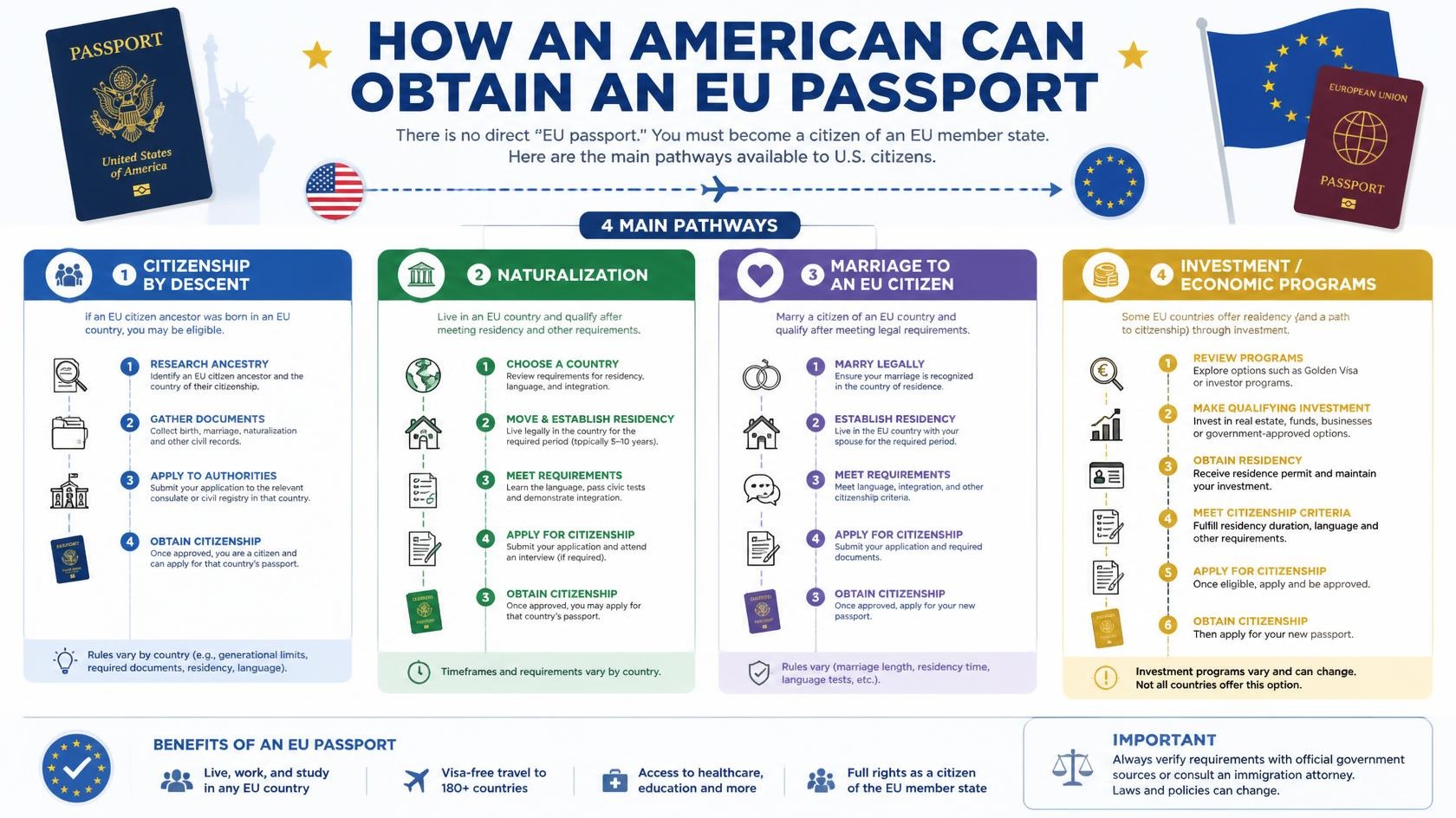
The Main Ways Americans Can Obtain EU Citizenship
For most Americans, there are four broad possibilities:
| Route | Who May Qualify? | Typical Challenge |
|---|---|---|
| Ancestry or descent | People with an eligible parent, grandparent, or other qualifying family connection | Proving the complete family line and meeting current nationality rules |
| Marriage or family connection | People married to or closely connected to a citizen of an EU country | Meeting residence, language, relationship, and other legal requirements |
| Residence and naturalization | Americans who legally live in an EU country for the required period | Maintaining lawful residence and satisfying integration requirements |
| Special programs | Applicants qualifying under specific national laws | Rules can be complex and may change quickly |
1. Citizenship Through Ancestry or Descent
For many Americans, ancestry is the first route worth investigating. If you have a parent, grandparent, or another qualifying ancestor from an EU country, you may be able to claim citizenship by descent.
This route is sometimes faster than moving to Europe and completing years of residence. However, it is not automatic simply because you have a European ancestor. Every country has its own rules about qualifying relatives, dates of birth, transmission of citizenship, registration requirements, and possible interruptions in the family line.
Irish Citizenship by Descent
Ireland is one of the best-known examples of a country with a citizenship-by-descent route for certain people with Irish family connections.
According to Ireland’s Department of Foreign Affairs, a person born outside Ireland may potentially become an Irish citizen through Foreign Birth Registration if a grandparent was born on the island of Ireland, or if a parent was an Irish citizen at the time of the applicant’s birth even though that parent was not born in Ireland. Once the person is entered on the Foreign Births Register, they become an Irish citizen and can apply for an Irish passport.
A typical ancestry case may require documents connecting:
- You to your parent.
- Your parent to your Irish-born grandparent.
- The relevant ancestor to the required proof of Irish birth.
- Any legal name changes, marriages, or other events affecting the documentary chain.
Example: An American applicant has a grandparent born on the island of Ireland. The applicant gathers certified civil records proving the relationship, submits the Foreign Birth Registration application, and, if approved and registered, becomes an Irish citizen before applying for an Irish passport.
Italian Citizenship by Descent
Italy has historically been a major destination for Americans researching citizenship by descent. However, applicants must be particularly careful because Italian nationality law has changed and continues to be subject to specific statutory requirements.
Italy’s Ministry of Foreign Affairs explains that citizenship by descent is based on the principle of ius sanguinis, but it also notes important changes introduced through legislation in 2025 affecting certain people born abroad who hold another citizenship. The eligibility analysis can therefore depend on the specific family history and the law applicable to the applicant’s circumstances.
Before relying on an Italian ancestor, applicants should carefully verify:
- The ancestor’s citizenship status.
- The dates of births and naturalizations in the family line.
- Whether citizenship was transmitted under the law applicable at the relevant time.
- Whether recent legal changes affect the applicant’s eligibility.
- Whether all civil records are consistent and properly documented.
Portuguese Citizenship Through Family Connection
Portugal recognizes several routes to nationality. Official Portuguese government information identifies situations that can include Portuguese parents or grandparents, marriage to a Portuguese citizen, and legal residence in Portugal for at least five years, among other possibilities.
Because the exact rules depend on the relationship and the applicant’s circumstances, having a Portuguese ancestor does not mean that every applicant automatically qualifies. A document review is essential.
What Documents Are Important for Ancestry Cases?
Citizenship-by-descent applications are often document-heavy. You may need:
- Long-form birth certificates.
- Marriage certificates.
- Death certificates.
- Naturalization records.
- Evidence of name changes.
- Adoption records, where relevant.
- Certified copies of identity documents.
- Apostilles or legalization where required.
- Certified translations into the required language.
One small inconsistency can create a major problem. For example, a surname may appear differently on a birth record, marriage certificate, and naturalization document. That does not necessarily make an application impossible, but it may require additional evidence or a formal correction.
2. Citizenship Through Marriage or Family Connection
Marriage to an EU citizen does not automatically give an American an EU passport. In most cases, the applicant must still satisfy the nationality law of the specific country.
Depending on the country, requirements may include:
- A minimum period of marriage.
- A period of legal residence.
- Proof that the relationship is genuine and legally recognized.
- Language knowledge.
- Good-character requirements.
- Evidence of continued connection to the country.
Some countries may provide a simplified route for spouses, while others still require significant residence or additional conditions.
The key principle is simple: marriage can create an eligibility route, but it does not automatically create citizenship.
3. Citizenship Through Legal Residence and Naturalization
If you do not have a qualifying ancestry connection or family route, naturalization through legal residence may be the most realistic option.
The general process usually looks like this:
- Choose an EU country where you can legally live.
- Obtain an appropriate visa or residence permit.
- Maintain lawful residence for the required period.
- Meet language or integration requirements, if applicable.
- Meet tax, criminal-record, and other legal requirements.
- Submit a citizenship application.
- Wait for a decision.
- After citizenship is granted, apply for a passport.
Portugal
Portugal’s official justice information states that foreign nationals may qualify for Portuguese nationality in several situations, including legal residence in Portugal for at least five years. Other routes may apply based on birth, family connections, marriage, and other circumstances.
The residence route requires careful planning. A person must maintain a lawful immigration status and satisfy the requirements applicable at the time of application.
France
France offers several nationality routes, including naturalization and nationality declarations in certain family or marriage situations. French government information identifies a five-year residence period as a general benchmark for naturalization in many circumstances, although exceptions and additional conditions can apply.
Applicants may need to demonstrate integration into French society, including language ability and other legal requirements.
Spain
For many foreign nationals, Spain’s general residence-based nationality route requires ten years of legal, continuous residence immediately before applying. Spanish law provides shorter periods for certain categories, including refugees and nationals of specified countries.
Americans should not assume that the shorter two-year period available to certain nationalities applies to U.S. citizens simply because the applicant speaks Spanish or has a cultural connection to Spain.
The Netherlands
The Dutch government explains that naturalization is one way to become a Dutch citizen and that foreign nationals may generally apply after legally living in the Netherlands for at least five years, subject to the applicable requirements. The Netherlands also has an option procedure for certain groups.
Other EU Countries
Every EU member state has its own citizenship law. The residence period, language rules, integration requirements, treatment of dual nationality, and application process can vary substantially.
For this reason, the “best” country is not necessarily the one with the shortest advertised residence period. The best route is usually the one for which you genuinely qualify and can realistically satisfy all requirements.
4. Investment and Special Citizenship Routes
Some EU countries have offered special immigration or investment-based routes. However, these programs are highly changeable and should never be treated as permanent shortcuts to an EU passport.
Rules may change because of:
- New legislation.
- European-level scrutiny.
- National security concerns.
- Changes to investment requirements.
- Program closures or suspensions.
Applicants should verify the current official government rules before transferring funds or signing contracts. Be especially cautious of advertisements promising a guaranteed EU passport, guaranteed approval, or an unusually fast result.
Which EU Countries May Be Relevant to Americans?
There is no single best EU country for every American applicant. The right choice depends on your family history, career plans, language skills, financial situation, and willingness to live abroad.
| Country | Potential Route to Investigate | Important Consideration |
|---|---|---|
| Ireland | Descent, naturalization, family connections | Irish ancestry may be important; Foreign Birth Registration rules apply to eligible cases. |
| Portugal | Residence, family connection, marriage, other nationality routes | Requirements depend on the applicant’s exact circumstances |
| Italy | Descent, residence, marriage, other routes | Recent legal changes make current eligibility review especially important |
| France | Naturalization, marriage, family connections | Residence, integration, and language requirements may apply |
| Spain | Residence, marriage, descent, other routes | General residence rules differ from special reduced-period categories |
| Netherlands | Naturalization and option procedure | Legal residence and nationality requirements apply |
How to Get an EU Passport as an American: Step-by-Step
Step 1: Research Your Family History
Start with your parents, grandparents, and potentially earlier ancestors. Record:
- Full legal names.
- Dates and places of birth.
- Marriage information.
- Immigration history.
- Naturalization dates.
- Countries of citizenship.
Do not rely only on family stories. A relative may say that your grandfather was “Italian” or “Irish,” but citizenship eligibility usually depends on documentary evidence and the specific law.
Step 2: Identify the Country With the Strongest Legal Route
Compare your possible routes. For example:
- If you have an Irish-born grandparent, investigate Irish citizenship by descent.
- If you have a qualifying Portuguese family connection, review Portuguese nationality rules.
- If you have no qualifying ancestry, explore residence-based immigration options.
- If you are married to an EU citizen, review the spouse route under that country’s law.
Step 3: Check Current Eligibility
Nationality law can change. A blog post, social media video, or old forum discussion may be outdated. Use the relevant government’s current nationality information and, when necessary, seek qualified professional advice.
Step 4: Build Your Document File
Create a document checklist before submitting anything. Check every name, date, place of birth, and relationship.
Step 5: Obtain Apostilles and Certified Translations
Documents issued in one country may need an apostille or other authentication before they are accepted by another country. A certified translation may also be required.
Requirements vary. Do not assume that a regular translation, notarization, or photocopy will satisfy the receiving authority.
Step 6: Submit the Citizenship Application
The application may be filed through:
- A consulate.
- A civil registry.
- An immigration authority.
- A government portal.
- Another designated authority.
Use the official instructions for the specific route.
Step 7: Wait for the Citizenship Decision
Processing times vary significantly. Avoid making travel, employment, or relocation plans based on an assumed approval date.
Step 8: Apply for the National Passport
After citizenship is confirmed, you can apply for the passport issued by that country. Passport applications are separate from citizenship applications and may require additional identity documents, photographs, fees, and proof of nationality.
Documents You May Need
A typical citizenship file may include some or all of the following:
| Document Category | Examples |
|---|---|
| Identity | U.S. passport, birth certificate, government ID |
| Civil status | Birth, marriage, divorce, and death certificates |
| Family connection | Parent and grandparent records, lineage documents |
| Residence | Residence permits, registration records, utility or government records where accepted |
| Criminal history | Police certificates or other records required by the country |
| Language | Approved language certificate, where required |
| Authentication | Apostille, legalization, or certification |
| Translation | Certified translation into the required language |
Can Americans Hold Dual Citizenship?
Generally, U.S. law allows Americans to hold dual nationality. The U.S. Department of State explains that a person may become a dual national of the United States and another country, although the other country may have its own restrictions or requirements.
Dual nationality can create practical responsibilities. The Department of State notes that U.S. dual nationals generally must enter and leave the United States using a U.S. passport and remain subject to U.S. legal obligations, including applicable tax laws.
However, the country whose citizenship you are seeking may require renunciation of another nationality or may impose restrictions. Always check both U.S. rules and the nationality law of the relevant EU country.
EU Citizenship Route Comparison
| Route | Potential Advantage | Potential Disadvantage |
|---|---|---|
| Descent | May avoid years of residence | Strict documentary and legal requirements |
| Marriage | May create a special eligibility pathway | Marriage alone usually does not guarantee citizenship |
| Naturalization | Available even without European ancestry | Requires years of lawful residence and integration |
| Special programs | May offer specific routes for qualifying applicants | Rules may change, or programs may close |
Pros and Cons of Getting EU Citizenship as an American
Pros
- Potential right to live and work in an EU member state and, under applicable EU rules, move within the EU.
- Greater flexibility for long-term relocation.
- Possible educational and professional opportunities.
- Potential ability to pass citizenship to children, depending on national law.
- Access to a national passport issued by an EU member state.
- Possible benefits for family mobility and international travel.
Cons
- Citizenship applications can be complicated and document-intensive.
- Naturalization may require several years of residence.
- Language and integration tests may apply.
- Some countries restrict or limit dual citizenship.
- Government fees, translations, apostilles, and legal assistance can increase total costs.
- Nationality laws can change after you begin researching a route.
Common Mistakes Americans Should Avoid
Assuming an EU Passport Can Be Applied For Directly
There is no general application for an EU passport. You must qualify for citizenship in a specific EU country first.
Relying on an Old Blog Post
Citizenship law changes. Italy’s recent nationality developments demonstrate why applicants should verify current rules rather than relying on outdated ancestry guides.
Ignoring Document Inconsistencies
Different spellings, dates, and places can cause delays. Review the entire family chain before submitting documents.
Assuming Marriage Automatically Creates Citizenship
Marriage may create an eligibility route, but additional legal requirements usually apply.
Confusing Residency With Citizenship
A residence permit does not automatically equal nationality. You may need to complete a separate citizenship application after satisfying the required conditions.
Using Unqualified “Guaranteed Passport” Services
No legitimate service should promise guaranteed citizenship approval when the decision belongs to a government authority. Be cautious of unrealistic timelines and claims that you can bypass normal legal requirements.
Practical Checklist: Before You Apply
- Identify the specific EU country involved.
- Confirm the legal citizenship route.
- Review the current official government requirements.
- Build a complete family tree if applying through ancestry.
- Obtain official civil records.
- Check names and dates for inconsistencies.
- Determine whether apostilles or legalization are required.
- Arrange certified translations where necessary.
- Confirm dual-nationality rules.
- Prepare the application according to the official instructions.
- Keep copies of all submitted documents.
How Elit Documents Can Help
Citizenship and passport applications often depend on accurate documentation. Applicants may need help organizing civil records, obtaining apostilles, arranging document legalization, or preparing certified translations.
Elit Documents provides document-focused support for individuals handling government, immigration, identity, legalization, apostille, and certified translation needs. If you are researching an EU citizenship route as an American, the first step is to identify the correct country and legal pathway. From there, properly prepared documentation can help you avoid preventable delays.
Ready to organize your documentation? Visit Elit Documents to explore document preparation, apostille, legalization, and certified translation services relevant to your situation.
Frequently Asked Questions
1. Can an American get an EU passport?
Yes, but an American must first become a citizen of an EU member state. After citizenship is granted or officially recognized, the person can apply for that country’s passport.
2. What is the easiest way for an American to get EU citizenship?
There is no single easiest route for everyone. Citizenship by descent may be the most direct option for someone with a qualifying European parent or grandparent. For others, residence-based naturalization may be the practical route.
3. Can I get an EU passport through my grandparents?
Possibly. Some EU countries provide citizenship-by-descent routes through grandparents or other ancestors. Eligibility depends on the specific country, the family relationship, dates, citizenship history, and current law.
4. Can I get an EU passport through marriage?
Marriage to an EU citizen may provide a citizenship pathway in some countries, but marriage alone generally does not guarantee an EU passport. Additional requirements may include residence, language, integration, or a minimum marriage period.
5. How long does it take to get an EU passport as an American?
The timeline depends on the citizenship route. An ancestry case may be different from a naturalization case, which can require several years of lawful residence before citizenship is even available. Processing times also vary by country and application type.
6. Do I have to give up my U.S. citizenship?
Not necessarily. U.S. law generally permits dual nationality, but the EU country you are applying to may have its own rules. Always check the nationality laws of both countries.
7. Is an EU passport the same as an EU citizenship certificate?
No. Citizenship is the legal status. A passport is a travel document issued after you have citizenship and satisfy the passport authority’s requirements.
8. Can I buy an EU passport?
You should be extremely cautious with anyone promising a guaranteed EU passport for a payment. Citizenship programs and immigration routes are governed by national law, and rules can change. You must qualify under a lawful route.
9. Can an American live in Europe first and later apply for citizenship?
Yes, in some cases. An American may obtain a lawful residence status, live in the country for the required period, and later apply for naturalization if all eligibility conditions are satisfied.
10. What documents are usually needed for an EU citizenship application?
Requirements vary, but applicants may need birth certificates, marriage records, proof of identity, residence evidence, police certificates, family records, apostilles or legalization, and certified translations.
Conclusion
For Americans, learning how to get an EU passport begins with understanding that there is no single European Union passport application. You must first qualify for citizenship in a specific EU member state.
The most common pathways are ancestry, marriage or family connection, legal residence followed by naturalization, and certain special routes established by national law. For some applicants, a grandparent or parent may provide the strongest opportunity. For others, building a life in an EU country and meeting naturalization requirements may be the realistic path.
The most important first step is to identify the country and route that actually matches your circumstances. Then verify the current law, collect the correct documents, obtain any required apostilles or legalization, and arrange certified translations where necessary.
Need help preparing documents for an international citizenship, immigration, apostille, legalization, or certified translation process? Contact Elit Documents to explore professional document services for your next application.