
Are you dreaming of exploring the bustling streets of New York City, taking a road trip along the sun-drenched coast of California, or attending a crucial business conference in Chicago? Traveling to the United States is a life-changing experience, but before you can pack your bags and board a flight, there is one major hurdle to clear: securing a US tourist visa. The application process can feel like a labyrinth of complex forms, strict document requirements, and intimidating interviews. It is completely normal to feel overwhelmed when figuring out the exact steps, costs, and processing times involved.
Navigating immigration and government documentation does not have to be a nightmare if you are equipped with the right information. In this comprehensive, step-by-step guide, we will cover everything you need to know about the B1/B2 tourist visa application process. Whether you are a student planning a holiday, a professional seeking to attend a trade show, or a family wanting to reunite with loved ones, this guide is tailored for you. We will explore the intricacies of the process, dive into the specifics of how long can a tourist stay in usa, explain the exact procedure for those wondering how to get us visa in uk, and show you how relying on professional documentation services can drastically improve your chances of approval.
By the time you reach the end of this article, you will have a clear, actionable roadmap to successfully apply for your tourist visa and start planning your American adventure with confidence.
Understanding the B1/B2 Visitor Visa
Before diving into the application process, it is vital to understand what a US tourist visa actually is. The United States government categorizes nonimmigrant visas based on the primary purpose of your travel. For temporary visitors, the most common category is the B-class visa, which is subdivided into B1 and B2.
The B1 Business Visitor Visa
The B1 visa is designed for travelers entering the US for temporary business purposes. This does not mean you can seek employment or receive a salary from a US-based company. Instead, permitted activities include:
- Consulting with business associates or clients.
- Attending scientific, educational, professional, or business conventions and conferences.
- Settling an estate.
- Negotiating contracts.
- Participating in short-term training.
The B2 Tourist Visitor Visa
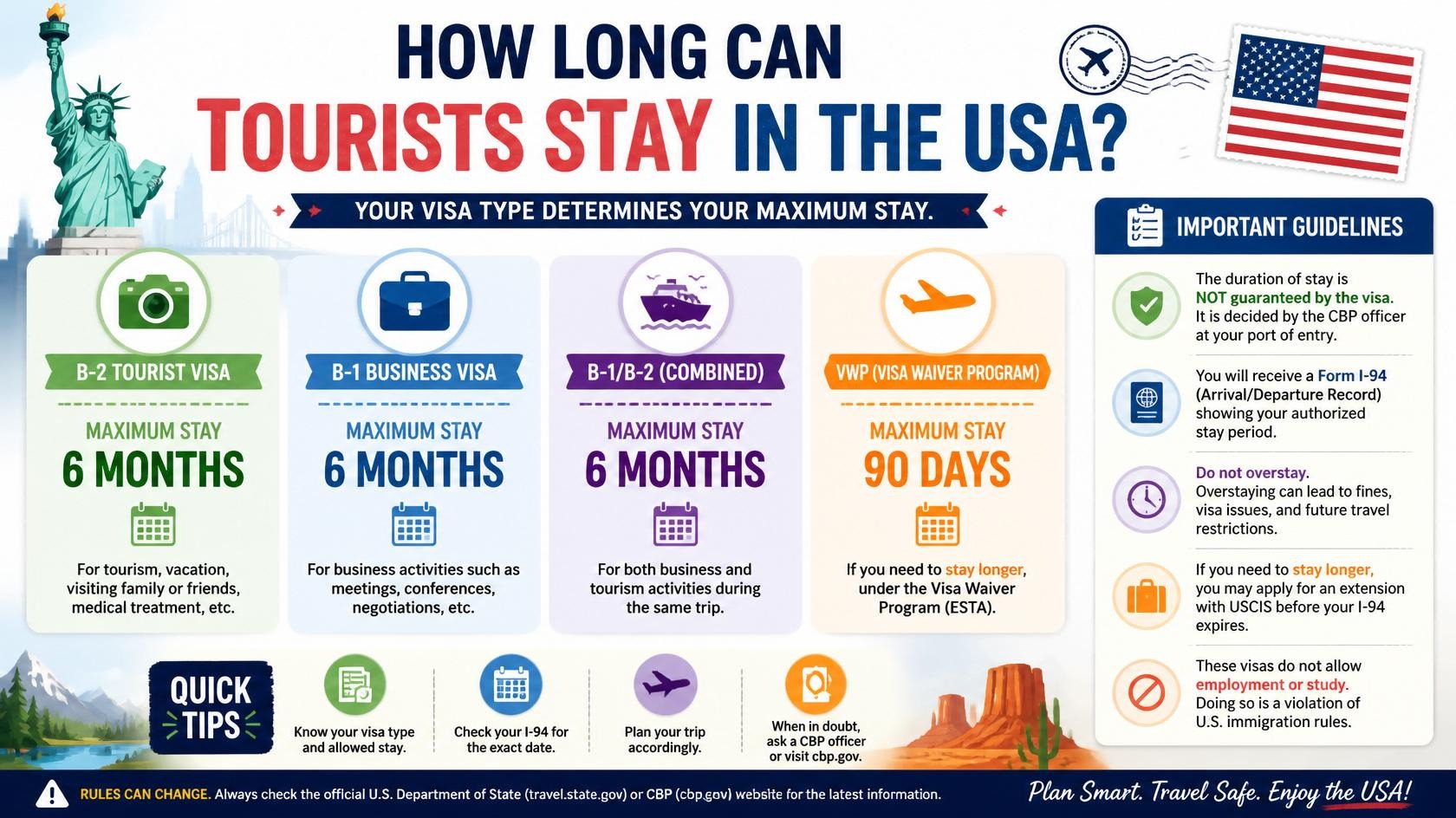
The B2 visa is strictly for tourism, leisure, and visits with friends or family. It also covers temporary medical treatment. Activities permitted under a B2 visa include:
- Tourism and vacationing.
- Visiting relatives or friends residing in the US.
- Receiving specialized medical treatment.
- Participating in social events hosted by fraternal, social, or service organizations.
- Amateur participation in musical, sports, or similar events (provided you are not being paid).
- Enrolling in a short recreational course of study (not for credit toward a degree).
In most cases, the US Department of State issues a combined B1/B2 visa, granting you the flexibility to travel for both business and leisure on the same visa document. It is a highly versatile visa, often valid for up to 10 years depending on your country of citizenship and reciprocity agreements.
How Long Can a Tourist Stay in USA?
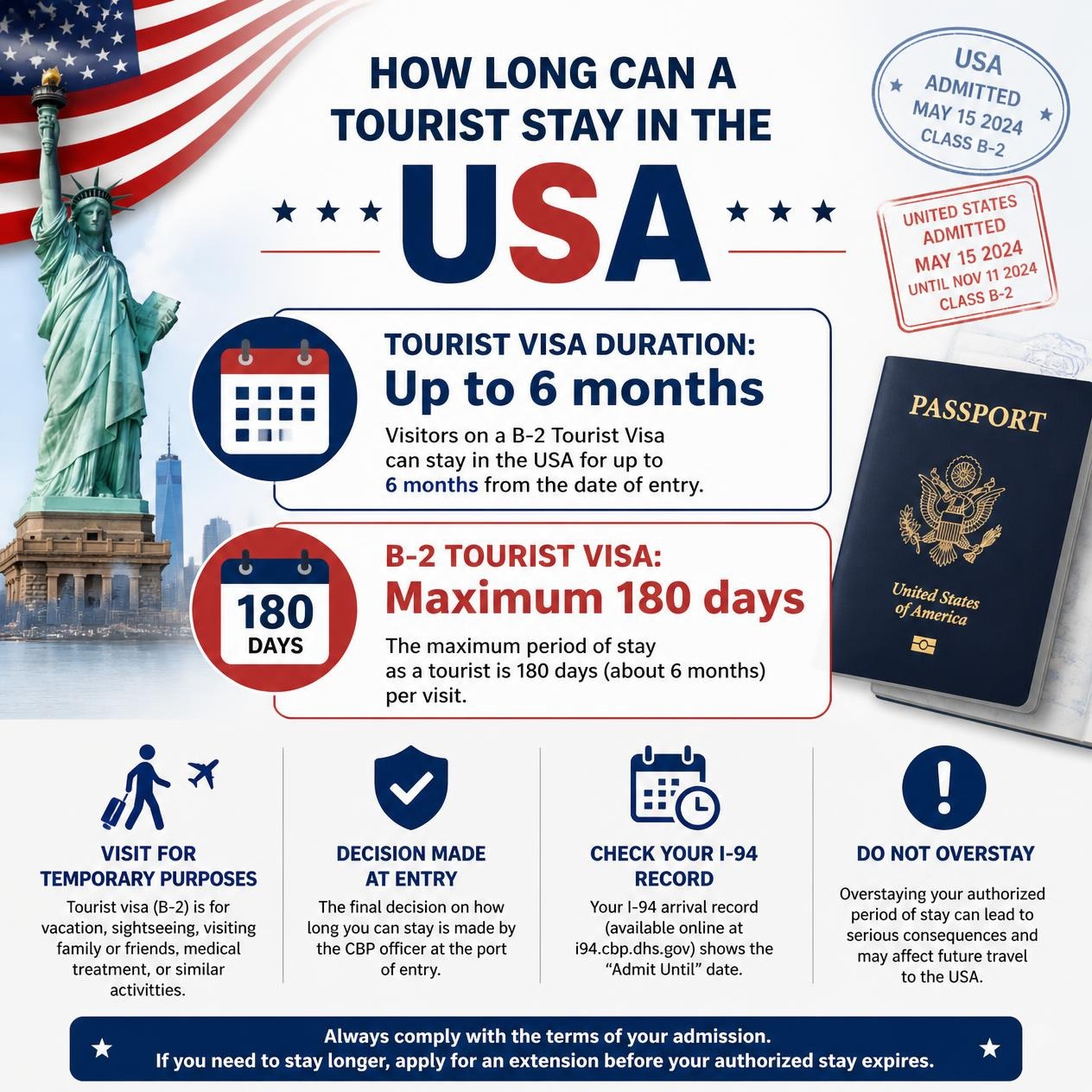
One of the most frequently asked questions by travelers is: how long can a tourist stay in usa? There is a common misconception that if you hold a visa valid for 10 years, you can stay in the United States for an unlimited amount of time. This is entirely false. Your visa validity period (the window of time during which you can travel to a US port of entry) is entirely different from your authorized duration of stay (how long you can legally remain in the country on a single trip).
The Role of the CBP Officer
When you arrive at a US port of entry (such as an airport or land border crossing), you will meet with a Customs and Border Protection (CBP) officer. This officer has the absolute authority to determine whether you are admissible to the United States and how long you are permitted to stay. For individuals traveling on a B1/B2 visa, the absolute maximum duration of stay granted for a single visit is generally six (6) months.
The Form I-94 Record
Your permitted length of stay is officially recorded on an electronic document known as Form I-94 (Arrival/Departure Record). You can access your I-94 online through the official CBP website by entering your passport details. The date listed under “Admit Until Date” on your I-94 is the strict deadline by which you must depart the United States. If the officer stamps your passport, the date written in the stamp is your departure deadline.
Important Nuances Regarding Duration of Stay
- It is Not Always Six Months: While six months is the maximum standard allowance, the CBP officer may grant a much shorter stay (e.g., 2 weeks or 30 days) depending on your stated purpose of travel, your return flight ticket, and your overall travel history.
- Frequent Visits Draw Suspicion: Even though the B1/B2 is a multiple-entry visa, using it to practically live in the US by staying for six months, leaving for a week, and returning for another six months is illegal. CBP expects tourists to spend significantly more time outside the US than inside. A pattern of prolonged stays will likely result in a denial of entry.
- Overstaying Has Severe Consequences: If you remain in the US even one day past your I-94 “Admit Until Date,” your visa will be automatically voided. If you accrue more than 180 days of unlawful presence, you will face a 3-year ban from returning to the US. Over a year of unlawful presence triggers a 10-year ban.
How to Apply for a Tourist Visa: Step-by-Step
Now that you understand the parameters of the B1/B2 visa, it is time to look at the application process. While the exact sequence can slightly vary depending on the local US Embassy or Consulate, the core steps remain identical worldwide. If you are seeking reliable document preparation, it is highly recommended to utilize services like Elit Documents to ensure every form is perfectly optimized for approval.
Step 1: Determine Your Eligibility and Visa Type
Ensure that the B1/B2 visa is the correct category for your needs. If you intend to work, study full-time, or marry a US citizen, you need a completely different visa category. Proceeding with a tourist visa when you have immigrant intent will lead to a swift denial.
Step 2: Complete the DS-160 Online Form
The DS-160 (Online Nonimmigrant Visa Application) is the foundation of your visa request. You must complete this form electronically via the Consular Electronic Application Center (CEAC) website. The form will ask for detailed information about your background, including:
- Personal and family demographics.
- Passport details.
- Travel itinerary (even if estimated).
- Current and past employment or education.
- Background and security questions regarding criminal history and immigration violations.
Crucial Tip: The DS-160 must be perfectly accurate. Discrepancies between your DS-160 and your interview answers are the leading cause of visa denials. Once completed, print the confirmation page with the barcode—you will need this for your interview.
Step 3: Pay the Visa Application Fee
The current Machine Readable Visa (MRV) fee for a B1/B2 visa is $185 USD. This fee is non-refundable, regardless of whether your visa is approved or denied. Payment methods vary by country and can include online bank transfers, debit cards, or cash payments at designated local banks. Always keep your receipt number as it is required to schedule your appointment.
Step 4: Schedule Your Visa Interview
Almost all applicants between the ages of 14 and 79 are required to attend an in-person interview. You will schedule this through your local US Embassy’s dedicated portal. Depending on your location and the time of year, interview wait times can range from a few days to over a year. Plan your travel accordingly.
Step 5: Gather the Required Documentation
Preparation is everything. The consular officer will rely heavily on your verbal answers, but having iron-clad documentation to back up your claims is essential. Organizing your paperwork professionally can make a massive difference. This is where services like Elit Documents excel—ensuring your portfolio is flawless.
Mandatory Documents:
- A valid passport (must be valid for at least six months beyond your intended period of stay).
- The DS-160 confirmation page.
- The appointment confirmation letter.
- One recent passport-sized photograph (2×2 inches, white background, no glasses).
- The MRV fee payment receipt.
Supporting Documents to Prove “Strong Ties”:
Under US immigration law, every applicant is presumed to be an intending immigrant until they can prove otherwise. You must provide evidence of strong ties to your home country that will compel you to return. These include:
- Employment letters stating your position, salary, and authorized leave of absence.
- Property deeds, lease agreements, or mortgage statements.
- Recent bank statements to prove you can fund your trip.
- Family civil documents (marriage certificates, children’s birth certificates).
- Travel itinerary (flight reservations, hotel bookings).
Step 6: Attend the Consular Interview
On the day of your interview, arrive early. You will go through security screening and have your fingerprints scanned before meeting the consular officer. The interview itself is typically very short—often lasting no more than 2 to 5 minutes. Answer questions honestly, confidently, and concisely. Do not offer unsolicited documents unless the officer specifically asks for them.
How to Get US Visa in UK: A Specific Guide
For British citizens and foreign nationals residing in the United Kingdom, the process has specific nuances. A common query among UK residents is how to get us visa in uk, especially since British citizens are generally eligible for the ESTA (Electronic System for Travel Authorization) under the Visa Waiver Program.
ESTA vs. B1/B2 Visa in the UK
If you hold a British passport, you may not need a B1/B2 visa. You can apply for an ESTA, which allows for business or tourism travel up to 90 days without a formal visa interview. However, you MUST apply for a B1/B2 visa in the UK if:
- You plan to stay in the US for more than 90 days.
- You have a previous criminal record.
- You have previously been denied entry to the US or had an ESTA revoked.
- You have traveled to certain restricted countries (like Iran, Iraq, Syria, Sudan, North Korea, etc.) on or after March 1, 2011.
- You are a resident in the UK but hold a passport from a country not in the Visa Waiver Program.
The Application Process in the UK
If you determine that you need a B1/B2 visa rather than an ESTA, the process of how to get us visa in uk mirrors the global steps but with local specifics:
- Complete DS-160: Fill out the form online selecting either the US Embassy in London or the Consulate General in Belfast as your interview location.
- Create a User Account: Register on the official UK US Visa Information Service website to pay the $185 fee via debit card or bank transfer.
- Schedule Appointment: Book your interview at the London Embassy (located in Nine Elms) or the Belfast Consulate.
- Gather Documents: UK residents must provide robust proof of residency and ties. If you are an expatriate living in the UK, bring your BRP (Biometric Residence Permit) and proof of employment in the UK.
- Courier Service: If approved, your passport will be returned to you via DX courier service to a designated pickup location or your home address in the UK.
For applicants in the UK facing complex situations, such as prior overstays or legal complications, partnering with a documentation expert like Elit Documents can streamline the preparation phase, ensuring your paperwork aligns perfectly with consular expectations.
Common Reasons for Tourist Visa Denials
Understanding why visas are rejected can help you avoid making the same mistakes. The most common legal ground for a B1/B2 denial is Section 214(b) of the Immigration and Nationality Act. A 214(b) refusal means the consular officer was not convinced that you have strong enough ties to your home country, and therefore, suspects you plan to remain in the US permanently.
Red flags that often trigger a 214(b) denial include:
- Lack of Stable Employment: Being unemployed or holding a newly acquired, low-paying job.
- Insufficient Funds: Unable to prove how you will finance a month-long vacation in an expensive US city.
- Vague Travel Plans: Not knowing where you are staying, what you plan to do, or having an open-ended itinerary.
- Immediate Relatives in the US: Having a US citizen spouse, parent, or sibling can sometimes be viewed as an anchor that might tempt you to stay, placing a higher burden of proof on your home-country ties.
- Poor Interview Demeanor: Answering inconsistently, appearing overly nervous, or failing to communicate clearly can lead to an instant refusal.
Can You Extend Your Tourist Visa Stay?
Sometimes, legitimate emergencies or unexpected events occur. If you are already in the United States and realize you need to stay beyond the date stamped on your I-94, you must take immediate legal action. You cannot simply stay and hope for the best.
To extend your stay, you must file Form I-539 (Application to Extend/Change Nonimmigrant Status) with the United States Citizenship and Immigration Services (USCIS). You must file this application before your current authorized stay expires. USCIS recommends filing at least 45 days in advance.
When applying for an extension, you must provide compelling evidence, such as:
- A written statement explaining in detail why the extension is necessary (e.g., a medical emergency, unexpected family illness).
- Evidence that the extended stay will be temporary, including new return flight tickets.
- Proof that you have the financial means to support yourself during the extended period without working illegally.
- Proof that your home country employment or residence will not be abandoned due to the extended absence.
If you file your I-539 on time, you are generally permitted to remain in the US while the application is pending, even if your I-94 expires during the wait. However, if the extension is denied, you must depart immediately.
The Value of Professional Documentation Services
The US visa application process is highly unforgiving of errors. A simple typo on your DS-160, a mistranslated civil document, or a poorly structured employment letter can result in a denial that remains on your permanent record. This is where professional legal and travel documentation services become invaluable.
At Elit Documents, applicants find a trusted partner dedicated to meticulous document preparation, legalization, translation, and apostille services. Whether you need your foreign birth certificate officially translated, your business contracts notarized for a B1 trip, or comprehensive assistance in organizing your B2 portfolio, Elit Documents ensures your profile is presented with absolute precision.
For job seekers, professionals, and business owners, presenting flawless, legally compliant paperwork to a consular officer demonstrates professionalism and intent. Navigating the bureaucratic red tape is daunting, but with expert assistance, you drastically minimize risks and optimize your chances for visa approval.
Conclusion
Securing a US tourist visa requires patience, honesty, and meticulous preparation. From understanding exactly how long can a tourist stay in usa to navigating the specific rules of how to get us visa in uk, every detail matters. The key to success lies in proving your strong ties to your home country, providing accurate information, and confidently conveying your temporary travel intent during the consular interview.
Remember that the visa stamp is only the first step—the CBP officer at the port of entry has the final say on your admission and duration of stay. Always respect immigration laws, never overstay your I-94 date, and keep your travel patterns consistent with tourism or temporary business.
Do not leave your travel dreams to chance. Ensure your application, translations, and supporting evidence are perfect before you step foot in the embassy. Visit Elit Documents today for reliable, professional documentation and visa assistance tailored to your specific journey.
Frequently Asked Questions
Does a 10-year US visa mean I can live in the US for 10 years?
No. A 10-year visa validity simply means you have 10 years to travel to the US border to request entry. The maximum duration you can actually stay during any single visit is determined by the CBP officer upon arrival, which is typically a maximum of 6 months.
Can I look for a job while on a B1/B2 tourist visa?
You cannot engage in any productive employment or receive a salary from a US source while on a tourist or business visitor visa. While attending a job interview is technically permitted in some narrow scopes, working is strictly forbidden and will result in deportation and a permanent ban.
What happens if my US visa expires while I am inside the United States?
If your physical visa foil expires while you are in the US, it is perfectly fine as long as your Form I-94 (Admit Until Date) is still valid. Your authorized stay is governed by the I-94, not the visa expiration date. However, you will need to renew the visa before trying to re-enter the US on a future trip.
Do I need to book my flights before applying for the visa?
No. The US Department of State strongly advises applicants NOT to purchase non-refundable airline tickets or make final hotel bookings until their visa has been officially approved and their passport returned. Providing an estimated travel itinerary is sufficient for the interview.
If my tourist visa is denied, how long do I have to wait to reapply?
There is no official waiting period to reapply after a 214(b) denial. However, reapplying immediately without a significant change in your circumstances (such as a new high-paying job, marriage, or property purchase) will almost certainly result in another denial. It is best to wait until your personal situation has substantially improved.