
How to Apply for a Tourist Visa: A Complete Step-by-Step Guide
Planning an international trip should be an exciting experience, filled with thoughts of exploring new cultures, closing major business deals, or reuniting with family and friends. But before you can pack your bags and board that flight, there is one crucial hurdle almost every international traveler must face: securing a tourist visa. Navigating the world of immigration and government documentation can be overwhelming. From deciphering confusing embassy websites to ensuring every piece of paperwork is perfectly translated and legalized, the process often feels like a full-time job.
If you have ever found yourself staring at a blank application form wondering what a specific term means, or stressing over how to gather your supporting documents, you are not alone. Visa rejections are incredibly common and are usually the result of minor clerical errors, incomplete documentation, or a misunderstanding of the destination country’s specific entry rules.
This comprehensive, step-by-step guide is designed to demystify the visa application process. Whether you are an individual planning a long-awaited vacation, a business owner attending an overseas conference, or a student looking to explore before the semester begins, this article will walk you through exactly what you need to know. We will cover the universal steps for applying for any tourist visa, highlight the essential documentation you must prepare, provide actionable tips for a successful embassy interview, and even dive into a specific, highly requested scenario
By the end of this guide, you will have the knowledge and confidence to submit a flawless visa application, backed by the expert support available at Elit Documents.
Understanding the Basics of a Tourist Visa
Before we jump into the application steps, it is important to understand exactly what a tourist visa is and what it allows you to do. A tourist visa is an official document or stamp issued by a foreign government that grants you permission to enter, travel within, and exit their country for a predetermined amount of time. It is important to note that a tourist visa is strictly for leisure, short-term visits, or non-paid activities. You cannot use a standard tourist visa to seek long-term employment, enroll in a full-time degree program, or establish permanent residency.
Types of Tourist Visas
While the umbrella term is “tourist visa,” many countries break their short-term visitor visas into different categories depending on the nature of your trip:
- Single-Entry Visas: This type of visa allows you to enter the destination country only once. As soon as you exit the country, the visa becomes invalid, regardless of whether there is time left on the validity period.
- Multiple-Entry Visas: A multiple-entry visa permits you to leave and re-enter the destination country multiple times within a specific validity period (such as six months, one year, or even ten years).
- Transit Visas: If you are simply passing through a country on your way to a final destination, you may need a transit visa, which usually allows a stay of 24 to 72 hours.
- Business Visitor Visas: While similar to a tourist visa, this allows you to attend meetings, conferences, or negotiate contracts, but strictly prohibits you from receiving a salary from a company within that country.
Universal Steps to Apply for a Tourist Visa
While every country has its own unique immigration laws, the core process of applying for a tourist visa remains relatively standardized across the globe. Following these steps carefully will ensure you build a strong, compelling application.
Step 1: Determine Your Visa Requirements and Eligibility
The very first thing you must do is check whether you actually need a visa. Visa requirements depend entirely on your country of citizenship (the passport you hold) and your destination. Many countries have reciprocal visa-waiver agreements. If you determine that a visa is required, you must verify the specific type of visitor visa that matches your travel intent.
Visit the official government or embassy website of your destination country. Avoid relying on third-party travel blogs for this specific step, as immigration laws change frequently. Look for an online “Visa Checker” tool, which most modern government portals provide.
Step 2: Gather Your Required Documentation
Document preparation is where most applicants fail. A single missing document or an uncertified translation can result in an immediate rejection. While specific requirements vary, a standard tourist visa application will almost always require the following:
- A Valid Passport: Your passport must be valid for at least six months beyond your intended date of departure from the destination country. It must also have at least two blank pages for entry and exit stamps.
- Completed Application Form: Most countries now require you to fill out a digital application form (such as the DS-160 for the USA or the online GOV.UK form for the UK).
- Recent Passport Photographs: You will need physical or digital photos that meet the exact size and background color specifications of the destination country. (e.g., 2×2 inches for the US, 45x35mm for the UK and Schengen area).
- Proof of Financial Means: Consular officers want to know you can afford your trip without resorting to illegal employment. You will typically need to provide three to six months of official bank statements, pay stubs, or an employment letter.
- Travel Itinerary: This includes round-trip flight reservations (or proof of onward travel) and confirmed hotel bookings or a letter of invitation if staying with friends or family.
- Travel Insurance: Many countries (especially the Schengen Area in Europe) mandate proof of travel medical insurance covering emergency medical expenses and repatriation.
Pro Tip: If your supporting documents (like birth certificates, marriage certificates, or bank statements) are not in the official language of the country you are applying to, they must be professionally translated and certified. This is where Elit Documents excels, providing flawless document preparation, certified translations, and apostille services to ensure your paperwork meets strict embassy standards.
Step 3: Complete the Online Application Form
Take your time when filling out the digital application form. Ensure that your name matches your passport exactly—do not use nicknames. Double-check all dates, passport numbers, and addresses. Any discrepancy between your application form and your supporting documents will raise red flags during processing.
Step 4: Pay the Visa Application Fee
Visa fees are non-refundable, even if your application is rejected. Payment methods vary by embassy. Some allow you to pay online via credit card during the digital application process, while others require a bank transfer or a cash payment at a designated visa application center. Always print the payment receipt, as you will need it for your appointment.
Step 5: Schedule and Attend Your Visa Interview or Biometrics Appointment
Once your application is submitted and paid for, you will usually need to book an appointment at the nearest embassy, consulate, or authorized Visa Application Center (VAC). During this appointment, you will submit your biometric data (fingerprints and a digital photograph) and hand over your physical passport and supporting documents.
Depending on the country, you may also be required to undergo a short interview. The consular officer will ask questions about your trip, your financial situation, and your ties to your home country to ensure you intend to return.
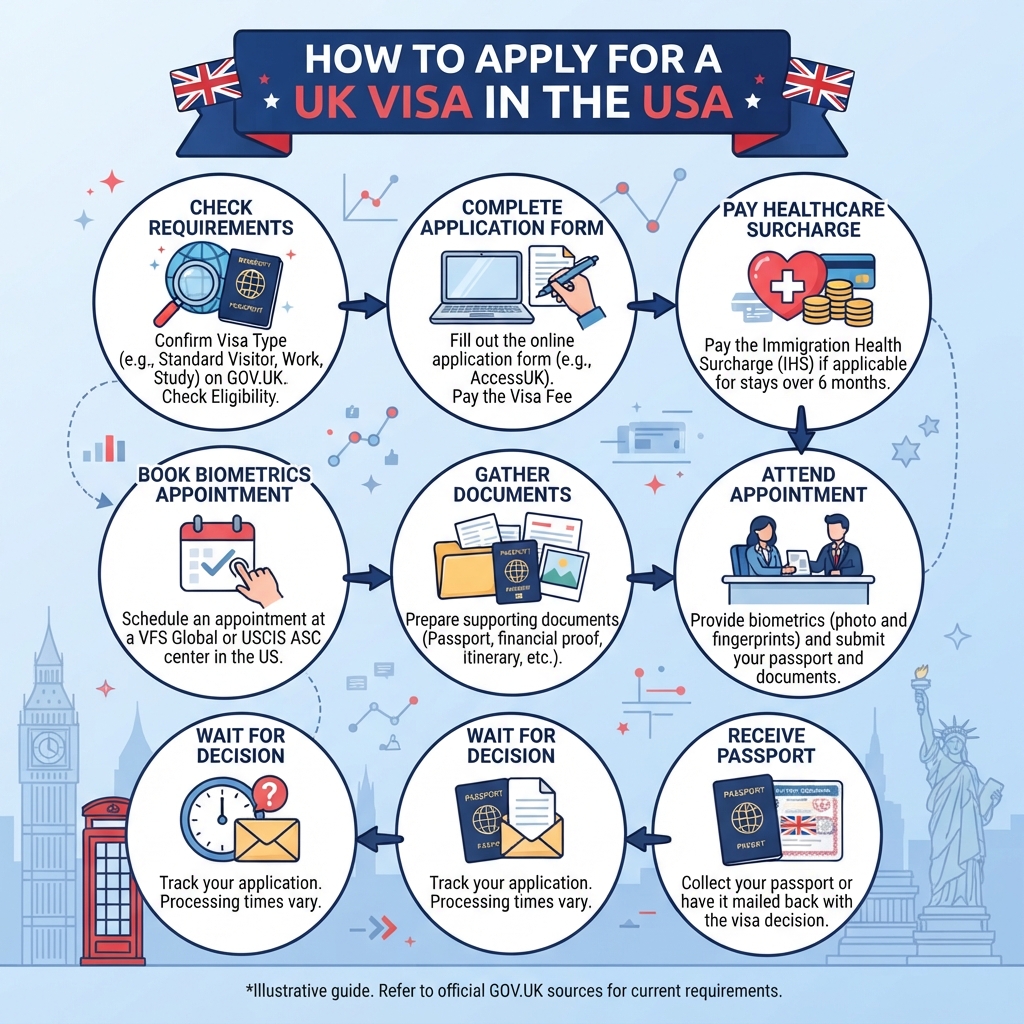
Specific Scenario: How to Apply for a UK Visa in the US
To provide a clear, real-world example, let’s look at exactly how to apply for a UK visa in the US. The UK has a highly structured immigration system, and residents of the United States (who are not US citizens, or US citizens seeking to stay longer than 6 months or for specific restricted reasons) often need to navigate this process. The UK utilizes an external partner, VFS Global, alongside the US Department of Homeland Security’s Application Support Centers (ASCs) to process applications.
1. Determine Your Visa Type
Go to the GOV.UK website and use the “Check if you need a UK visa” tool. If you are applying for a standard tourist visit, you will likely apply for the Standard Visitor Visa, which allows a stay of up to 6 months.
2. Complete the Online Application on GOV.UK
Create an account on the GOV.UK portal. You will fill out a detailed questionnaire regarding your travel history, employment, and finances in the US. Once the form is complete, you will be prompted to pay the visa application fee online.
3. Book Your Biometrics Appointment
After paying the fee on GOV.UK, you will be automatically redirected to the VFS Global website. Here, you have two choices for providing your biometrics in the US:
- USCIS Application Support Centers (ASCs): There are over 130 ASCs across the United States. This is the standard, most accessible route for most applicants.
- VFS Global Premium Application Centres (PACs): Located in major cities (like New York, Washington DC, Miami, Chicago, Los Angeles), these centers offer faster processing, document scanning assistance, and courier services for an additional premium fee.
4. Upload Your Supporting Documents
Before attending your biometrics appointment, VFS Global allows you to self-upload your supporting documents (financial statements, proof of legal residence in the US, itinerary, etc.) digitally. This saves time and ensures your paperwork is attached to your digital profile. Ensure all documents are clear, legible, and accompanied by certified translations if they are not in English.
5. Attend the Biometrics Appointment
Arrive at your chosen ASC or PAC on time. You must bring your current passport, your appointment confirmation letter, and the receipt of your visa application. They will take your fingerprints and photograph. If you chose a standard ASC, no interview is conducted, and they do not review your supporting documents on-site.
6. Mail Your Passport and Application
If you used a standard USCIS ASC, you have 5 days after your biometrics appointment to mail your physical passport, the stamped biometrics receipt, and any physical supporting documents to the UK Visas and Immigration (UKVI) scanning hub in New York. You must include a fully addressed prepaid return shipping label (usually UPS) so your passport can be mailed back to you once the decision is made.
Common Visa Application Mistakes to Avoid
Even highly educated professionals and experienced travelers can make critical errors during the visa application process. Avoid these common pitfalls to increase your chances of approval:
- Failing to Prove Strong Ties to Your Home Country: Consular officers operate under the assumption that you might try to immigrate illegally. You must prove you have reasons to return home. Strong ties include a stable job (proven by an employment letter), property ownership, or immediate family members remaining behind.
- Submitting Uncertified or Poorly Translated Documents: If you submit a bank statement or birth certificate in a foreign language without a certified translation, it will be ignored. Professional translation and legalization are non-negotiable.
- Inconsistent Information: If your application states you earn $5,000 a month, but your bank statements show erratic deposits of $1,000, the officer will suspect fraud. Ensure your financial narrative makes logical sense.
- Applying Too Late: Visa processing times vary wildly depending on the season and global events. Always apply well in advance of your travel dates. For example, UK visas typically take 3 to 6 weeks, while US visas can sometimes face interview wait times of several months.
How Elit Documents Can Streamline Your Visa Process
Securing a tourist visa is heavily reliant on presenting a flawless portfolio of documentation. One missing stamp, a poorly translated legal document, or an unauthenticated certificate can bring your travel plans to a grinding halt.
This is where Elit Documents becomes your most valuable travel partner. We specialize in comprehensive document services designed specifically for visa applicants, immigrants, and international business professionals. Our core services include:
- Certified Translations: We provide highly accurate, embassy-approved translations of vital records, financial documents, and legal paperwork.
- Apostille & Legalization: We navigate the complex bureaucratic process of obtaining Apostille stamps to authenticate your domestic documents for international use.
- Document Preparation: From organizing your application packet to ensuring every form is filled out accurately, our experts handle the heavy lifting.
- Visa Assistance: We offer guided support to help you understand specific consulate requirements, minimizing the risk of rejection.
Frequently Asked Questions (FAQs)
1. How early should I apply for a tourist visa?
It is generally recommended to apply for a tourist visa 2 to 3 months before your intended date of travel. Some countries allow you to apply up to 6 months in advance. Applying early protects you against unexpected administrative delays or requests for additional documents.
2. Does buying a plane ticket guarantee a visa?
No. In fact, most embassies strongly advise against purchasing non-refundable flight tickets before your visa is officially approved. Instead, submit a reserved flight itinerary or a flexible booking as proof of your travel plans.
3. What happens if my visa application is denied?
If your visa is denied, the embassy will provide a letter stating the reason for rejection (such as insufficient funds or lack of strong ties to your home country). You can usually reapply immediately, but you must address the specific reason for the initial denial in your new application. You will have to pay the application fee again.
4. If my passport expires in three months, can I still apply for a visa?
Most countries require your passport to be valid for a minimum of six months beyond your planned date of departure from their country. If your passport is nearing expiration, you must renew it before initiating the visa application process.
Conclusion
Applying for a tourist visa doesn’t have to be a stressful, confusing ordeal. By understanding the specific requirements of your destination, meticulously gathering and preparing your documents, and presenting a clear, honest application, you can navigate the process with ease. Whether you are figuring out how to apply for a UK visa in the US or preparing for a trip across Europe, attention to detail is your greatest asset.
Don’t let document errors derail your travel, business, or educational plans. Trust the experts to handle the complexities of translation, legalization, and paperwork preparation.
Ready to start your visa journey with confidence? Visit Elit Documents today for professional, reliable document preparation, certified translation, and visa assistance services tailored to your exact needs!