
How to Obtain a European Passport: A Complete Guide to EU Citizenship
If you are searching for how to obtain a European passport, the first thing to understand is that there is no single passport issued by the European Union. Instead, you generally need to become a citizen of a specific European Union country first. Once your citizenship is legally confirmed, you may then apply for that country’s national passport.
For British citizens, UK passport holders, international travelers, immigrants, and people with European family connections, obtaining citizenship in an EU country can provide important opportunities. Depending on the country and your personal circumstances, you may qualify through ancestry, legal residence, marriage, parentage, birth, or another legal pathway.
However, European citizenship laws are not the same everywhere. A route that works in one European country may not be available in another. A person who qualifies through ancestry in one country may not qualify through the same family connection elsewhere.
This guide explains the main legal ways to obtain a European passport, how British citizens may qualify for EU citizenship after Brexit, what documents are usually required, how the application process works, and how apostille, legalisation, and certified translation may become part of the documentation process.
How to Obtain a European Passport
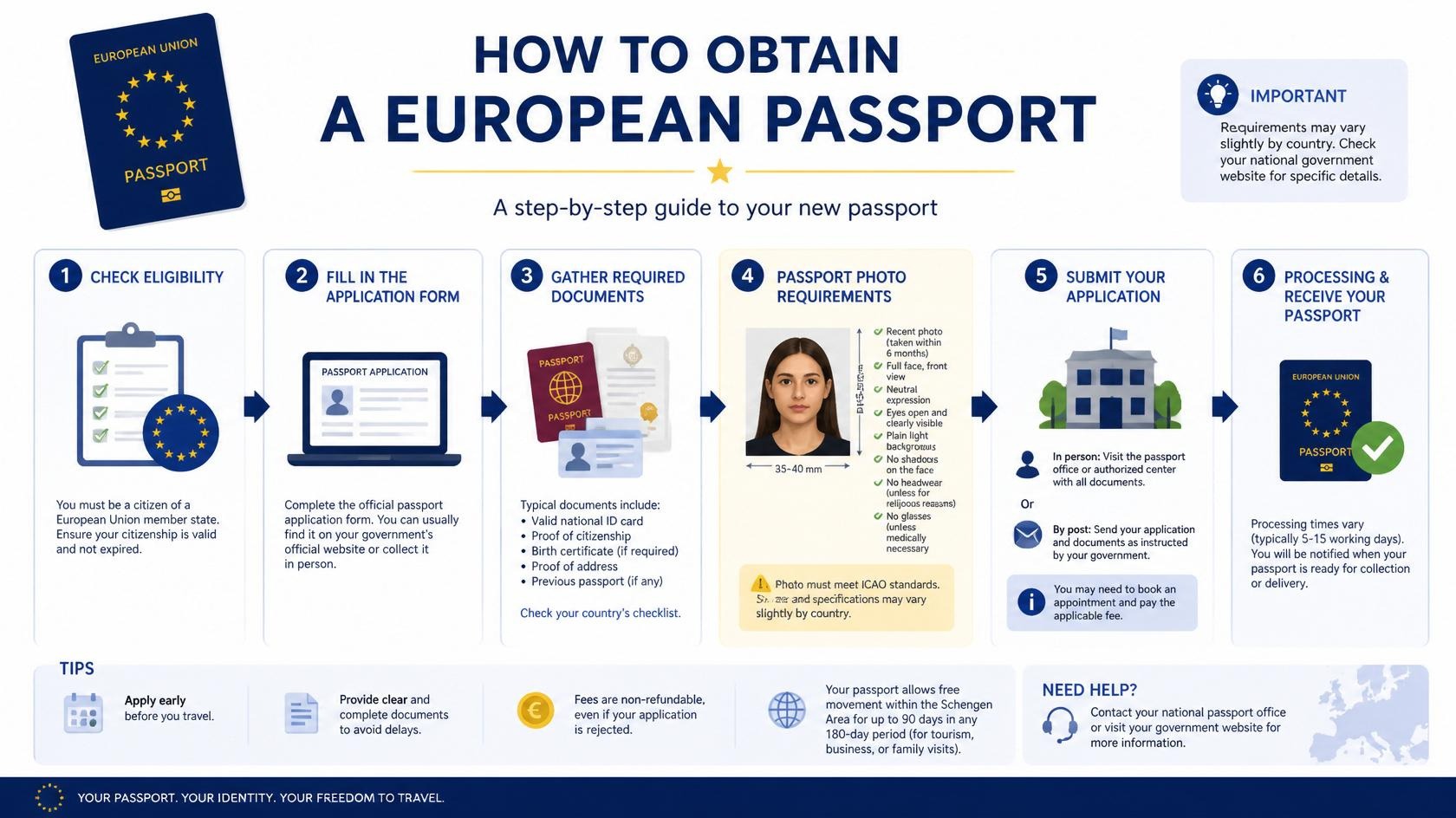
To obtain a European passport, you generally need to qualify for citizenship in a specific European Union country first. After your citizenship is approved, you may apply for that country’s national passport.
The general process usually involves:
- Choose a European country where you may have a legal citizenship pathway.
- Check the current nationality requirements.
- Determine whether you qualify through ancestry, residence, marriage, parentage, birth, or another legal route.
- Collect official supporting documents.
- Arrange certified translations if required.
- Obtain apostilles or legalisation where necessary.
- Submit the citizenship application.
- Wait for the government decision.
- Obtain proof of citizenship.
- Apply for the national passport.
There is no legitimate universal application for a single “European passport.” You must normally apply through the government or authorised authority of the specific country whose citizenship you are seeking.
What Is a European Passport?
The term European passport is commonly used to describe a passport issued by a country that is part of the European Union.
For example, citizens of EU member states may hold national passports issued by their respective countries. These passports are not issued by the European Union as one central passport authority.
Countries such as France, Germany, Italy, Ireland, Spain, Portugal, and Poland issue their own national passports to eligible citizens.
Generally, becoming a citizen of an EU member state also means becoming an EU citizen. This may provide important rights under applicable European rules, including certain rights connected with movement, residence, work, and study in other EU countries.
A residence permit is not the same as citizenship. Living legally in a European country does not automatically give you the right to obtain that country’s passport.
Main Ways to Obtain European Citizenship
The most common legal pathways to European citizenship include:
| Citizenship Route | Who May Qualify? | Common Evidence |
|---|---|---|
| Citizenship by descent | People with eligible European ancestors | Birth, marriage, and civil records |
| Naturalisation | Long-term legal residents | Residence, identity, language, and other documents |
| Marriage | Spouses of eligible citizens | Marriage and relationship evidence |
| Parentage | Children of eligible citizens | Birth and nationality documents |
| Birth | People meeting specific nationality rules | Birth and parental records |
| Special legal routes | Applicants meeting country-specific requirements | Relevant official evidence |
The best route depends on your personal circumstances and the laws of the specific country involved.
Citizenship by Descent or Ancestry
For many applicants, citizenship by descent is one of the most attractive ways to seek European citizenship.
This route may be available if you have a parent, grandparent, or sometimes another ancestor who was a citizen of a particular European country.
However, simply having a European ancestor does not automatically mean that you qualify.
The relevant country may examine:
- The generation of your qualifying ancestor.
- Whether citizenship was legally passed through the family line.
- Whether the ancestor was still a citizen at the relevant time.
- Whether the ancestor lost or renounced citizenship.
- Your date and place of birth.
- The nationality law applicable when each generation was born.
- Whether official documents prove the complete family connection.
Example of a Citizenship-by-Ancestry Claim
Imagine that you believe your grandparent was a citizen of an EU country. You may need to prove the entire family connection using official documents.
These may include:
- Your birth certificate.
- Your parents’ birth certificates.
- Your grandparents’ birth certificates.
- Marriage certificates connecting the generations.
- Death certificates where relevant.
- Proof of your ancestor’s nationality.
The purpose is to demonstrate a legally recognised connection between you and the qualifying ancestor.
Why Document Accuracy Matters
Family records often contain discrepancies. A surname may be spelled differently on different certificates. A birth date may be recorded incorrectly. A place of birth may appear differently in separate documents.
These inconsistencies do not always make an application impossible. However, they may require additional evidence, official corrections, or explanations.
This is why applicants should carefully review their entire document chain before submitting a citizenship application.
Citizenship Through Legal Residence and Naturalisation
Another major route to European citizenship is naturalisation after legal residence.
Many European countries allow eligible foreign nationals to apply for citizenship after living legally in the country for a required period.
However, the requirements vary significantly from country to country.
A naturalisation application may consider:
- The length of legal residence.
- Physical presence in the country.
- The type of residence permit.
- Language ability.
- Civic or cultural knowledge.
- Criminal record.
- Tax compliance.
- Financial circumstances.
- Integration into society.
Typical Naturalisation Process
- Obtain legal residence in the country.
- Maintain your qualifying residence status.
- Meet the required residence period.
- Complete language or civic requirements if applicable.
- Prepare your identity and supporting documents.
- Submit the citizenship application.
- Respond to requests for additional information.
- Receive a citizenship decision.
- Apply for the national passport after citizenship is confirmed.
One of the most important distinctions to understand is that a residence permit is not the same as citizenship. A residence permit may allow you to live in a country, but you generally need to complete a separate citizenship process before applying for that country’s passport.
Citizenship Through Marriage
Marriage to a European citizen may create a pathway to citizenship in certain countries.
However, marriage does not automatically guarantee citizenship or a passport.
The relevant country may require:
- A legally valid marriage.
- A minimum period of marriage.
- A period of residence.
- Evidence of a genuine relationship.
- Language knowledge.
- Integration requirements.
- Good character.
- Additional supporting documentation.
Marriage may create a legal pathway to citizenship, but it does not automatically create a right to a European passport.
Applicants should be cautious about websites promising guaranteed citizenship through marriage without clearly explaining the applicable legal requirements.
Citizenship Through Parentage or Birth
Some people may qualify for citizenship because one or both parents are citizens of a European country.
The rules may depend on:
- The nationality of the parent.
- Whether the parent was a citizen at the time of birth.
- Whether the child was born inside or outside the country.
- Whether citizenship was automatically acquired.
- Whether registration is required.
For children born outside the country, nationality transmission rules can sometimes be complicated.
A parent may have citizenship, but the child may still need to be registered before obtaining a passport.
The exact legal position depends on the nationality law of the relevant country.
Can British Citizens Obtain a European Passport?
Yes, a British citizen may be able to obtain a European passport if they qualify for citizenship in an EU country.
Possible routes include:
- Citizenship by descent.
- Citizenship through legal residence.
- Citizenship through marriage.
- Citizenship through a parent.
- Citizenship through birth.
- Another legal nationality pathway.
Brexit changed the general relationship between British citizens and EU free movement rights.
A British passport alone does not normally provide the same EU citizenship rights that British citizens generally had when the UK was an EU member state.
However, a British citizen may still become an EU citizen if they qualify for nationality in an EU member state.
Example
A British citizen may discover that:
- A parent was an eligible citizen of an EU country.
- A grandparent may create a citizenship pathway.
- They have lived in an EU country long enough to qualify for naturalisation.
- They are married to a citizen of a European country where a legal route exists.
Each situation must be assessed according to the applicable law.
Can You Have Both a British and European Passport?
The answer depends on the nationality laws of both countries.
The United Kingdom generally allows dual nationality. This means a British citizen may, in many situations, acquire another nationality without automatically losing British citizenship.
However, not every European country permits dual citizenship in the same way.
Some countries:
- Allow dual citizenship freely.
- Allow dual citizenship only in specific circumstances.
- Require special permission.
- Require renunciation of another nationality.
Before applying for foreign citizenship, British citizens should check the rules of the country whose citizenship they want to obtain.
Documents Required for European Citizenship
The exact document requirements depend on the country and the citizenship route.
However, applicants may commonly need the following documents.
Identity Documents
- Current passport.
- National identity card, where applicable.
- Birth certificate.
- Proof of address.
- Passport photographs.
Family Documents
- Birth certificates.
- Marriage certificates.
- Divorce certificates.
- Death certificates.
- Adoption documents.
- Family registration records.
Ancestry Documents
- Ancestor birth certificates.
- Citizenship records.
- Naturalisation certificates.
- Historical civil registry records.
- Marriage records connecting generations.
Residence Documents
- Residence permits.
- Registration certificates.
- Tax records.
- Employment records.
- Rental agreements.
- Official government correspondence.
Character Documents
Depending on the citizenship route, applicants may need criminal record certificates from countries where they have lived.
Translation Documents
If a document is written in a language that the receiving authority does not accept, a certified translation may be required.
The exact translation requirements vary between countries and authorities.
Apostille, Legalisation and Certified Translation
International citizenship applications often involve documents issued in different countries and languages. This can create additional administrative requirements.
What Is an Apostille?
An apostille is a form of authentication used in certain international document situations.
It helps confirm the authenticity of a signature, seal, or stamp on a public document for use in another country where the relevant international rules apply.
However, not every document requires an apostille.
What Is Legalisation?
Legalisation is another process used to authenticate documents for international use.
The required process depends on:
- The country where the document was issued.
- The country where the document will be used.
- The type of document.
- The requirements of the receiving authority.
What Is Certified Translation?
A certified translation is a translation prepared according to the requirements of the relevant authority.
Not all authorities accept the same type of translation.
Some may require:
- Certified translation.
- Sworn translation.
- Official translation.
- Translator certification.
- Specific formatting.
Before ordering a translation, confirm the requirements of the authority receiving the document.
Step-by-Step: How to Obtain a European Passport
Step 1: Identify the Right Country
Do not begin by searching only for the “easiest European passport.”
Instead, consider your actual circumstances.
Ask yourself:
- Do I have European ancestry?
- Do I have a European parent?
- Have I lived in an EU country?
- Am I married to an EU citizen?
- Was I born in a European country?
- Do I have another legal connection?
Step 2: Identify Your Citizenship Route
Choose the pathway that appears legally relevant to your circumstances.
For example, your route may be based on ancestry, naturalisation, marriage, parentage, or birth.
Step 3: Check Current Requirements
Nationality laws can change.
Do not rely entirely on old blog posts, social media videos, or outdated family advice.
Always review current requirements from the relevant authority.
Step 4: Build Your Document File
Create a complete file containing your identity documents, civil certificates, family documents, residence evidence, and citizenship evidence.
Step 5: Check for Inconsistencies
Compare names, dates of birth, places of birth, parent information, and marriage details across all documents.
Resolve major discrepancies where necessary.
Step 6: Arrange Translation
Determine whether the receiving authority requires a certified translation.
Step 7: Arrange Authentication
Check whether your documents require an apostille, legalisation, or certified copies.
Step 8: Submit the Citizenship Application
Submit the correct forms and supporting evidence to the appropriate authority.
Step 9: Respond to Requests
Government authorities may request additional documents, clarifications, updated certificates, or further evidence.
Step 10: Apply for the Passport
After citizenship is granted, apply for the national passport through the relevant passport authority.
European Citizenship Routes Compared
| Route | Main Benefit | Main Challenge |
|---|---|---|
| Descent | May avoid long residence requirements | Requires strong family evidence |
| Naturalisation | Available without ancestry in some cases | Requires qualifying residence |
| Marriage | May provide a family-based route | Rules differ between countries |
| Parentage | May provide direct citizenship rights | Transmission rules can be complex |
| Birth | May apply in specific circumstances | Birth alone is not always sufficient |
Pros and Cons of Obtaining a European Passport
Potential Advantages
- May provide citizenship rights in an EU member state.
- May provide rights connected with living, working, and studying within the EU under applicable rules.
- May make travel within Europe more convenient.
- May allow dual nationality where both countries permit it.
- May provide additional long-term residence and work options.
- May create additional opportunities for eligible family members.
Potential Disadvantages
- Applications can involve complex documentation.
- Processing times can vary significantly.
- Certified translations may be required.
- Apostille or legalisation may be necessary.
- Some countries restrict dual nationality.
- Nationality laws can change over time.
- Eligibility may be narrower than applicants initially expect.
Common Mistakes to Avoid
Assuming Any European Ancestor Qualifies
An ancestor may be European but still not create a legal citizenship route.
Confusing Residence with Citizenship
Living in Europe does not automatically mean that you are a citizen.
Applying for a Passport Too Early
You generally need citizenship confirmation before applying for a passport.
Ignoring Document Differences
Name and date inconsistencies can create delays or requests for additional evidence.
Using the Wrong Translation
A translation that does not meet the receiving authority’s requirements may be rejected.
Assuming Every Document Needs an Apostille
Authentication requirements vary depending on the document and destination authority.
Trusting Guaranteed Approval Claims
No legitimate private service can guarantee that a government will approve a citizenship application.
Relying on Outdated Information
Always check current requirements before beginning the application process.
European Citizenship Application Checklist
- Identify the specific country.
- Identify your legal citizenship pathway.
- Review the current requirements.
- Collect official documents.
- Check names and dates for consistency.
- Obtain missing records.
- Check translation requirements.
- Check apostille requirements.
- Understand the citizenship process.
- Understand the passport application process.
- Check dual citizenship rules.
- Use the correct government authority.
How Elit Documents Can Help
European citizenship and passport applications often involve documents from different countries and languages.
Elit Documents provides documentation-related services that may help applicants organise their paperwork for international use, including:
- Certified translation services.
- Apostille assistance.
- Document legalisation support.
- Government documentation support.
- Immigration documentation services.
- Identity documentation services.
How to Obtain a European Passport: A Complete Guide to EU Citizenship
If you are searching for how to obtain a European passport, the first thing to understand is that there is no single passport issued by the European Union. Instead, you generally need to become a citizen of a specific European Union country first. Once your citizenship is legally confirmed, you may then apply for that country’s national passport.
For British citizens, UK passport holders, international travelers, immigrants, and people with European family connections, obtaining citizenship in an EU country can provide important opportunities. Depending on the country and your personal circumstances, you may qualify through ancestry, legal residence, marriage, parentage, birth, or another legal pathway.
However, European citizenship laws are not the same everywhere. A route that works in one European country may not be available in another. A person who qualifies through ancestry in one country may not qualify through the same family connection elsewhere.
This guide explains the main legal ways to obtain a European passport, how British citizens may qualify for EU citizenship after Brexit, what documents are usually required, how the application process works, and how apostille, legalisation, and certified translation may become part of the documentation process.
How to Obtain a European Passport: Quick Answer
To obtain a European passport, you generally need to qualify for citizenship in a specific European Union country first. After your citizenship is approved, you may apply for that country’s national passport.
The general process usually involves:
- Choose a European country where you may have a legal citizenship pathway.
- Check the current nationality requirements.
- Determine whether you qualify through ancestry, residence, marriage, parentage, birth, or another legal route.
- Collect official supporting documents.
- Arrange certified translations if required.
- Obtain apostilles or legalisation where necessary.
- Submit the citizenship application.
- Wait for the government decision.
- Obtain proof of citizenship.
- Apply for the national passport.
There is no legitimate universal application for a single “European passport.” You must normally apply through the government or authorised authority of the specific country whose citizenship you are seeking.
What Is a European Passport?
The term European passport is commonly used to describe a passport issued by a country that is part of the European Union.
For example, citizens of EU member states may hold national passports issued by their respective countries. These passports are not issued by the European Union as one central passport authority.
Countries such as France, Germany, Italy, Ireland, Spain, Portugal, and Poland issue their own national passports to eligible citizens.
Generally, becoming a citizen of an EU member state also means becoming an EU citizen. This may provide important rights under applicable European rules, including certain rights connected with movement, residence, work, and study in other EU countries.
A residence permit is not the same as citizenship. Living legally in a European country does not automatically give you the right to obtain that country’s passport.
The citizenship decision itself is made by the relevant government authority. No private document service can guarantee approval.
However, accurate document preparation can help reduce avoidable administrative problems.
If your documents need translation, authentication, legalisation, or professional preparation, Elit Documents can help you understand the documentation process and prepare your paperwork more efficiently.
Frequently Asked Questions
How do you obtain a European passport?
You generally first need to qualify for citizenship in a specific EU country. After receiving citizenship, you can apply for that country’s national passport.
What is the easiest way to get a European passport?
There is no single easiest route for everyone. Citizenship by descent may be suitable for someone with qualifying ancestry, while naturalisation may be suitable for a long-term legal resident.
Can British citizens get a European passport after Brexit?
Yes. British citizens may qualify for citizenship in an EU country through ancestry, residence, marriage, parentage, or another legal route.
Can I get an EU passport through my grandparents?
Possibly. Some countries provide citizenship routes through grandparents or other ancestors, but the exact requirements depend on the country’s nationality law.
Does marrying an EU citizen give me a passport?
Not automatically. Marriage may create a pathway to citizenship in certain countries, but additional requirements usually apply.
How long does it take to obtain a European passport?
The timeline depends on the country and citizenship route. Naturalisation may require years of residence before you can apply, while some ancestry routes may follow a different process.
Can I keep my British passport after obtaining EU citizenship?
The UK generally permits dual nationality, but the other country may have its own rules regarding dual citizenship.
Do I need an apostille?
Possibly. The requirement depends on the document, the country where it was issued, and the authority receiving it.
Do I need certified translation?
You may need certified translation if your documents are not in an accepted language or if the receiving authority requires a particular type of translation.
Can someone guarantee my European passport?
No legitimate service can guarantee a government citizenship or passport decision. Professional services can assist with documentation and administrative preparation, but the government decides eligibility.
Conclusion: How to Obtain a European Passport Successfully
If you want to understand how to obtain a European passport, start by identifying the specific European country where you may have a legitimate citizenship pathway.
The most common options include citizenship by descent, naturalisation through legal residence, marriage, parentage, birth, and other country-specific legal routes.
For British citizens, obtaining EU citizenship after Brexit may still be possible, but you must qualify under the nationality law of a specific EU member state.
The strongest applications are based on accurate eligibility research, complete official documents, consistent information, correct translations, and proper authentication where required.
If you need help with certified translations, apostille, legalisation, or international document preparation, Elit Documents can assist with the documentation side of your process.
Contact Elit Documents today to discuss your document preparation, certified translation, apostille, legalisation, and government documentation needs.