
This is particularly important for UK citizens and British passport holders. Since Brexit, holding a British passport does not automatically provide EU citizenship rights. However, British citizens may still qualify for citizenship in an EU Member State through routes such as ancestry, legal residence, marriage, family connections, or other nationality laws.
In this comprehensive guide, we explain how the process generally works, the main ways people may qualify for EU citizenship, what documents may be required, how certified translation and apostille services may help, and the common mistakes applicants should avoid.
You cannot apply for one universal “EU passport.” You normally need to qualify for citizenship of a specific EU Member State first. After obtaining citizenship, you can generally apply for that country’s national passport.
What Is an EU Passport?
An EU passport is commonly used as a general term for a passport issued by a country that is a member of the European Union. However, there is no single passport document issued directly by the European Union to every citizen.
For example, a person may hold an Irish passport, French passport, German passport, Italian passport, Spanish passport, or another passport issued by an EU Member State. These are national passports, but their holders may also benefit from rights associated with EU citizenship.
The passport application process therefore depends on the specific country involved. The rules for obtaining an Irish passport may be completely different from the rules for obtaining a French, Italian, German, Spanish, or Portuguese passport.
Why the country matters
Nationality law is primarily determined by each country’s own legal system. This means that the following questions can have different answers depending on the country:
- How long must you live there before applying for citizenship?
- Can citizenship be obtained through a grandparent?
- Does marriage to a citizen create a simplified route?
- Is dual citizenship allowed?
- Is a language test required?
- Which documents must be translated?
- Are apostilles or legalisation required?
For this reason, the first step is not simply asking, “How do I apply for an EU passport?” A better question is:
Which EU country’s citizenship might I qualify for?
EU Citizenship vs EU Passport: What Is the Difference?
Many people use the terms “EU citizenship” and “EU passport” interchangeably, but they are not exactly the same thing.
| Term | Meaning |
|---|---|
| EU citizenship | A status associated with being a national of an EU Member State. |
| National citizenship | Citizenship of a specific country such as Ireland, France, Germany, or Italy. |
| EU passport | A national passport issued by an EU Member State. |
| Residence permit | Permission to live in a country without necessarily being a citizen. |
| Permanent residence | A long-term immigration status that is not the same as citizenship. |
EU citizenship may provide important rights under EU law. EU citizens generally have rights related to free movement within the European Union, subject to applicable rules and conditions. EU nationals can generally travel within the EU using a valid passport or national identity card.
However, obtaining a residence permit does not automatically mean that you have citizenship. Similarly, holding permanent residence does not automatically mean that you can immediately apply for a national passport.
Can British Citizens Get an EU Passport?
Yes, a British citizen may be able to obtain an EU passport. However, the person must normally qualify for citizenship or nationality in a specific EU Member State.
Since Brexit, UK citizens do not automatically have the same EU citizenship status they had when the UK was a Member State. Nevertheless, Brexit does not prevent British citizens from independently applying for another nationality where they meet the legal requirements.
Potential routes may include:
- citizenship by descent;
- citizenship through a qualifying parent or ancestor;
- naturalisation after lawful residence;
- citizenship through marriage or a recognised family relationship;
- special nationality provisions; or
- other routes permitted under the law of a particular EU country.
Can British citizens have dual citizenship?
The UK generally allows dual citizenship. However, the country whose citizenship you are seeking may have its own rules and may restrict or limit dual nationality.
Therefore, before applying for an EU nationality, it is important to check both:
- the UK’s rules; and
- the nationality laws of the specific EU country.
Do not assume that every EU country has identical rules regarding dual citizenship.
Main Routes to EU Citizenship
There is no single route that applies to everyone. The most common pathways include:
- Citizenship by descent or ancestry
- Citizenship by residence and naturalisation
- Citizenship through marriage or family connection
- Special registration or nationality provisions
- Investment-related residence or special legal routes where available
The best route depends on your personal circumstances, family history, residence history, nationality, and the legal requirements of the country involved.
1. Citizenship by Descent or Ancestry
Citizenship by descent is one of the most popular routes researched by people who want to obtain an EU passport.
Under certain nationality laws, a person may qualify for citizenship because a parent, grandparent, or another qualifying ancestor was a citizen or national of that country.
However, having an ancestor from an EU country does not automatically guarantee citizenship.
How the ancestry route generally works
An applicant usually needs to prove the family relationship between themselves and the qualifying ancestor.
For example, if you are claiming citizenship through a grandparent, you may need to prove:
- your own identity;
- your parent’s identity;
- your grandparent’s identity;
- the relationship between each generation;
- the ancestor’s nationality or citizenship;
- that citizenship could legally be transmitted; and
- that no legal event interrupted the transmission of citizenship.
Typical documents for a descent claim
- birth certificates;
- marriage certificates;
- death certificates where relevant;
- naturalisation records;
- nationality certificates;
- old passports;
- official civil registry records; and
- other documents proving the family connection.
Why historical documents can be complicated
Older documents often contain spelling differences, incorrect dates, or different versions of names.
For example, a person’s name might appear differently on:
- a birth certificate;
- a marriage certificate;
- a census record;
- an immigration record; and
- a later passport.
These inconsistencies may or may not be a problem depending on the relevant authority. Some can be explained through supporting evidence, while others may require formal correction.
Applicants should carefully compare their records before submitting an application.
2. Citizenship by Residence and Naturalisation
Another common way to qualify for EU citizenship is through lawful residence in an EU country.
Generally, an applicant must live legally in the country for a required period and satisfy additional conditions before applying for naturalisation.
Requirements may include:
- a minimum period of lawful residence;
- continuous or qualifying physical presence;
- language proficiency;
- knowledge of the country’s history or civic system;
- good character requirements;
- proof of integration;
- tax compliance; and
- other country-specific requirements.
Residence does not automatically equal citizenship
This is one of the most important points to understand.
A person may live in an EU country for many years and still need to make a separate citizenship application.
The general process may look like this:
- Obtain lawful residence.
- Maintain valid immigration status.
- Meet the required residence period.
- Meet language or integration requirements.
- Collect supporting documents.
- Submit a naturalisation application.
- Wait for the government decision.
- Complete any required formalities after approval.
The exact requirements vary by country.
3. Citizenship Through Marriage or Family Connection
Marriage to an EU citizen may create a possible route to citizenship in some countries, but marriage does not automatically provide an EU passport.
Depending on the country, an applicant may need to meet requirements such as:
- being legally married to the citizen;
- remaining married for a required period;
- proving the relationship is genuine;
- meeting residence conditions;
- passing a language test; or
- meeting other nationality requirements.
Some countries may offer simplified citizenship procedures to spouses, while others may still require significant residence or integration requirements.
Important warning about marriage-based citizenship
Marriage to an EU citizen may create eligibility for a nationality application, but it does not automatically guarantee citizenship or a passport.
The application must still comply with the laws and procedures of the relevant country.
4. Special Citizenship and Registration Routes
Some countries have special nationality provisions for specific categories of applicants.
Examples may include:
- people with historical connections to the country;
- people from particular territories or communities;
- former citizens seeking to restore nationality;
- children of citizens;
- people covered by special statutory provisions; or
- applicants eligible for registration under a specific nationality law.
These routes are highly country-specific. You should not assume that a programme or legal pathway available in one EU Member State is also available in another.
5. Investment and Residence Routes
Investment-related immigration programmes are often misunderstood.
A residence-by-investment route is not necessarily a citizenship-by-investment route.
| Route | General result |
|---|---|
| Residence by investment | May provide permission to live in a country subject to programme rules. |
| Permanent residence | May provide a more permanent immigration status. |
| Naturalisation | May allow citizenship after meeting legal requirements. |
| Special nationality route | May provide a separate route where legally available. |
Programmes and laws can change. Anyone considering an investment-related route should verify the current legal position with the relevant government authority and qualified professional advisers where appropriate.
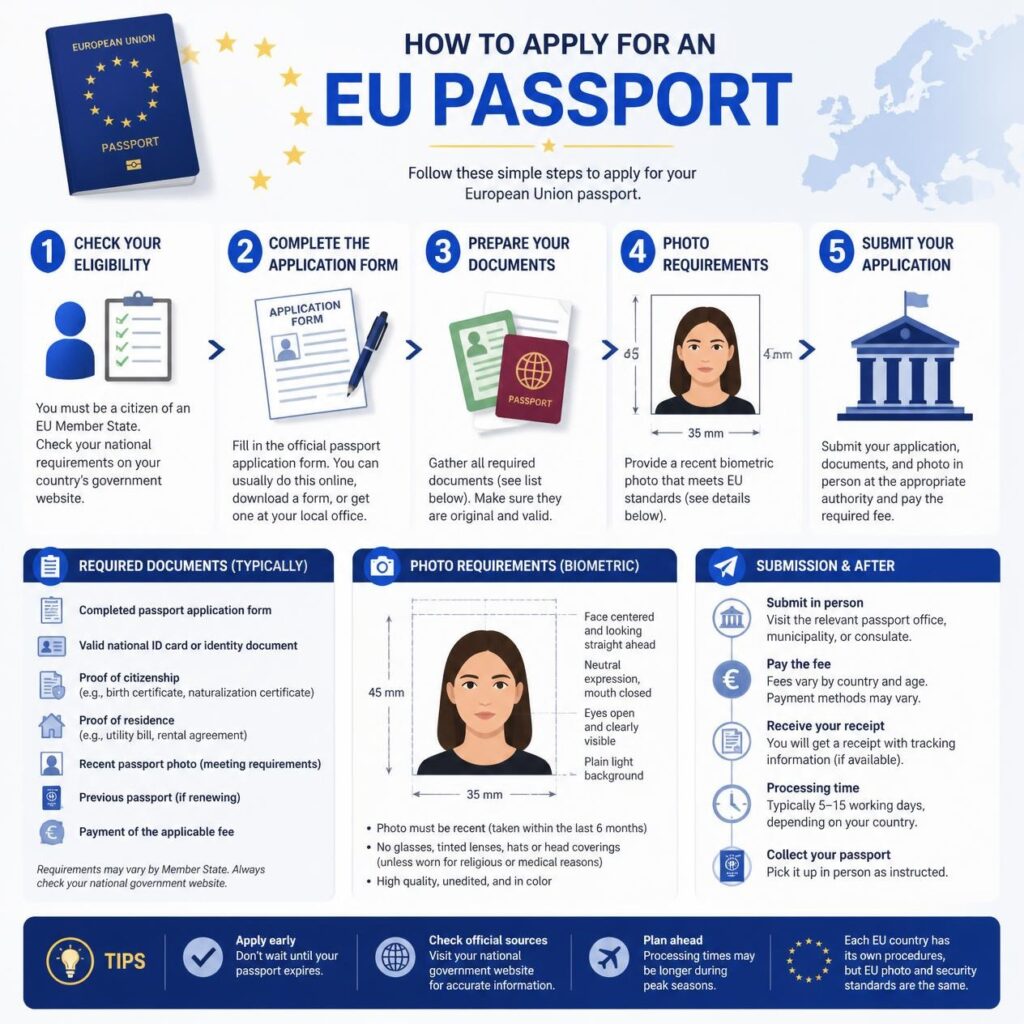
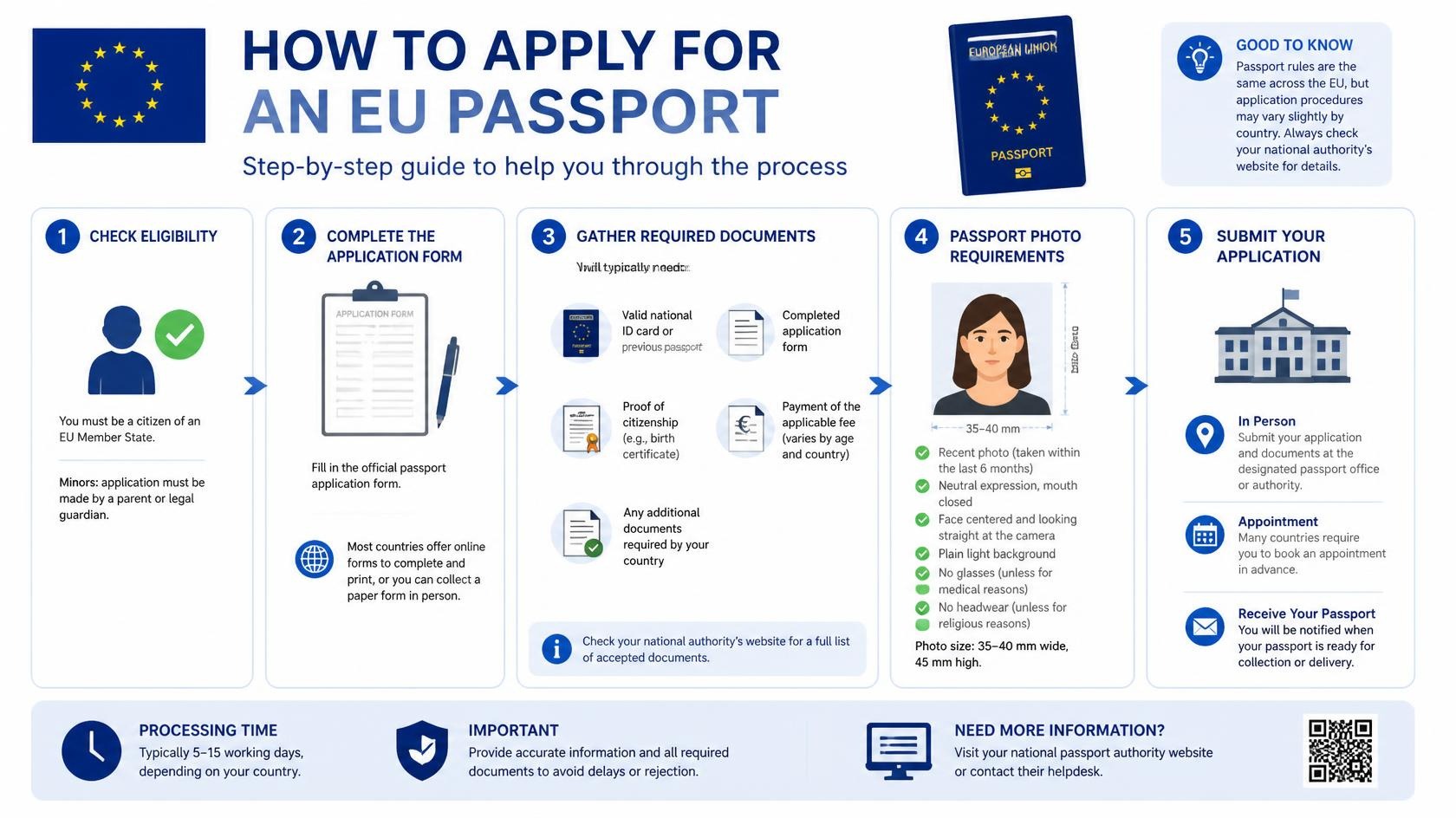
How to Apply for an EU Passport
Step 1: Choose the specific EU country
Start by identifying the EU country where you may have a realistic citizenship pathway.
Consider:
- your family ancestry;
- your parents’ nationalities;
- your grandparents’ nationalities;
- where you have legally lived;
- your marital or family relationships;
- your language skills; and
- your long-term plans.
Step 2: Identify the correct citizenship route
Once you have identified a possible country, determine whether your route is based on:
- descent;
- residence;
- marriage;
- registration;
- restoration of nationality; or
- another legal provision.
Step 3: Check the current official requirements
Nationality law can change. Always confirm the current requirements with the official authority responsible for citizenship or nationality matters.
Check:
- eligibility requirements;
- residence periods;
- language requirements;
- dual citizenship rules;
- document requirements;
- application fees; and
- submission procedures.
Step 4: Create a document checklist
Do not wait until the last minute to start collecting documents.
| Document | Possible purpose |
|---|---|
| Birth certificate | Identity and family relationship evidence |
| Marriage certificate | Relationship or name history evidence |
| Passport | Identity and nationality evidence |
| Residence records | Proof of lawful residence |
| Police certificate | May be required for naturalisation |
| Certified translation | Translation of documents into the required language |
| Apostille or legalisation | Authentication for international document use |
Step 5: Obtain official documents
Authorities may require official or certified copies rather than ordinary photocopies.
Depending on the application, you may need:
- long-form certificates;
- recently issued certificates;
- certified copies;
- official extracts; or
- documents issued by a recognised government authority.
Step 6: Check for inconsistencies
Review your documents carefully.
Check:
- your full name;
- your date of birth;
- your place of birth;
- your parents’ names;
- marriage information; and
- nationality details.
Small inconsistencies can sometimes create questions or additional requests for evidence.
Step 7: Arrange translation and authentication
If your documents are written in a language that the receiving authority does not accept, you may need a certified translation.
You may also need an apostille or legalisation depending on the document and the country where it will be used.
Step 8: Submit the citizenship application
The correct submission location depends on the country and the citizenship route.
Possible authorities may include:
- an embassy;
- a consulate;
- a civil registry office;
- a local government authority;
- a national immigration authority; or
- another government department.
Step 9: Wait for a decision
Processing times vary significantly between countries and application types.
Applicants should be cautious of anyone promising guaranteed approval or a guaranteed passport within a specific short period without considering the actual government process.
Step 10: Apply for the national passport
After citizenship is granted or officially confirmed, the applicant may generally be able to submit a separate passport application.
The citizenship application and the passport application are often two different processes.
Documents You May Need for an EU Citizenship Application
Every country has its own requirements, but the following documents are commonly relevant.
Identity documents
- current passport;
- birth certificate;
- national identity document;
- passport photographs where required; and
- other official identity evidence.
Family documents
- birth certificates;
- marriage certificates;
- divorce records;
- adoption documents;
- name-change certificates; and
- other civil-status documents.
Residence documents
For naturalisation applications, evidence of residence may include:
- residence permits;
- tax documents;
- employment records;
- education records;
- rental records; and
- other official evidence of physical presence.
Police and criminal record certificates
Some citizenship applications require police certificates from countries where the applicant has lived.
The certificate may need to be recent and may need authentication or translation.
Language and civic evidence
Some countries require proof of language ability or knowledge of national history, society, or civic principles.
The required level and acceptable evidence vary according to national law.
Certified Translation, Apostille and Legalisation
International citizenship applications often involve documents issued in different countries and languages. This makes document preparation an important part of the overall process.
What is certified translation?
A certified translation is a translation prepared and certified in a way that meets the requirements of the receiving authority.
Different authorities may have different requirements. Some may accept a translator’s certification, while others may require a sworn translator or a specific official format.
Before ordering a translation, check the requirements of the authority receiving the document.
What is an apostille?
An apostille is a form of authentication used for certain public documents intended for international use between countries where the applicable international framework applies.
It is generally used to authenticate the origin of a document, such as a signature, seal, or official stamp.
What is legalisation?
Legalisation is another method of authenticating documents for use in another country.
The process may involve one or more authorities depending on the countries and documents involved.
Why the order of document preparation matters
Applicants should not automatically assume that documents should be translated first.
Depending on the requirements, the document may need authentication before translation, or the translated document may need separate certification.
Always confirm the correct procedure before finalising important documents.
EU Citizenship Routes Compared
| Route | Who may qualify? | Main challenge | Important consideration |
|---|---|---|---|
| Descent | People with qualifying ancestry | Proving the family chain | Nationality transmission rules |
| Residence | Long-term legal residents | Meeting residence and integration rules | Absences may matter |
| Marriage | Eligible spouses or partners | Meeting additional conditions | Marriage is not automatic citizenship |
| Registration | People covered by special laws | Strict eligibility requirements | Country-specific rules |
| Investment-related | Applicants meeting programme rules | Complex legal and financial requirements | Residence is not automatically citizenship |
Pros and Cons of Obtaining EU Citizenship
Potential advantages
- Potential access to rights associated with EU citizenship.
- Eligibility to hold a passport issued by an EU Member State.
- Potentially easier travel within the EU under applicable rules.
- Possible rights to live, work, or study in other EU countries subject to applicable conditions.
- Potential benefits for eligible family members depending on the circumstances.
- Possible dual nationality where both countries permit it.
Potential disadvantages and challenges
- The citizenship process can take significant time.
- Document collection may be complicated.
- Historical records may contain inconsistencies.
- Certified translation and authentication can add time and expense.
- Some countries restrict dual nationality.
- Nationality laws may change.
- Approval is never guaranteed solely because an applicant has an ancestor or has lived in a country.
Special Considerations for UK Citizens After Brexit
For UK citizens, the most important point is that a British passport does not automatically provide EU citizenship.
However, British citizens may still qualify for another nationality if they meet the requirements of a particular EU Member State.
Before applying, check:
- whether the country allows dual nationality;
- whether your family history creates an eligibility route;
- whether your residence history satisfies the requirements;
- whether a marriage-based route is available;
- whether you need to renounce another nationality; and
- which documents must be translated or authenticated.
Can you keep your British passport?
In many situations, British citizens may retain British citizenship after acquiring another nationality. However, the other country may have its own restrictions.
Therefore, always check the nationality law of the specific country involved.
Can dual nationals travel with two passports?
Dual nationals may hold two passports, but the practical rules for using them can vary.
Applicants should check:
- which passport should be used when entering a country;
- which passport should be presented to airlines;
- whether a country requires its citizens to use its national passport; and
- whether the personal details match across documents.
Common Mistakes to Avoid
1. Searching for one universal EU passport application
There is no single universal application for an EU passport. You must identify a specific EU country first.
2. Confusing residence with citizenship
A residence permit is not the same as citizenship. Permanent residence is also not automatically the same as nationality.
3. Assuming ancestry automatically guarantees citizenship
Having an EU ancestor may create a possible pathway, but the legal rules must be satisfied and the family connection must be proven.
4. Ignoring dual citizenship rules
The UK may allow dual citizenship, but the other country may impose restrictions.
5. Submitting inconsistent documents
Differences in names, dates, or places may lead to questions or requests for additional evidence.
6. Using outdated information
Nationality laws can change. Always check current official requirements.
7. Believing guaranteed passport promises
No legitimate document service can guarantee that a government will approve an application when the applicant does not meet the legal requirements.
EU Citizenship and Passport Checklist
- I have identified a specific EU country.
- I understand the possible citizenship route.
- I have checked current official requirements.
- I have reviewed my family ancestry where relevant.
- I have collected birth and marriage records.
- I have checked names and dates for inconsistencies.
- I know whether certified translation is required.
- I know whether apostille or legalisation is required.
- I have checked dual citizenship rules.
- I know which authority receives the application.
- I understand that citizenship and passport applications may be separate.
- I have kept copies of my documents.
How Elit Documents Can Help With International Documentation
Applying for citizenship or a passport in another country can involve multiple documents, languages, government offices, and authentication requirements.
Elit Documents provides documentation-related services that may help individuals prepare international documents for official use, depending on the specific requirements of the receiving authority.
Relevant services may include:
- certified translation services;
- apostille assistance;
- document legalisation support;
- government documentation assistance;
- identity document support; and
- international document preparation.
It is important to understand that a document service cannot replace the government authority responsible for deciding citizenship or passport eligibility. The relevant government authority makes the final decision.
How Do You Apply for an EU Passport?
- Choose the specific EU country where you may qualify for citizenship.
- Identify your possible route, such as ancestry, residence, marriage, or another legal pathway.
- Check the current nationality requirements.
- Collect official identity, family, residence, and supporting documents.
- Arrange certified translations where required.
- Obtain apostilles or legalisation where required.
- Submit the citizenship application to the correct authority.
- Wait for the citizenship decision.
- After citizenship is approved, apply separately for the country’s national passport.
Frequently Asked Questions
1. Can I apply directly for an EU passport?
No. The European Union does not issue one universal passport application. You normally need to qualify for citizenship of a specific EU Member State first. After citizenship is granted or confirmed, you may apply for that country’s passport.
2. Can a British citizen get an EU passport after Brexit?
Yes, a British citizen may qualify for citizenship in an EU Member State through routes such as ancestry, lawful residence, marriage, or another legal pathway. The exact requirements depend on the specific country.
3. Does having an EU grandparent guarantee an EU passport?
No. An EU grandparent may create a possible citizenship-by-descent route, but the relevant country’s nationality law must be satisfied. You may need to prove the complete family relationship chain.
4. Can I keep my British passport after obtaining EU citizenship?
In many cases, British citizens may retain British citizenship after obtaining another nationality. However, the other country may have restrictions on dual citizenship, so its rules must be checked carefully.
5. Is permanent residence the same as EU citizenship?
No. Permanent residence is an immigration status, while citizenship is a nationality status. A passport is generally issued according to the nationality laws of the country concerned.
6. Can marriage to an EU citizen give me an EU passport?
Marriage may provide a possible citizenship pathway in some countries, but it does not automatically guarantee citizenship or a passport. Additional requirements may apply.
7. Do I need certified translation for EU citizenship documents?
Possibly. Requirements vary by country and authority. Documents written in another language may need certified translation or another accepted translation format.
8. Do documents need an apostille for an EU citizenship application?
Sometimes. The requirement depends on the document, the issuing country, and the receiving authority. You should confirm the requirements before submitting documents.
9. How long does it take to obtain an EU passport?
There is no single processing time. The citizenship process may take considerably longer than the passport application, and processing times vary by country and application route.
10. Can a document service guarantee an EU passport?
No legitimate service can guarantee a government decision. A professional document service may help with translation, apostille, legalisation, and document preparation, but the government authority decides whether an applicant qualifies.
Conclusion: Start With Citizenship, Not the Passport
If you are searching for how to apply for an EU passport, the most important thing to remember is that there is no single application for a universal EU passport.
The usual process is:
For British citizens, possible routes may include qualifying ancestry, lawful residence, marriage, family connections, and other country-specific nationality provisions.
Your documentation is often one of the most important parts of the process. Birth certificates, marriage records, passports, residence documents, criminal record certificates, certified translations, apostilles, and legalisation may all be relevant depending on your circumstances.
Because nationality laws and document requirements can vary, always verify the current rules with the relevant official authority before applying.
If you need assistance with certified translation, apostille, legalisation, or other international documentation requirements, Elit Documents can help with the document-preparation side of your international documentation needs.
Ready to organise your important documents? Contact Elit Documents today to learn more about available documentation, translation, apostille, and legalisation services