
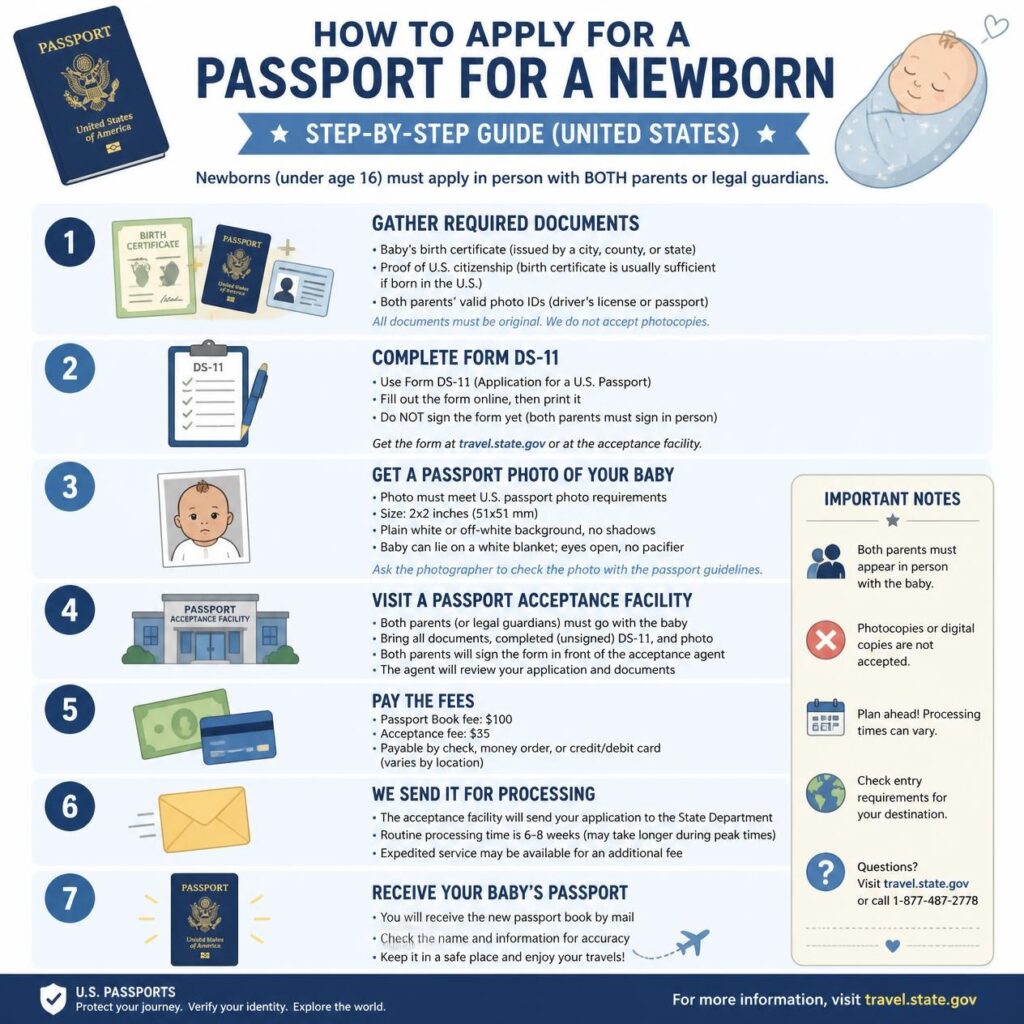
For a newborn or child under age 16, the U.S. passport application is generally a first-time, in-person application using Form DS-11. The child must appear in person, and both parents or guardians generally need to appear with the child or provide additional documentation explaining why one parent cannot attend. A passport issued to a child under 16 is valid for five years and cannot simply be renewed like an adult passport. The U.S. Department of State provides the official child passport requirements.
This complete guide explains the newborn passport process step by step, including citizenship evidence, the birth certificate, parental consent, passport photos, Form DS-11, application fees, processing times, common mistakes, and what to do if you need the passport quickly.
To apply for a U.S. passport for a newborn, complete Form DS-11, gather proof of the baby’s U.S. citizenship, proof of the parent-child relationship, parental identification, a compliant passport photo, and the required fees. The baby must apply in person at an authorized passport acceptance facility with the required parent or guardian consent.
Quick Answer: How Do You Apply for a Newborn Passport?
The basic process is:
- Confirm that the baby is eligible for a U.S. passport.
- Complete Form DS-11 but do not sign it before your appointment.
- Gather the baby’s proof of U.S. citizenship.
- Gather proof of the parent-child relationship.
- Prepare valid identification for the attending parent or parents.
- Obtain one acceptable passport photo of the baby.
- Arrange for the baby and required parent or guardian to appear in person.
- Pay the passport application fee and acceptance facility fee.
- Submit the application at an authorized passport acceptance facility.
- Track the application and wait for the passport to be issued.
Children under age 16 must apply in person. The U.S. Department of State currently states that both parents or guardians should generally appear with the child. If one or both parents cannot attend, additional evidence or consent documentation may be required.
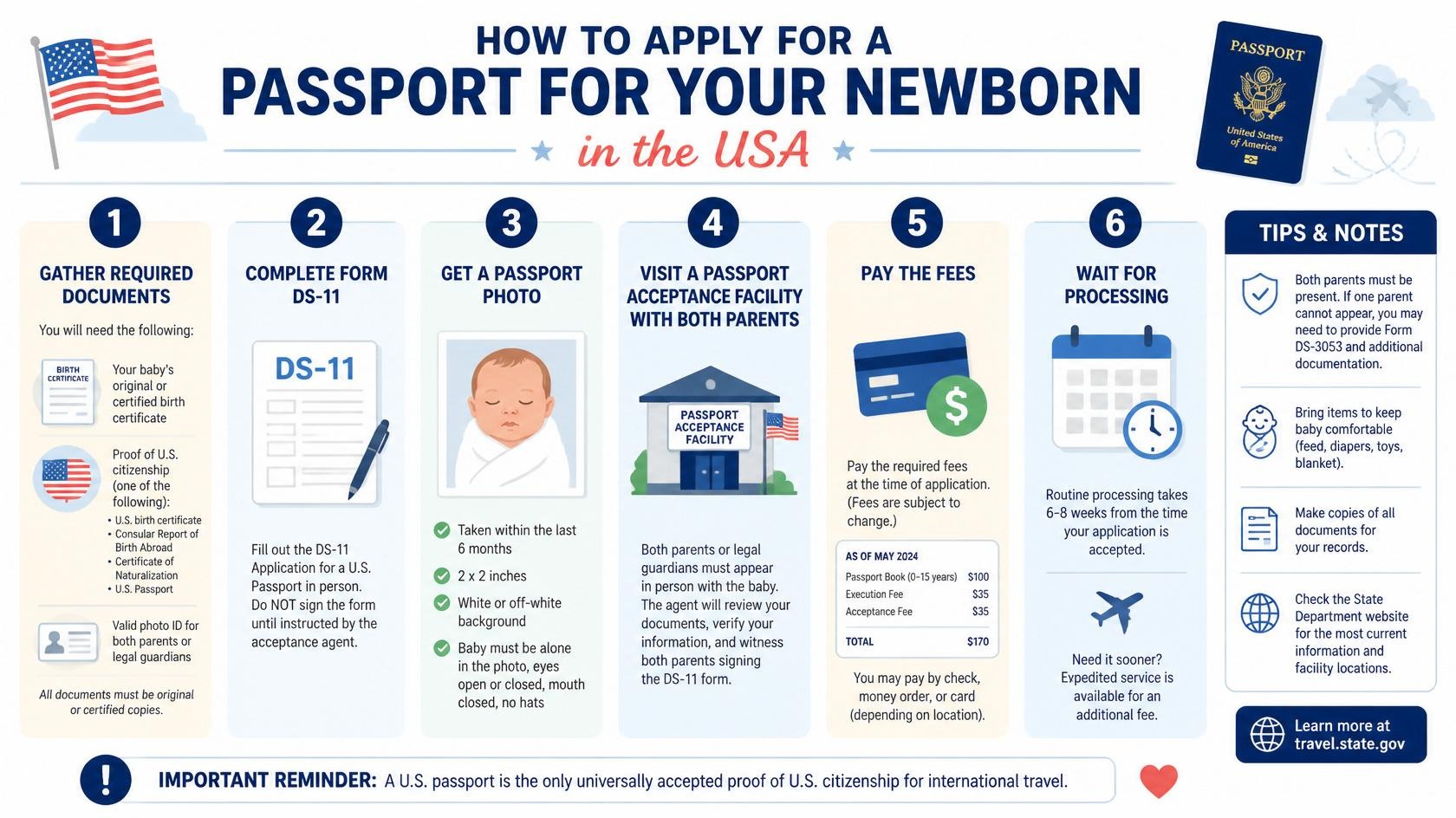
Newborn Passport Requirements in the USA
A newborn does not receive a passport automatically. Even if the baby was born in the United States and has a U.S. birth certificate, the parent or guardian must submit a separate passport application.
The main requirements usually involve five areas:
| Requirement | What You Generally Need |
|---|---|
| Application form | Form DS-11 |
| Baby’s citizenship evidence | Usually an acceptable U.S. birth certificate or other qualifying citizenship evidence |
| Parent-child relationship | Usually established through the child’s birth certificate or other approved documentation |
| Parental identification | Valid government-issued identification for the attending parent or guardian |
| Photograph | One passport photo that meets U.S. passport photo requirements |
| Application fees | Department of State fee plus the acceptance facility fee |
Because documentation can vary in situations involving adoption, guardianship, a missing parent, foreign birth, name differences, or custody orders, applicants should review the official requirements for their specific circumstances before submitting the application.
Documents Needed to Apply for a Newborn Passport
1. Form DS-11
For a first-time passport application for a child under 16, the application is generally made using Form DS-11, Application for a U.S. Passport.
Parents can complete the form using the official passport form-filler process and print it. The form should not be signed until the passport acceptance agent instructs the applicant to sign it during the appointment.
Carefully check:
- The baby’s full legal name
- Date of birth
- Place of birth
- Social Security number, if applicable
- Parent information
- Mailing address
- Contact information
A small error in a name or date of birth can create unnecessary delays. Compare the information on the application with the baby’s official birth certificate before attending the appointment.
2. Proof of U.S. Citizenship
The baby must provide acceptable evidence of U.S. citizenship. For a baby born in the United States, the most common document is an official birth certificate issued by the relevant state, city, county, or territory.
The document should be an official record that meets the applicable passport requirements. A hospital souvenir certificate or informal birth announcement is not the same as official citizenship evidence.
Parents should make sure the baby’s official birth certificate is available before applying. If the birth certificate has not yet been issued, the family may need to wait until acceptable citizenship evidence is available or explore the appropriate official procedure for the specific situation.
3. Proof of the Parent-Child Relationship
The baby’s birth certificate commonly helps establish the relationship between the child and the parent or parents applying. Other situations, such as adoption or legal guardianship, may require different documents.
Make sure names are consistent wherever possible. For example, a parent’s name on the birth certificate may differ from the name on their identification because of marriage, divorce, or a legal name change. In those situations, additional supporting documents may be appropriate.
4. Parent or Guardian Identification
The attending parent or guardian generally needs acceptable government-issued identification. The identification should be valid and should allow the passport acceptance agent to verify the applicant’s identity.
Parents should bring the required identification and any necessary photocopies according to the current instructions. Requirements can vary depending on the type of identification and the specific application circumstances.
5. A Passport Photo of the Newborn
A passport photo is required for the baby’s application. Newborn passport photos can be challenging because babies may move, cry, sleep, or fail to look directly toward the camera.
U.S. passport photo guidance recognizes that infant eyes may not be completely open, but the child should still generally face the camera and the image must meet the applicable photo standards. No other person should appear in the photograph.
How to Apply for a Passport for a Newborn in the USA: Step by Step
Step 1: Confirm the Baby’s Citizenship Documentation
Start by locating the baby’s official proof of citizenship. For most babies born in the United States, this is the official birth certificate.
Do not wait until the last minute if you have international travel planned. Birth certificate processing and passport processing are separate steps, and delays with one document can affect the entire travel timeline.
Step 2: Complete Form DS-11
Complete the application carefully and print it single-sided. Do not sign the application before your appointment unless instructed by the official application process.
Before printing, check every field. The most important information to verify includes:
- Full legal name
- Date and place of birth
- Parent names
- Social Security number information
- Mailing address
- Emergency contact information, if requested
Step 3: Prepare the Required Documents
Put all documents together in one organized folder. A useful order is:
- Completed but unsigned DS-11 application
- Baby’s citizenship evidence
- Proof of parent-child relationship
- Parent or guardian identification
- Required photocopies
- Passport photo
- Payment method
Organization is especially helpful when applying with a newborn because appointments can be stressful and time-sensitive.
Step 4: Arrange the Baby’s Passport Photo
Take or obtain a compliant passport photo before the appointment. A newborn does not need to stand or sit independently. Parents often use a plain, light background and carefully position the baby while ensuring that no parent, hand, blanket, or other person appears in the final image.
Always follow the official photo requirements rather than relying only on a general photo app or social-media photo tool.
Step 5: Schedule or Locate an Acceptance Facility
New passport applications for children are submitted in person at an authorized passport acceptance facility or another appropriate passport service location.
Acceptance facilities may include certain post offices, government offices, libraries, and other approved locations. Appointment requirements vary, so check the facility’s instructions before traveling.
Step 6: Attend the Appointment with the Baby
The baby must appear in person. Required parents or guardians should also attend.
Both parents or guardians generally need to appear and provide consent for a child under 16. If one parent cannot attend, the application may require additional documentation such as a consent form, evidence of sole legal custody, or another document applicable to the circumstances.
Step 7: Pay the Required Fees
For a child under 16 applying for a passport book in 2026, the U.S. Department of State fee chart lists a $100 application fee and a $35 acceptance facility fee. A child passport card has different fees, and applicants requesting both a book and card pay the applicable combined amount.
Payment methods can vary by location and fee type. Check the current official fee instructions before attending the appointment.
Step 8: Track the Application
After submitting the application, monitor the application status using the official passport status system and watch for email or mail communications requesting additional information.
If the Department of State requests additional documentation, respond as quickly as possible. Missing information can extend the processing timeline.
What Birth Certificate Does a Newborn Need for a Passport?
Parents frequently ask whether a hospital certificate is enough. The safest approach is to use the official citizenship evidence required by the U.S. Department of State.
For a child born in the United States, an official birth certificate is commonly used to demonstrate U.S. citizenship and establish the parent-child relationship.
Before applying, verify:
- The document is an official government-issued record.
- The baby’s name matches the passport application.
- The date and place of birth are correct.
- The parent information is accurate.
- Any name differences are supported by appropriate documentation.
If the baby was born outside the United States, the process may be different. The family may need to establish citizenship through documents such as a Consular Report of Birth Abroad or other evidence depending on the child’s circumstances.
How to Take a Passport Photo for a Newborn
Newborn passport photos are one of the most common sources of frustration for parents. Babies cannot follow instructions, sit still on command, or maintain a neutral facial expression for a photographer.
Fortunately, a newborn does not need to behave like an adult for a passport photo. The goal is to produce a clear, compliant photograph that follows the official requirements.
Newborn Passport Photo Tips
- Use a plain, light-colored background.
- Make sure only the baby appears in the final image.
- Use even lighting without harsh shadows.
- Keep the baby’s face visible.
- Avoid hats, sunglasses, and unnecessary accessories.
- Do not digitally alter the baby’s appearance.
- Take several photographs so you have options.
- Follow the current official photo specifications.
The Department of State states that an infant’s eyes do not have to be completely open, although the baby should generally face the camera and the photograph must otherwise satisfy the requirements.
Can a Baby Sleep in a Passport Photo?
Parents should follow the current official photo requirements carefully. A sleeping newborn can be difficult to photograph correctly because the baby’s face may not be positioned toward the camera. The most important consideration is whether the final photograph meets the applicable passport photo rules.
Parental Consent: What If One Parent Cannot Attend?
Parental consent is an important part of the passport process for children under 16.
When both parents or guardians are available, the process is usually simpler because both can appear with the child and provide consent.
When one parent cannot attend, the required documentation depends on the reason. Examples may include:
- The other parent provides a properly completed consent document.
- One parent has sole legal custody.
- The other parent is deceased.
- A court order addresses custody or passport consent.
- There are special circumstances involving guardianship.
Do not assume that a verbal explanation is enough. The Department of State may require specific documentary evidence. In complicated custody or guardianship cases, carefully review the official requirements before submitting the application.
How Much Does a Newborn Passport Cost?
Passport costs depend on whether you apply for a passport book, passport card, or both, as well as whether you request expedited service.
| Application | Department of State Fee | Acceptance Facility Fee |
|---|---|---|
| Child passport book | $100 | $35 |
| Child passport card | $15 | $35 |
| Child passport book and card | $115 | $35 |
The 2026 official fee chart also lists an additional $60 expedite fee for faster processing. A separate optional fee may apply for 1–3 day delivery of an issued passport book within the United States. Fees and payment rules can change, so verify the current official fee schedule before applying.
How Long Does It Take to Get a Newborn Passport?
Current U.S. Department of State processing information lists:
- Routine processing: approximately 4–6 weeks.
- Expedited processing: approximately 2–3 weeks, with an additional fee.
These processing times do not include the time it may take to mail the application to the passport agency or the time needed to receive the completed passport after it is mailed. The Department of State states that mailing can add additional time on both ends.
If you need to travel internationally within 14 calendar days, an urgent passport appointment may be available through a passport agency, subject to the applicable requirements and proof of international travel.
Expert tip: Do not schedule a newborn’s international trip based only on the processing time printed on a website. Leave additional time for birth certificate delays, appointment availability, mailing, document requests, and unexpected processing issues.
Passport Book vs. Passport Card for a Newborn
Most families traveling internationally by airplane should choose a passport book.
| Feature | Passport Book | Passport Card |
|---|---|---|
| International air travel | Yes | No |
| Land and sea travel to certain nearby destinations | Yes | Yes |
| Child validity | 5 years | 5 years |
| Best for international flights | Yes | No |
The passport card is not valid for international air travel. It may be useful for certain land and sea crossings, but families planning to fly internationally with a newborn generally need a passport book.
Why Apply for a Newborn Passport Early?
Applying early provides several advantages.
1. More Time to Fix Errors
If a document contains an incorrect name or date of birth, early preparation gives you time to correct the problem before travel.
2. Less Travel Stress
International travel with a newborn already requires planning. Completing the passport process early removes one major source of uncertainty.
3. More Appointment Flexibility
Passport acceptance facilities can become busier during peak travel periods. Applying early gives families more choices.
4. Better Protection Against Delays
Processing times can change. Applications may also take longer if additional information is requested.
Common Mistakes Parents Make
Mistake 1: Signing Form DS-11 Too Early
Do not sign the application before the passport acceptance agent instructs you to do so.
Mistake 2: Using an Unacceptable Birth Record
A hospital keepsake document may not be the same as acceptable citizenship evidence. Use the appropriate official documentation.
Mistake 3: Waiting Until the Week Before Travel
Even expedited processing is not a guarantee that a passport will arrive before a specific flight. Start early.
Mistake 4: Forgetting the Baby Must Appear
A newborn must appear in person for the child passport application.
Mistake 5: Assuming One Parent Can Always Apply Alone
Parental consent rules are important. If one parent cannot attend, additional documents may be required.
Mistake 6: Submitting an Incorrect Photo
Newborn photos are often rejected because another person appears in the image, the baby is not positioned properly, or the image does not meet the official technical requirements.
Mistake 7: Choosing the Wrong Passport Type
If the family plans to fly internationally, a passport card alone is not sufficient.
Newborn Passport Application Checklist
Use this checklist before your appointment:
- Completed Form DS-11
- Application not signed until instructed
- Official proof of the baby’s U.S. citizenship
- Proof of parent-child relationship
- Parent or guardian identification
- Required photocopies
- Compliant passport photo
- Required parent or guardian consent
- Additional custody or guardianship documents, if applicable
- Correct application fee
- Acceptance facility fee
- Appointment confirmation, if required
- Travel timeline reviewed carefully
What If the Newborn Was Born Outside the United States?
The answer depends on the child’s citizenship status and the circumstances of the birth.
A child born abroad to a U.S. citizen parent may have a different citizenship documentation process than a child born in the United States. In some cases, a Consular Report of Birth Abroad or other evidence may be relevant.
Parents should not automatically assume that a foreign birth certificate alone proves U.S. citizenship. Review the official citizenship and passport requirements that apply to the child’s individual situation.
What If the Baby’s Name Has Changed?
If the baby’s legal name differs between documents, additional documentation may be needed. For example, a legal name change, adoption, or correction to a birth record can affect the documents submitted with the passport application.
Before applying, compare:
- The baby’s birth certificate
- The passport application
- Any court order or legal name-change documentation
- Other supporting identity records
Consistent information helps reduce avoidable delays.
Can You Renew a Newborn’s Passport?
Children under age 16 cannot renew their passports using the adult renewal process. The Department of State states that a child under 16 must apply in person each time, and child passports are valid for five years.
That means parents should expect to submit a new child passport application when the child needs a new passport.
Pros and Cons of Applying for a Newborn Passport Early
Pros
- Provides more time before international travel.
- Allows time to correct document errors.
- Reduces last-minute stress.
- Creates more flexibility for appointment scheduling.
- Helps families plan international travel more confidently.
Cons
- The passport application requires an in-person process.
- Newborn passport photos can be difficult to prepare.
- Both parents may need to coordinate attendance or consent documents.
- Child passports are valid for only five years.
- Processing times and fees can change.
Expert Tips for a Smooth Newborn Passport Application
Start With the Birth Certificate
The passport application depends heavily on accurate citizenship documentation. Obtain and carefully review the official birth certificate before beginning the passport process.
Do Not Book Extremely Tight Travel Plans
Even when normal processing times look reasonable, mailing, appointments, document requests, and seasonal demand can affect the total timeline.
Keep Copies of Your Application Materials
Maintain copies of documents and payment records where appropriate. Do not mail original documents unless the official instructions require them.
Check the Official Requirements Before the Appointment
Passport rules, fees, processing times, and forms can change. Always verify current requirements through official government resources before submission.
Use Professional Document Support When the Situation Is Complicated
Families dealing with unusual documentation, legal name changes, international birth records, apostille needs, certified translations, custody issues, or other government documentation challenges may benefit from professional document assistance.
Elit Documents provides document-related support services for individuals who need help organizing, preparing, or understanding documentation for government and international purposes. Professional support does not replace official government decision-making, but it can help applicants reduce avoidable document errors and understand the preparation process more clearly.
Featured Snippet: What Documents Are Needed for a Newborn Passport?
To apply for a newborn passport in the USA, you generally need Form DS-11, proof of the baby’s U.S. citizenship, proof of the parent-child relationship, valid parent or guardian identification, a compliant passport photo, required parental consent, and the applicable fees.
Featured Snippet: How Long Does a Newborn Passport Take?
Current U.S. passport processing times are approximately 4–6 weeks for routine service and 2–3 weeks for expedited service, not including all mailing time. Families should allow additional time before international travel.
Featured Snippet: Does a Newborn Need a Passport to Travel Internationally?
Yes. A U.S. citizen newborn generally needs a valid U.S. passport book for international air travel outside the United States.
Frequently Asked Questions
1. Can I apply for a U.S. passport for my newborn?
Yes. A newborn can apply for a U.S. passport. Children under age 16 must apply in person, and the application generally requires Form DS-11, proof of citizenship, parental consent, identification, a passport photo, and the applicable fees.
2. Does my newborn have to be present for the passport application?
Yes. The child must appear in person for a passport application under age 16.
3. What form do I use for a newborn passport?
First-time applicants under age 16 generally use Form DS-11.
4. Can one parent apply for a newborn’s passport?
Both parents or guardians generally need to appear and consent. If one parent cannot attend, additional documentation may be required depending on the circumstances.
5. How much is a passport for a newborn in the USA?
For 2026, the official fee chart lists $100 for a child passport book application and a $35 acceptance facility fee. Additional fees may apply for expedited service or optional services. Always verify current fees before applying.
6. How long is a newborn passport valid?
A passport issued to a child under age 16 is valid for five years.
7. Can a newborn’s eyes be closed in a passport photo?
Official guidance states that an infant’s eyes do not have to be completely open, although the child should generally face the camera and the photo must otherwise meet the applicable requirements.
8. Can I use a passport card instead of a passport book?
A passport card is not valid for international air travel. Families planning to fly internationally generally need a passport book.
9. Can I renew my child’s passport by mail?
Children under age 16 cannot renew their passports using the standard adult renewal process. They must apply in person again.
10. How early should I apply for my baby’s passport?
Apply as early as possible before international travel. Current processing times do not include every part of the total timeline, including mailing and potential document requests.
Conclusion: Apply Early and Prepare Carefully
Learning how to apply for a passport for a newborn in the USA is much easier when the process is broken into manageable steps. Start with the baby’s official citizenship documentation, complete Form DS-11 carefully, prepare a compliant passport photo, gather parental identification and consent documents, and submit the application in person at an authorized facility.
The most important advice is simple: do not wait until the last minute. Newborn passport applications involve several documents, and processing times do not include every stage from document preparation to final delivery.
If your situation involves complex documentation, international records, certified translations, apostille or legalization requirements, name differences, custody documentation, or other government paperwork, Elit Documents can help you understand and organize the documentation process.
Need help preparing important government or international documents? Contact Elit Documents to learn how professional document support may help you prepare your paperwork more efficiently and confidently.