
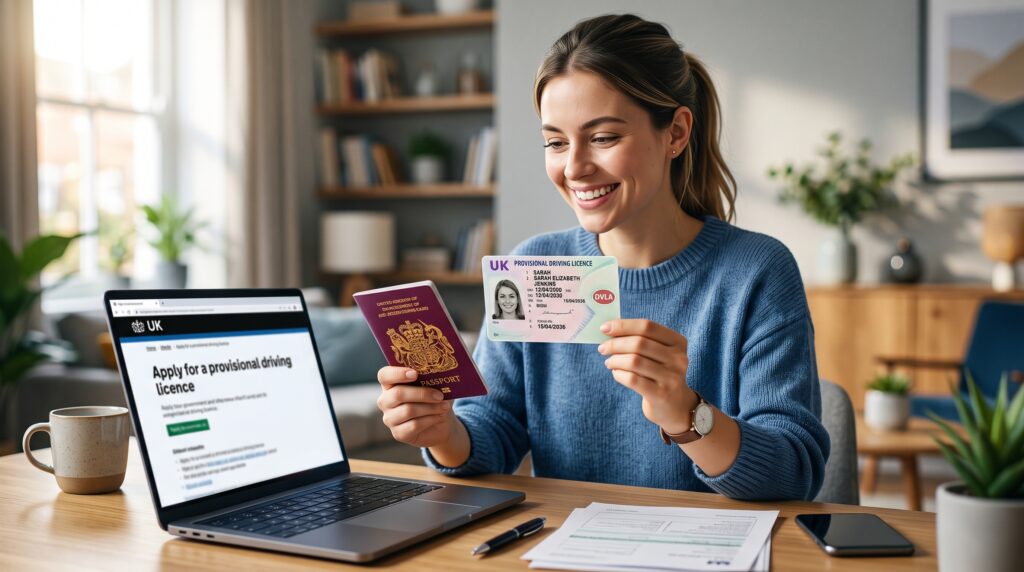
Getting your first driving licence is an exciting milestone. Whether you are a young person preparing to drive for the first time, a new resident in the UK, or someone who simply wants more independence, applying for a provisional driving licence is the first step towards becoming a qualified driver.
A provisional driving licence is an official document issued by the Driver and Vehicle Licensing Agency (DVLA) that allows you to learn how to drive legally on UK roads. It does not allow you to drive independently, but it gives you permission to begin your driving journey under learner driver rules.
Before you can take driving lessons, practise driving with a supervisor, or book your driving tests, you must have a valid provisional licence.
The provisional licence allows you to:
- Take professional driving lessons with an approved driving instructor
- Practise driving on public roads with a qualified supervisor
- Study for and take the driving theory test
- Book and take your practical driving test
Without a provisional driving licence, you cannot legally start learning to drive a car on UK roads.
In this complete guide, we explain everything you need to know about how to apply for a provisional driving licence in the UK, including:
- Who is eligible to apply
- Required documents and information
- How to apply online
- How to apply by post
- Application costs
- Processing times
- Common mistakes to avoid
- What to do after receiving your licence
By following the correct process, you can complete your application smoothly and avoid unnecessary delays.
What Is a Provisional Driving Licence in the UK?
A provisional driving licence is a learner licence that allows you to begin driving practice before obtaining a full UK driving licence.
It is the first official driving document most new drivers apply for. The licence confirms that you meet the basic requirements to learn driving and allows you to participate in driver training.
A provisional licence includes important information such as:
- Your name
- Date of birth
- Photograph
- Driving categories you are allowed to learn
- Licence number
However, it is important to understand that a provisional licence is not the same as a full driving licence.
A full driving licence means you have successfully completed both:
- The driving theory test
- The practical driving test
After passing both tests, you can apply for a full licence and drive without learner restrictions.
With a provisional driving licence, you must follow specific learner driver rules.
What Can You Do With a Provisional Driving Licence?
Once you receive your provisional licence, you can begin preparing for your driving test.
Learn to Drive a Car
The main purpose of a provisional licence is to allow you to learn how to control and operate a vehicle safely.
You can practise important driving skills such as:
- Steering control
- Changing gears
- Parking
- Understanding road signs
- Following traffic rules
- Handling different road conditions
Take Professional Driving Lessons
Many new drivers choose to learn with an approved driving instructor.
Professional lessons help you:
- Learn correct driving techniques
- Understand UK road rules
- Prepare for the practical test
- Build confidence behind the wheel
A qualified instructor can identify mistakes early and help you develop safe driving habits.
Practise With a Qualified Driver
You can also practise driving with another person who meets the legal requirements.
The supervising driver usually must:
- Be at least 21 years old
- Have held a full driving licence for at least three years
- Be qualified to drive the type of vehicle you are practising in
This allows learners to gain extra experience outside formal lessons.
Take Your Driving Tests
A provisional driving licence allows you to take the next steps in becoming a fully qualified driver.
You can:
- Prepare for the theory test
- Book your theory test
- Take your practical driving test after passing the theory test
Passing both tests is required before you can drive independently.
Can You Drive Alone With a Provisional Licence?
No. A provisional driving licence does not allow you to drive without supervision.
Until you pass your practical driving test, you must follow learner driver requirements.
These include:
- Displaying L plates (or D plates in Wales)
- Being supervised by a qualified driver when practising
- Following restrictions that apply to learner drivers
Driving alone without meeting these requirements can result in penalties, fines, and insurance problems.
Who Can Apply for a Provisional Driving Licence?
Before applying, you must check whether you meet the eligibility requirements.
The DVLA has specific rules regarding age, residency, eyesight, and personal information.
Minimum Age Requirements for a Provisional Licence
One of the most common questions is:
“How old do you have to be to apply for a provisional driving licence in the UK?”
You can apply for a provisional driving licence when you are:
15 years and 9 months old
However, applying at this age does not mean you can immediately drive a car.
The rules are:
- You can apply from 15 years and 9 months
- You can start driving a car from age 17
- You can ride certain motorcycles from a younger age depending on the vehicle category
Applying early can be useful because your licence is already ready when you reach the legal driving age.
Residency Requirements
To apply for a provisional driving licence in Great Britain, you normally need to be a resident of:
- England
- Scotland
- Wales
The DVLA manages driving licences for Great Britain.
Northern Ireland has a separate system managed by the Driver & Vehicle Agency (DVA).
If you live in Northern Ireland, you need to apply through the Northern Ireland licensing system instead.
Other Requirements to Apply
Besides age and residency requirements, you must also meet other conditions.
Meet the Eyesight Requirements
You must be able to meet the minimum eyesight standard required for driving.
This normally includes being able to read a vehicle registration plate from the required distance.
If you need glasses or contact lenses to meet the eyesight standard, you must use them when driving.
Provide Accurate Personal Information
Your application information must be correct and match your official documents.
This includes:
- Full legal name
- Date of birth
- Current address
- Identity information
What Documents Do You Need to Apply for a Provisional Driving Licence?
Before starting your application, it is important to prepare the correct information and documents. Having everything ready can make the process faster and reduce the chance of delays.
The documents you need may depend on your personal situation, such as whether you are a UK citizen, a foreign national living in the UK, or applying with a different type of identity document.
When applying for a provisional driving licence, you will normally need to provide:
- Proof of identity
- Personal information
- Address details
- National Insurance number (if available)
- A suitable photograph
- Details of any previous driving licences
Identity Documents Required for a Provisional Licence
The DVLA needs to confirm your identity before issuing a driving licence.
The easiest option for many applicants is a valid UK passport.
UK Passport
If you have a valid UK passport, the application process is usually simpler because your identity can often be verified electronically.
Your passport information can be used to confirm:
- Your full name
- Date of birth
- Nationality
- Identity details
Other Accepted Identity Documents
If you do not have a UK passport, you may still be able to apply using other accepted documents.
Examples may include:
- Immigration documents
- Biometric residence documents
- Other approved identity documents
The exact documents accepted depend on your circumstances.
It is important to provide original documents if you apply by post because copies may not be accepted.
Personal Information Needed for Your Application
When completing your provisional driving licence application, you will need to provide accurate personal details.
These include:
Full Name
Your name must match your official identity documents.
If your name has changed because of marriage, legal change, or another reason, you may need to provide supporting evidence.
Date of Birth
Your date of birth must match your identity documents.
Even small mistakes can create delays because the DVLA uses this information to verify your identity.
Current Address
You must provide your current residential address.
The DVLA uses this address to:
- Send your driving licence
- Contact you about your application
- Maintain your driving record
Make sure your address is complete and accurate, including:
- House number
- Street name
- Town or city
- Postcode
National Insurance Number
If you have a National Insurance number, you should provide it during the application.
It helps the DVLA confirm your identity and match your details with government records.
If you do not have one, this does not always prevent you from applying, but additional identity checks may be required.
Previous Driving Licence Information
If you have previously held any driving licence, you may need to provide details.
This includes:
- Previous UK driving licence details
- Foreign driving licence information
- Previous applications
Providing accurate information helps the DVLA keep your driving record correct.
If you have never applied for a driving licence before, you simply indicate that you are a first-time applicant.
Photograph Requirements for a Provisional Licence
Your photograph is an important part of your driving licence because it is used for identification.
The requirements depend on how you apply.
Online Application Photo Requirements
If you apply online, you may be able to use a digital photograph.
A suitable digital photo should:
- Clearly show your face
- Have good lighting
- Have a plain background
- Look similar to your current appearance
- Not include filters or editing
You should look directly at the camera with a neutral expression.
Postal Application Photo Requirements
If applying by post, you normally need to provide a passport-style photograph.
The photo should meet official passport photo standards.
Poor-quality photographs can delay your application because the DVLA may request a replacement.
How to Apply for a Provisional Driving Licence Online
For most people, applying online is the quickest and easiest way to get a provisional driving licence.
The online process is designed to be simple and can usually be completed within a short time if you have all required information ready.
Step 1: Visit the Official DVLA Website
The first step is to use the official government application service.
Always use the official DVLA website when applying.
Many unofficial websites appear in search results and offer to complete the application for you. Some of these services charge additional fees on top of the official licence cost.
Using the official service helps you:
- Avoid unnecessary charges
- Submit information directly to the DVLA
- Receive official confirmation
Step 2: Complete the Online Application Form
After starting your application, you will need to complete several sections.
You will provide details such as:
- Your name
- Date of birth
- Address history
- Nationality information
- Identity details
- Driving licence category
Take your time when completing the form.
A small mistake, such as entering the wrong date of birth or incorrect address, can slow down the process.
Before submitting, check every section carefully.
Step 3: Provide Identity Information
During the application, the DVLA will verify your identity.
Depending on your circumstances, this may involve:
- Passport verification
- Providing identity document details
- Additional checks
If your identity cannot be confirmed automatically, you may need to provide further information.
This does not necessarily mean there is a problem, but it can increase processing time.
Step 4: Upload or Provide Your Photograph
During an online application, you may be asked to provide a suitable photograph.
The system will guide you through the requirements.
Make sure your image:
- Is clear
- Shows your full face
- Has no unnecessary editing
- Matches official photo requirements
A poor photograph can cause delays.
Step 5: Pay the Application Fee
After completing your details, you will need to pay the provisional driving licence application fee.
Payment is normally made online using accepted payment methods.
The fee covers the processing and production of your provisional licence.
Before paying:
- Check your details are correct
- Confirm your application information
- Review the payment amount
Step 6: Submit Your Application
Once you have completed all sections and paid the fee, you can submit your application.
After submission:
- You should receive confirmation
- Your application will be reviewed by the DVLA
- Your licence will be produced once approved
Keep any confirmation details until you receive your licence.
How to Track Your Provisional Licence Application
After applying online, you may be able to check your application status through the DVLA service.
Tracking your application can help you understand whether:
- Your application is being processed
- Additional information is required
- Your licence has been issued
If there are delays, the DVLA may contact you for further details.
How to Apply for a Provisional Licence by Post
Although online applications are the preferred option for many people, you can also apply by post.
Postal applications are useful for people who:
- Cannot complete the online process
- Need to provide physical documents
- Have identity documents that cannot be verified online
However, postal applications usually take longer because documents must be checked manually.
Step-by-Step Postal Application Process
Step 1: Get the Correct Application Form
You need the appropriate DVLA application form for a first provisional driving licence.
Make sure you use the correct form and complete the latest version.
Step 2: Complete All Sections Carefully
Fill in:
- Personal details
- Address information
- Identity information
- Driving licence categories
Check everything before sending.
Incorrect information can result in your application being returned.
Step 3: Include Required Documents
Depending on your situation, you may need to include:
- Identity documents
- Passport-style photograph
- Supporting documents
Only send documents requested by the DVLA.
Step 4: Send Your Application
Post your completed application and documents to the address provided on the form.
Consider using a tracked postal service if you are sending important identity documents.
Step 5: Wait for Confirmation
After receiving your application, the DVLA will review your information.
If everything is correct, your provisional driving licence will be produced and sent to your address.
How much does it cost to apply for a provisional driving licence in the UK?”
The cost depends on how you apply. The online application is usually the cheapest and most convenient option, while applying by post generally costs more.
Before applying, it is also useful to understand that getting a driving licence involves more than just the application fee. New drivers should also budget for lessons, tests, and learning materials.
Provisional Licence Application Fees
Online Application Cost
Applying online through the official DVLA service is usually the cheapest option.
The online application fee is:
£34
The payment is made during the application process using an accepted payment method.
The online option is popular because it is:
- Faster
- Easier to complete
- Less expensive
- More convenient for most applicants
Postal Application Cost
If you apply by post, the application fee is:
£43
Postal applications cost more because they require manual processing and physical document handling.
You may need to choose the postal route if:
- You cannot complete the online application
- You need to send identity documents
- Your circumstances require additional verification
Additional Costs New Drivers Should Consider
The provisional licence is only the beginning of your driving journey.
Most learners will also need to pay for other driving-related expenses.
Driving Lessons
Driving lessons are usually the biggest expense for new drivers.
The total cost depends on:
- Number of lessons needed
- Location
- Instructor prices
- Your learning speed
Some learners pass after fewer lessons, while others need more practice to become confident.
Professional lessons can help you:
- Learn correct techniques
- Understand road safety
- Prepare for the practical test
- Avoid developing bad driving habits
Theory Test Fee
Before taking your practical driving test, you must pass the driving theory test.
The theory test checks your knowledge of:
- UK road rules
- Traffic signs
- Hazard awareness
- Safe driving practices
You need to pay a separate fee to take the theory test.
Many learners use:
- Theory test apps
- Practice questions
- Online study materials
Preparing properly can improve your chances of passing the first time.
Practical Driving Test Fee
After passing your theory test and gaining enough driving experience, you can book your practical driving test.
The practical test assesses your ability to:
- Control the vehicle safely
- Follow road rules
- Deal with traffic situations
- Complete required manoeuvres
- Drive independently
If you fail and need to retake the test, you will need to pay another test fee.
Learning Materials
Many learners also spend money on additional learning resources.
Examples include:
- Highway Code books
- Theory test apps
- Driving practice videos
- Mock tests
These resources can make learning easier and help you prepare more effectively.
How Long Does a Provisional Licence Take to Arrive?
After submitting your application, many people want to know:
“How long does it take to receive a provisional driving licence in the UK?”
The answer depends on:
- How you applied
- Whether your identity can be verified quickly
- Whether additional checks are needed
- Whether your documents are correct
Online Application Processing Time
Online applications are usually processed faster because much of the information can be checked electronically.
If your details are correct and your identity is successfully verified, your licence may arrive relatively quickly.
However, delays can still happen if:
- Your information does not match official records
- Additional checks are required
- Your photograph does not meet requirements
Postal Application Processing Time
Postal applications usually take longer because the DVLA must manually review documents.
The process can take longer because:
- Documents must be checked physically
- Information must be verified manually
- Applications must be processed through the postal system
For this reason, applicants who need their licence quickly often choose the online method.
Reasons Your Provisional Licence Application May Be Delayed
Most applications are straightforward, but delays can happen.
Understanding common problems can help you avoid them.
Incorrect Personal Information
One of the most common reasons for delays is incorrect information.
Examples include:
- Spelling mistakes in your name
- Incorrect date of birth
- Wrong address details
- Information that does not match official records
Always check your application carefully before submitting.
Missing Documents
If you apply by post, missing documents can delay the process.
Examples:
- Missing identity documents
- Incorrect photographs
- Incomplete forms
The DVLA may contact you requesting additional information before processing your application.
Identity Verification Problems
Sometimes the DVLA cannot automatically confirm your identity.
This can happen if:
- Your details have changed recently
- Your documents need additional checking
- Your information does not match government records
Additional verification does not necessarily mean your application will be rejected, but it may take longer.
Photograph Issues
A photograph that does not meet requirements can also delay your application.
Common problems include:
- Poor lighting
- Blurry image
- Face not clearly visible
- Incorrect background
- Heavy editing or filters
Make sure your photograph follows official requirements before submitting it.
Common Mistakes When Applying for a Provisional Licence
Although applying for a provisional licence is usually simple, many applicants make mistakes that slow down the process.
Avoiding these common errors can help you receive your licence faster.
Providing Incorrect Personal Details
Your driving licence is an official identity document, so accuracy is extremely important.
Your:
- Name
- Date of birth
- Address
- Identity information
must match your official records.
Even a small mistake can cause problems later when:
- Booking driving tests
- Verifying your identity
- Updating your licence
Always review your application before submission.
Sending the Wrong Documents
When applying by post, some applicants send documents that are incomplete or not accepted.
Before sending anything:
- Check the required documents
- Confirm they are valid
- Keep copies of important information
Sending unnecessary documents can also create confusion and slow down processing.
Using Unofficial Websites
A common mistake is applying through unofficial websites that appear similar to government websites.
Some third-party websites offer application assistance but charge additional service fees.
Before applying, always check that you are using the official DVLA service.
Using the official route helps you:
- Avoid extra charges
- Protect your personal information
- Complete the correct application process
Applying Too Early or Too Late
Understanding the correct timing is important.
You can apply from:
15 years and 9 months old
However, if you are preparing to start driving at 17, applying early can help ensure your licence is ready.
Waiting too long may delay your driving plans, especially if you want to:
- Start lessons
- Take your theory test
- Book a practical test
Planning ahead makes the process smoother.
What Should You Check Before Submitting Your Application?
Before clicking submit, review:
✓ Your name is correct
✓ Your date of birth matches your documents
✓ Your address is accurate
✓ Your photograph meets requirements
✓ Your identity details are correct
✓ Your payment information is complete
A few minutes of checking can prevent weeks of unnecessary delays.
What Happens After You Receive Your Provisional Licence?
Receiving your provisional driving licence is an important step, but it is only the beginning of your journey towards becoming a fully qualified driver.
Once your licence arrives, you can legally start learning to drive and preparing for your driving tests.
The next steps usually include:
- Finding a driving instructor
- Taking driving lessons
- Studying for the theory test
- Practising driving safely
- Booking your practical driving test
Taking a structured approach can help you become a safer and more confident driver.
Start Driving Lessons
Most new drivers begin by taking lessons with an approved driving instructor.
A professional instructor can help you learn the correct techniques from the beginning and prepare you for the practical driving test.
Choosing a Driving Instructor
When choosing an instructor, consider:
- Whether they are approved and qualified
- Their experience with learner drivers
- Reviews from previous students
- Lesson prices
- Availability
- Teaching style
A good instructor should make you feel comfortable while helping you improve your driving skills.
What You Learn During Driving Lessons
Early lessons usually focus on basic vehicle control.
You may learn:
- How to start and stop safely
- Steering techniques
- Changing gears
- Using mirrors correctly
- Understanding road signs
- Turning and junction control
- Parking skills
As your confidence improves, lessons become more advanced.
You will practise:
- Driving in busy traffic
- Dual carriageways
- Roundabouts
- Independent driving
- Emergency stops
- Different road conditions
Book Your Theory Test
Before taking your practical driving test, you must pass the driving theory test.
The theory test checks whether you understand the rules and responsibilities of driving in the UK.
It includes two main parts:
- Multiple-choice questions
- Hazard perception test
Preparing for the Theory Test
Good preparation increases your chance of passing.
Useful study methods include:
- Reading the Highway Code
- Using official practice questions
- Watching hazard perception examples
- Taking mock tests
Many learners fail because they focus only on practical driving and do not spend enough time studying road rules.
Practise Driving Legally With a Provisional Licence
A provisional licence allows you to practise driving, but you must follow learner driver rules.
Before driving, make sure you understand your responsibilities.
Display L Plates
Learner drivers must display:
- L plates in England and Scotland
- L plates or D plates in Wales
The plates must be clearly visible so other road users know you are learning.
Drive With Proper Supervision
When practising outside driving lessons, you normally need to be accompanied by someone who meets the legal requirements.
The supervising driver should:
- Be qualified to drive the vehicle
- Meet the minimum age requirement
- Have held a full driving licence for the required period
Driving without proper supervision can result in legal consequences.
Have Proper Insurance
Before practising driving, the vehicle must have appropriate insurance coverage.
This applies whether:
- You own the vehicle
- You use a family member’s vehicle
- You use another person’s car
Driving without valid insurance is illegal and can result in serious penalties.
Frequently
Can I apply for a provisional licence before turning 17?
Yes.
You can apply for a provisional driving licence from:
15 years and 9 months old
However, you cannot start driving a car on public roads until you are:
17 years old
The early application option allows you to prepare your licence before you reach driving age.
How long does a provisional driving licence last?
A provisional driving licence normally remains valid until you pass your driving test or until it expires.
The photocard licence usually needs to be renewed after a set period, similar to other UK driving licences.
If your details change, such as your address or name, you should update your licence information.
Can I drive immediately after receiving my provisional licence?
Yes, but only under learner driver conditions.
A provisional licence allows you to start learning, but you cannot drive independently.
You must:
- Display learner plates
- Follow learner driver rules
- Have proper supervision
- Have suitable insurance
You can only drive alone after passing your practical driving test and receiving a full licence.
Can I Apply for a Provisional Licence Without a UK Passport?
Yes, in many cases.
A UK passport is one of the easiest ways to verify identity, but it is not the only option.
Other accepted identity documents may be available depending on your situation.
If you do not have a UK passport, check the DVLA requirements before applying to understand which documents you can use.
Can I Apply for a Provisional Licence Online?
Yes.
For most people, applying online is the quickest and easiest method.
The online process allows you to:
- Complete the application digitally
- Provide your information electronically
- Pay the fee online
- Receive confirmation quickly
However, some applicants may need to apply by post if their circumstances require physical documents.
Do I Need a National Insurance Number to Apply?
A National Insurance number is useful because it helps confirm your identity.
If you have one, you should provide it during your application.
If you do not have one, you may still be able to apply, but additional identity checks may be needed.
Can I Start Driving Lessons Without a Provisional Licence?
No.
You must have a valid provisional driving licence before you begin driving lessons on public roads.
A driving instructor will normally ask to see your licence before starting lessons.
What Happens If My Application Is Rejected?
If there is a problem with your application, the DVLA may contact you for more information.
Common reasons for issues include:
- Incorrect information
- Identity problems
- Missing documents
- Legal restrictions
If your application cannot be approved, you should follow the instructions provided by the DVLA.
Conclusion:
Applying for a provisional driving licence is the first legal step towards becoming a qualified driver in the UK.
The process is straightforward if you prepare the correct information and follow the correct steps.
Before applying, make sure you:
- Meet the eligibility requirements
- Have the correct documents ready
- Provide accurate personal details
- Use the official DVLA application service
- Choose the right application method
For most people, applying online is the simplest and fastest option.
Once you receive your provisional licence, you can begin your driving journey by taking lessons, preparing for your theory test, and gaining practical experience on UK roads.
Avoiding common mistakes and preparing properly will help you move smoothly from learner driver to fully qualified driver.