
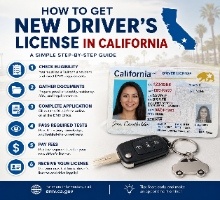
This guide explains how to get a new driver’s license in California step by step. You will learn what documents to prepare, when you may be able to start or complete a process online, what to expect during a DMV visit, and how the REAL ID option compares with a standard California driver’s license. You will also find practical tips for replacing a lost or stolen card, transferring an out-of-state license, and avoiding the most common application mistakes.
By the end, you should have a clear action plan for your specific situation—so you can approach your California DMV application confidently, bring the right paperwork, and move one step closer to receiving your new driver’s license.
What Does “New Driver’s License in CA” Mean?
People search for “how to get new driver’s license CA” for different reasons. The right path depends on your situation.
You May Need a New CA Driver’s License If:
- You have never had a driver’s license before.
- You recently moved to California from another U.S. state.
- You have a driver’s license from another country.
- You need to replace a lost, stolen, damaged, or mutilated California license.
- You want to upgrade from a standard license to a REAL ID license.
- You need a license after a name change, gender marker update, or address change.
- You are applying under AB 60 because you cannot provide proof of lawful U.S. presence but can meet California identity and residency requirements.
The biggest mistake is assuming every “new license” case follows the same process. A first-time adult driver usually needs a permit and a driving test. A person moving from another U.S. state may not need the same behind-the-wheel requirement. A person with a foreign driver’s license generally needs to complete the California process and pass a driving test for an original California license.
Who Can Apply for a California Driver’s License?
California offers several driver’s license paths for eligible applicants. The most common license for everyday driving is the noncommercial Class C license. This is the license most people need for regular cars and personal vehicles.
Common Applicant Types
| Applicant Type | Likely Path | Important Note |
|---|---|---|
| First-time adult driver | Apply, pass tests, get instruction permit, then pass drive test | Practice before booking the driving test |
| New resident with another U.S. license | Apply for CA license and complete DMV requirements | Bring identity, SSN, and residency documents |
| Driver with foreign license | Apply for CA license and pass driving test | Bring an accompanying licensed driver to and from the drive test if required |
| Applicant needing REAL ID | Apply for REAL ID driver’s license | Bring original identity and residency documents |
| Applicant without proof of lawful presence | AB 60 driver’s license route | Requires proof of identity and California residency |
| Lost or stolen license holder | Request replacement | Replacement does not usually mean restarting the full licensing process |
Documents Needed for a New CA Driver’s License
Your documents are often the most important part of the application. California DMV must verify who you are, where you live, and whether your legal name matches your identity records.
Basic Document Categories
- Proof of identity: Examples may include a valid passport, birth certificate, permanent resident card, naturalization certificate, or other DMV-accepted identity document.
- Social Security number: If you have an SSN, you should be prepared to provide it during the application.
- Proof of California residency: Utility bills, bank statements, lease agreements, mortgage bills, insurance documents, school records, or government letters may help, depending on DMV acceptance rules.
- Name-change documents: Marriage certificate, divorce decree, adoption record, or court order may be needed if your current name does not match your identity document.
- Legal presence documents: Non-U.S. citizens may need immigration or lawful presence documents, depending on the license type.
- Certified translations: If key documents are not in English, certified translation may be required by the receiving authority or useful for avoiding confusion.
Document Checklist Before Visiting the DMV
- Check that your full name is consistent across all records.
- Bring original or certified copies when required.
- Do not rely only on photocopies unless the DMV specifically allows them.
- Make sure residency documents show your California address.
- Bring extra residency documents if you are unsure which one will be accepted.
- If your name changed, bring the full legal chain connecting your old and current names.
- If using a passport, make sure it is valid and not damaged.
- If using foreign records, consider certified translation before the appointment.
Expert Tip
Document mismatch is one of the easiest ways to lose time. If your passport says one version of your name, your immigration record says another, and your bank statement uses a shortened name, resolve the mismatch before the DMV appointment whenever possible.
How to Get a New Driver’s License in CA: Step-by-Step
Step 1: Decide Which License Type You Need
Before starting the application, decide whether you need a standard California driver’s license, a REAL ID driver’s license, or an AB 60 license. For most people, the biggest decision is standard vs REAL ID. A REAL ID license can be used as federally accepted identification for domestic air travel and access to certain federal facilities. A standard license allows you to drive but is not the same as a REAL ID.
Step 2: Start the DMV Application Online
California DMV allows applicants to start the driver’s license or ID card application online. The online application saves time, but it does not fully replace the DMV visit. You still need to visit a DMV field office to complete the process, verify documents, provide your thumbprint, take a photo, and complete required tests.
Step 3: Prepare Your Documents
Gather your identity, residency, Social Security, name-change, and immigration documents before the visit. If you are applying for a REAL ID, you should be especially careful because REAL ID document rules are stricter. Uploading documents online can save time, but you should still bring the original documents to the appointment.
Step 4: Visit a DMV Office
At the DMV, you will complete the in-person part of the application. This may include document review, fee payment, thumbprint scan, photo, vision exam, and knowledge test. Arrive with enough time because knowledge tests may not be offered close to closing time.
Step 5: Pass the Vision Test
The vision exam confirms that you can see well enough to drive safely. If you wear glasses or contact lenses, bring them. If the DMV places a corrective-lenses restriction on your license, you must wear corrective lenses while driving.
Step 6: Pass the Knowledge Test
The knowledge test checks your understanding of California traffic laws, road signs, safe driving rules, and driver responsibilities. Study the California Driver’s Handbook and use official sample tests when possible.
Step 7: Receive an Instruction Permit If Required
If you are a first-time driver, you may receive an instruction permit before you can take the behind-the-wheel test. The permit allows you to practice driving under required supervision. Minors have additional requirements, including driver education and permit holding periods.
Step 8: Schedule and Pass the Driving Test
The behind-the-wheel test measures whether you can safely operate a vehicle in real traffic conditions. The test includes a vehicle safety check and a driving performance evaluation. You must bring a safe, properly insured vehicle for the test.
Step 9: Receive Your Temporary License
If you pass and meet all requirements, the DMV may issue a temporary license while your physical card is mailed. Keep the temporary document safe until the card arrives.
Step 10: Check Your License Details
When your card arrives, check your name, address, date of birth, restrictions, license class, and REAL ID marking if applicable. If something is wrong, contact the DMV promptly.
REAL ID vs Standard CA Driver’s License vs AB 60
Choosing the right license type matters. The wrong choice may force you to upgrade later or bring additional documents.
| License Type | Best For | Can Be Used to Drive? | Federal ID Use? | Key Document Requirement |
|---|---|---|---|---|
| REAL ID Driver’s License | Drivers who want one card for driving and federal identification | Yes | Yes, for domestic flights and certain federal facilities | Proof of identity, SSN, and California residency |
| Standard Driver’s License | Drivers who only need California driving privileges | Yes | No, not REAL ID compliant | DMV-accepted identity and residency documents |
| AB 60 Driver’s License | California residents unable to prove lawful U.S. presence | Yes | No | Proof of identity and California residency |
Quick Answer: How Do You Get a New Driver’s License in CA?
To get a new driver’s license in CA, you usually start by completing the California DMV driver’s license application online, gather your identity and California residency documents, visit a DMV office, pay the application fee, pass the vision and knowledge tests, receive an instruction permit if required, and pass the behind-the-wheel driving test. If you want your California license to work as federally accepted identification for domestic flights and certain federal facilities, choose a REAL ID driver’s license and bring the required original documents.
A new CA driver’s license requires a DMV application, identity proof, California residency proof, fee payment, thumbprint, photo, vision test, knowledge test, and, for first-time or foreign-license applicants, a driving test.
Which One Should You Choose?
Choose a REAL ID if you want your California driver’s license to double as federally accepted identification. Choose a standard license if you have another acceptable federal ID, such as a valid passport, and do not need your driver’s license for federal ID purposes. Choose the AB 60 route only if it fits your legal-presence situation and you meet California’s identity and residency requirements.
How Much Does a New CA Driver’s License Cost?
California DMV fees can change, so applicants should always confirm the current fee before applying. As of the current DMV fee schedule reviewed for this guide, a noncommercial Class C original or renewal application is listed at $46, while certain replacement or driver’s license information-change transactions are listed at $37.
| Transaction | Estimated Current DMV Fee | Notes |
|---|---|---|
| Original Class C driver’s license | $46 | Nonrefundable application fee |
| Class C renewal | $46 | May vary by transaction type |
| Replacement lost or stolen license | $37 | For eligible replacement requests |
| Driving retest | $9 | Applies if required after a failed driving test |
Extra Costs to Consider
- Certified translation of non-English documents
- Replacement passport or identity record fees
- Legal name-change document copies
- Driving school or practice lessons
- Vehicle insurance for the driving test
- Transportation to and from the DMV
California DMV Tests: What to Expect
Knowledge Test
The knowledge test checks whether you understand California driving rules. Study official DMV materials rather than relying only on random practice tests. Pay attention to right-of-way rules, speed limits, signs, lane use, safe following distance, alcohol and drug rules, pedestrian safety, bicycle lanes, school zones, and distracted driving laws.
Vision Test
The vision test is usually straightforward, but do not take it lightly. If you need glasses, bring them. If your eyesight has changed, schedule an eye exam before visiting the DMV.
Behind-the-Wheel Driving Test
The driving test usually includes two major parts: a pre-drive safety check and a driving performance evaluation. During the pre-drive check, you may need to identify or demonstrate basic vehicle controls. During the driving evaluation, the examiner checks how safely you drive, follow instructions, observe traffic, turn, stop, change lanes, and respond to road conditions.
Driving Test Checklist
- Valid instruction permit or existing license, if applicable
- Appointment confirmation
- Properly insured test vehicle
- Vehicle registration documents
- Working brake lights, turn signals, horn, tires, mirrors, and seat belts
- Licensed accompanying driver if required
- Glasses or contacts if needed
Special Situations When Getting a New CA License
If You Have Never Had a License Before
You will usually need to apply, pass the knowledge and vision tests, get an instruction permit, practice, and then pass the behind-the-wheel test. New drivers should not rush this process. Passing the driving test is not only about controlling the vehicle; it is about showing safe judgment.
If You Moved to California From Another State
If you already have a valid license from another U.S. state, you still need to apply for a California license and satisfy DMV requirements. Bring your current license, identity documents, SSN, and California residency proof. Check whether the DMV requires a knowledge test for your situation.
If You Have a Foreign Driver’s License
Foreign-license holders often underestimate the California process. A foreign license may help show driving experience, but it does not automatically become a California license. You may need to apply, complete testing, and pass the behind-the-wheel driving test. If your foreign documents are not in English, certified translation may help avoid confusion.
If Your Name Changed
If your current legal name differs from your passport, birth certificate, immigration document, or prior license, bring official name-change records. Examples include a marriage certificate, divorce decree, adoption record, or court order. The key is to create a clear document trail from the old name to the current name.
If Your License Was Lost, Stolen, or Damaged
If you already had a California driver’s license and the physical card was lost, stolen, damaged, or mutilated, you may be requesting a replacement rather than applying from zero. If your license was stolen, consider taking additional identity-protection steps, especially if other documents were taken at the same time.
If You Are a British Passport Holder in California
British passport holders living, studying, working, or traveling in California should pay close attention to identity and legal presence documentation. A valid UK passport can be important, but it may not be the only document required. Depending on your immigration category, you may also need U.S. visa, I-94, employment authorization, permanent resident, student, or other lawful presence records.
How Elit Documents Can Help With the Document Side
Elit Documents is not a DMV office and cannot guarantee approval of a California driver’s license application. The DMV makes the final decision. However, document preparation is often where applicants need support, especially when identity records cross countries, languages, or legal systems.
Helpful Document Services May Include:
- Certified translation of non-English birth certificates, marriage certificates, court orders, and identity documents
- UK passport renewal support for British citizens needing valid identity documents
- British citizenship documentation support
- Apostille and document legalization guidance for international records
- Review of name consistency across documents
- Support preparing identity document copies for official use
- Guidance on which documents may need certification before use abroad
When Document Help Is Most Valuable
Document support is especially useful if your birth certificate is not in English, your name changed in another country, your passport is expired, your marriage certificate needs legalization, your records use different spelling, or your immigration file relies on documents issued outside the United States.
Common Mistakes That Delay CA Driver’s License Applications
1. Bringing Photocopies Instead of Originals
For many identity and REAL ID documents, the DMV expects original or certified copies. A photocopy may not be enough.
2. Ignoring Name Mismatches
If your documents do not match, the DMV may need more evidence. Fix or explain the mismatch before your appointment.
3. Forgetting California Residency Proof
A passport proves identity, not California residency. Bring acceptable documents showing your California address.
4. Waiting Until the End of the Day for Testing
Testing availability may be limited near closing time. Schedule early and arrive prepared.
5. Not Studying the California Driver’s Handbook
Even experienced drivers from other states or countries should study California-specific rules.
6. Booking the Drive Test Before the Vehicle Is Ready
If your test vehicle has safety issues, the test may be postponed. Check lights, signals, mirrors, brakes, registration, and insurance before test day.
7. Assuming a REAL ID Is Automatic
A California driver’s license is not automatically a REAL ID. REAL ID requires additional document verification and has a special marking on the card.
Featured Snippet Optimization
Definition: California Driver’s License
A California driver’s license is a DMV-issued card that gives an eligible person legal permission to operate specific classes of motor vehicles in California and can also serve as identification depending on the license type.
Quick List: Steps to Get a New CA Driver’s License
- Choose standard, REAL ID, or AB 60 license type.
- Complete the California DMV application.
- Gather identity, SSN, residency, and name-change documents.
- Visit a DMV office.
- Pay the application fee.
- Provide thumbprint and photo.
- Pass the vision test.
- Pass the knowledge test.
- Get an instruction permit if required.
- Pass the behind-the-wheel driving test.
- Receive the physical license by mail.
Quick Comparison
| Need | Best Option |
|---|---|
| Drive only | Standard CA driver’s license |
| Drive and use license for domestic flights | REAL ID driver’s license |
| No proof of lawful U.S. presence but California resident | AB 60 driver’s license |
| Lost physical license card | Replacement license request |
Pros and Cons of Getting a New CA Driver’s License
Pros
- Legal driving privileges in California
- Useful government-issued photo identification
- REAL ID option for federal identification use
- Helpful for banking, employment verification, housing, and travel identity checks
- Can reduce reliance on carrying a passport for everyday ID needs
- Supports independence for work, school, family, and travel
Cons
- Requires careful document preparation
- May require multiple DMV visits if documents are incomplete
- First-time drivers must study and practice before testing
- Foreign-license holders may still need a California driving test
- REAL ID requires stricter document verification
- Fees are nonrefundable in many application situations
Frequently Asked Questions
1. How do I get a new driver’s license in CA?
Start the California DMV application, gather your identity and residency documents, visit a DMV office, pay the fee, pass the required tests, and complete the driving test if required.
2. Can I get a California driver’s license online?
You can start the application online, but most applicants still need to visit a DMV office to finish the process, verify documents, take a photo, provide a thumbprint, and complete testing.
3. What documents do I need for a new CA driver’s license?
You generally need proof of identity, Social Security number if applicable, California residency proof, and name-change or lawful presence documents if relevant.
4. Do I need a REAL ID driver’s license in California?
You need a REAL ID or another federally accepted ID, such as a valid passport, for domestic flights and certain federal facilities. If you already use a passport for those purposes, a standard license may be enough for driving.
5. How much does a new California driver’s license cost?
Current DMV fee schedules list a noncommercial Class C original or renewal license application at $46, while certain replacement or information-change transactions are listed at $37. Always confirm current fees before applying.
6. Do foreign drivers need to take a California driving test?
Foreign-license holders applying for an original California driver’s license generally need to pass a California driving test, even if they already drove in another country.
7. Can a UK passport help with a California driver’s license application?
A valid UK passport may help prove identity, but it may not be enough by itself. You may also need California residency proof, legal presence documents, and other records depending on your situation.
8. What if my name is different on my documents?
Bring official name-change documents, such as a marriage certificate, divorce decree, or court order, to connect your previous name to your current legal name.
9. What happens if my California license is lost or stolen?
If your license is lost, stolen, damaged, or mutilated, you may request a replacement through the official DMV process if eligible.
10. Can Elit Documents get my California driver’s license for me?
No. Only the California DMV can issue a California driver’s license. Elit Documents can help with lawful document preparation, certified translation, apostille, legalization, UK passport support, and identity-document organization where relevant.