
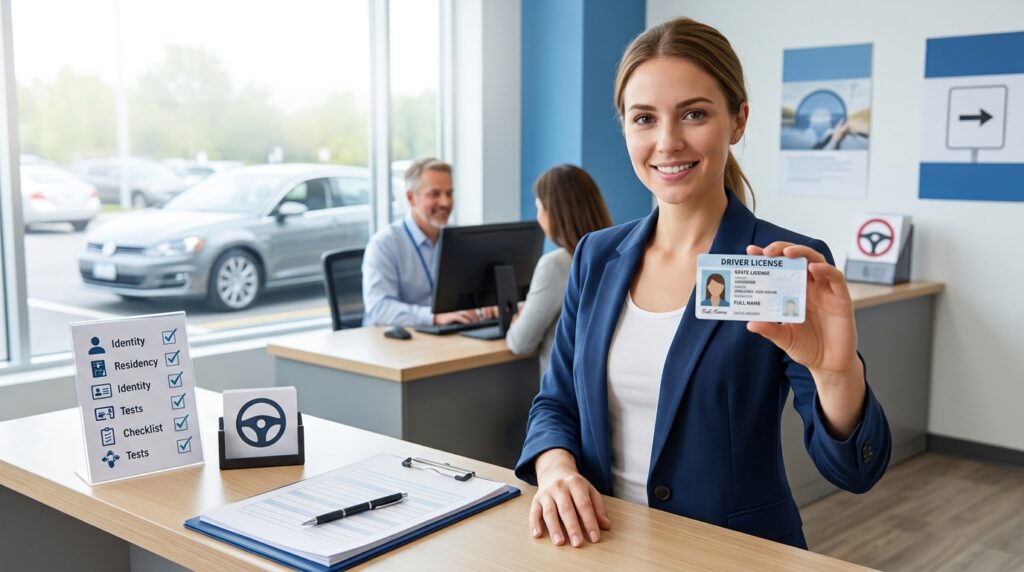
Getting a driver’s license is an important step for anyone who wants to drive legally. If you are applying for your first license, the process may seem confusing at first. You may need to prove your identity, provide documents, pass a knowledge test, complete a vision check, and pass a practical driving test.
So, how do you get a new driver’s license?
In most places, the process starts by checking your eligibility and learning the requirements of your local driver licensing authority. You then gather the required documents, complete an application, pay the applicable fees, and take any required tests. Once you meet all the requirements, your license can be issued.
However, the exact process is different from one country, state, or province to another. Age limits, documents, fees, testing rules, appointment systems, and delivery times can all vary.
This guide explains the general process of how to get a new driver’s license, what documents you may need, how the tests work, how much it can cost, and what you should do before applying.
What Is a New Driver’s License?
A driver’s license is an official document that allows a person to legally operate certain types of motor vehicles on public roads. It normally shows information such as the driver’s name, photograph, date of birth, license number, license class, and expiration date.
A new driver’s license usually means obtaining a license when you do not already hold the required license. For example, a person who has never been licensed may need to complete the first-time licensing process.
The term “new license” can also be confused with replacement and renewal.
A replacement license is generally issued when an existing license is lost, stolen, damaged, or otherwise needs to be replaced.
A renewal extends an existing driver’s license after it reaches or approaches its expiration date.
These processes are not always the same. If you already have a license, check whether you need a renewal or replacement instead of starting a first-time application.
Who Can Apply for a New Driver’s License?
Eligibility requirements depend on where you live. Before applying, check your local licensing authority’s rules.
Common requirements may include:
- Meeting the minimum age requirement
- Providing proof of identity
- Providing proof of residence or address
- Meeting applicable vision requirements
- Completing a learner’s permit period, where required
- Passing a written or knowledge test
- Passing a practical driving test
- Paying the required fees
- Meeting other legal requirements set by the licensing authority
Some places have graduated licensing systems for younger drivers. Under such systems, a new driver may first receive a learner’s permit or provisional license before receiving a full driver’s license.
Age Requirements
Minimum driving ages vary widely.
Some jurisdictions allow young people to begin supervised driving with a learner’s permit. A full driver’s license may become available later.
If you are under the required age for a full license, you may need to follow a staged licensing system. This can include supervised practice, a minimum holding period for a learner’s permit, driver education, and restrictions on when or with whom you can drive.
Do not assume that another person’s experience applies to your area. Always verify the age requirements with the official licensing authority.
What Documents Do You Need to Get a New Driver’s License?
One of the most important parts of the application process is preparing your documents.
The exact documents depend on your location and personal circumstances. However, licensing authorities commonly ask for documents that prove your identity, age, and residence.
Possible documents include:
- Passport or other accepted identity document
- Birth certificate
- National identity document
- Proof of residential address
- Immigration or residency documents, where applicable
- Learner’s permit, if applicable
- Driver education records, where required
- Passport-style photograph, where required
- Other documents requested by the licensing authority
You may need original documents rather than photocopies. Some authorities may also require certified copies or specific forms of identification.
Proof of Identity
Proof of identity helps the licensing authority confirm that you are the person applying for the license.
An accepted passport, national identity document, birth certificate, or other government-approved document may be used depending on the jurisdiction.
Before your appointment, check the official list of accepted documents. A document that is accepted in one location may not be accepted in another.
Proof of Address
Some licensing authorities require applicants to show where they live.
Examples may include official correspondence, government documents, bank statements, utility documents, or other accepted records.
The rules can include requirements about the document’s age, name, address, and issuing organization.
Do not rely on a random document simply because it shows your address. Confirm that it is included on your licensing authority’s approved list.
How to Get a New Driver’s License Step by Step
The following steps describe the general process. Your local procedure may be different, so use this as a guide rather than a replacement for official instructions.
Step 1: Check Your Eligibility
Start by checking whether you are eligible for a new driver’s license.
Look at the official licensing authority’s requirements for:
- Minimum age
- Residency
- Identification
- Learner’s permit requirements
- Driver education
- Testing
- Medical or vision requirements, if applicable
- Fees
- Appointment requirements
This step can save you time because you will know what you need before starting the application.
If you are a first-time driver, find out whether you must obtain a learner’s permit first.
Step 2: Get a Learner’s Permit If Required
Some jurisdictions require new drivers to obtain a learner’s permit before applying for a full driver’s license.
A learner’s permit may allow you to practice driving under specific conditions. For example, you may need to drive with a qualified supervising driver.
There may also be restrictions on driving times, passengers, or vehicle use.
The purpose of a learner’s permit is to provide supervised driving experience before a person takes the final driving test.
If your jurisdiction has this system, carefully follow all permit restrictions.
Step 3: Study the Official Driver Handbook
Before taking a knowledge test, study the official driver’s handbook for your jurisdiction.
The handbook normally covers topics such as:
- Traffic signs
- Road markings
- Speed limits
- Right-of-way rules
- Safe following distances
- Turning rules
- Parking rules
- Defensive driving
- Sharing the road
- Distracted driving
- Seat belt requirements
- Alcohol and drug-impaired driving laws
- Emergency situations
Do not depend only on unofficial practice websites. They can contain outdated or incorrect information.
The official handbook is usually the best starting point because it is designed around the rules used by the licensing authority.
Step 4: Gather Your Documents
Once you understand the requirements, prepare your documents.
Create a simple checklist before your appointment.
For example:
- Identity document
- Proof of address
- Proof of age
- Learner’s permit
- Application form
- Required photograph
- Payment method
- Other required documents
Check that names and dates are consistent across your documents.
If your documents contain different names because of a legal name change or another reason, find out whether additional documentation is required.
Step 5: Complete the Application
Complete the driver’s license application carefully.
Depending on your location, you may be able to start the process online, complete it in person, or use a combination of both.
Enter your personal information accurately. Check your name, date of birth, address, and other information before submitting the application.
If you do not understand a question on the application, ask the licensing authority for clarification rather than guessing.
Step 6: Make an Appointment If Required
Many licensing offices use appointment systems.
If an appointment is required, schedule it through the official licensing authority.
Keep your appointment details available and arrive with enough time to complete the process.
Some offices may have specific requirements for what you must bring to the appointment.
Step 7: Pay the Required Fees
Getting a driver’s license may involve one or more fees.
Depending on the location, you may have to pay for:
- Application processing
- Knowledge testing
- Driving testing
- License issuance
- Learner’s permit
- Replacement or other services
Fees vary significantly between jurisdictions.
Check the current official fee schedule before your appointment because prices can change.
Step 8: Take the Knowledge Test
Many first-time applicants must pass a knowledge or written test.
The test is designed to check whether you understand important road rules and safe driving practices.
Questions may cover:
- Road signs
- Traffic signals
- Right-of-way
- Speed regulations
- Parking
- Lane use
- Safe driving
- Pedestrian safety
- Bicycle safety
- Emergency vehicles
- Defensive driving
Read every question carefully.
Do not rush. If the test allows you to review your answers, use that opportunity before submitting it.
Step 9: Complete the Vision Test
A vision screening may be required before a driver’s license is issued.
The purpose is to check whether you have adequate vision for safe driving.
If you normally use glasses or contact lenses, follow the licensing authority’s instructions about bringing or wearing them.
If you have concerns about your vision, speak with an appropriate eye-care professional.
Step 10: Practice Driving
If you are required to take a practical driving test, practice before your appointment.
Focus on safe and legal driving rather than simply trying to memorize a test route.
Practice skills such as:
- Starting and stopping smoothly
- Turning correctly
- Using signals
- Checking mirrors
- Checking blind spots
- Maintaining a safe speed
- Staying in the correct lane
- Following road signs
- Parking
- Reversing
- Maintaining a safe following distance
- Responding appropriately to pedestrians and other road users
Practice only in ways that are legal in your area and follow any learner’s permit restrictions.
Step 11: Take the Driving Test
The practical driving test allows an examiner to evaluate your ability to control a vehicle and follow traffic rules.
The examiner may assess:
- Vehicle control
- Observation
- Signaling
- Lane positioning
- Turning
- Stopping
- Speed control
- Parking
- Awareness of other road users
- Compliance with traffic laws
The exact test varies by jurisdiction.
Try to remain calm and concentrate on safe driving. Listen carefully to the examiner’s instructions.
Step 12: Receive Your Driver’s License
After completing all required steps, the licensing authority may issue your driver’s license.
In some locations, you may receive a temporary or interim document while the physical license is produced.
The physical card may be provided at the licensing office or delivered later.
When you receive the license, check the information carefully. Make sure your name, date of birth, license class, and other important details are correct.
If something is wrong, contact the licensing authority.
How Much Does It Cost to Get a New Driver’s License?
The cost of getting a new driver’s license depends on the jurisdiction.
Possible costs include:
| Expense | May Apply? |
|---|---|
| Application fee | Yes |
| Learner’s permit fee | Sometimes |
| Knowledge test fee | Sometimes |
| Driving test fee | Sometimes |
| License issuance fee | Yes |
| Driver education | Sometimes |
| Medical or vision examination | Sometimes |
| Retesting fee | Sometimes |
There is no single worldwide price for a driver’s license.
The best way to find the current cost is to check the official fee schedule for your local licensing authority.
Remember that the total cost may be higher if driver education, additional testing, or professional driving lessons are required.
How Long Does It Take to Get a New Driver’s License?
The time required depends on the licensing process in your location.
The application itself may be completed relatively quickly, but becoming eligible for a full license can take longer.
For example, a first-time driver may need to:
- Apply for a learner’s permit.
- Complete supervised practice.
- Wait for a required period.
- Complete driver education.
- Pass required tests.
- Apply for the full license.
After approval, production and delivery of the physical card may take additional time.
Processing times can also change because of appointment availability, incomplete documents, testing schedules, holidays, or other administrative factors.
For the most accurate information, check the current processing information provided by your licensing authority.
What Happens If You Fail the Driving Test?
Failing a driving test does not necessarily mean you cannot become licensed.
Many jurisdictions allow applicants to take the test again after meeting certain conditions.
You may need to:
- Wait for a specific period
- Schedule another appointment
- Pay a retest fee
- Complete additional practice
- Meet another requirement
Use the examiner’s feedback to identify areas that need improvement.
For example, if you had difficulty with observation, lane positioning, parking, or signaling, spend more time practicing those skills before taking the test again.
Avoid rushing into another test before you are ready.
New Driver’s License vs. Replacement vs. Renewal
Understanding these terms can help you choose the correct application.
New Driver’s License
A new license is generally associated with becoming licensed for the first time or obtaining a license under a new licensing process.
Replacement Driver’s License
A replacement is generally used when your existing license is lost, stolen, damaged, or needs another physical replacement.
The requirements are often simpler than the first-time licensing process because you may already have a driving record.
Driver’s License Renewal
Renewal means extending an existing license.
A renewal may involve confirming your information, paying a fee, completing a vision check, taking a new photograph, or meeting other requirements.
The renewal process depends on the jurisdiction.
If you are unsure which service applies to you, check the official licensing website or contact the licensing office.
Common Reasons a Driver’s License Application Is Delayed
Several issues can cause delays.
Missing Documents
If you do not provide all required documents, the licensing office may not be able to complete your application.
Incorrect Information
A spelling mistake or incorrect personal detail can cause problems.
Review your application carefully before submitting it.
Failed Tests
If you do not pass a required test, you may need to retest before receiving the license.
Appointment Availability
Busy licensing offices may have limited appointment availability.
Planning ahead can help.
Unverified Information
Some applications may require additional checks before approval.
If additional information is requested, provide it through the official process.
Outstanding Fees
An unpaid fee can prevent an application from being completed.
Keep your payment receipt or confirmation when appropriate.
Tips for Getting Your New Driver’s License Successfully
Getting licensed becomes easier when you prepare in advance.
1. Use Official Information
Start with your government’s official driver’s license information.
Requirements can change, so current official information is more reliable than an old blog post or social media comment.
2. Prepare Your Documents Early
Do not wait until the day of your appointment to search for documents.
Create a checklist and confirm that each document meets the requirements.
3. Study the Official Handbook
The official handbook should be your main study resource for the knowledge test.
Pay special attention to signs, road rules, safety requirements, and situations that commonly appear in the test.
4. Practice Safe Driving
Practice with a qualified supervisor or instructor when required.
Focus on developing good driving habits rather than simply passing the test.
5. Know Your Vehicle
If you are using a vehicle for the driving test, make sure it meets the licensing authority’s requirements.
Check basic items such as:
- Lights
- Indicators
- Brakes
- Mirrors
- Tires
- Seat belts
- Registration and insurance documents, where applicable
The exact vehicle requirements depend on the jurisdiction.
6. Arrive Prepared
Bring all required documents, your appointment information, and an accepted payment method.
Arriving prepared can reduce unnecessary delays.
7. Ask Questions When You Are Unsure
If you do not understand a licensing requirement, ask the official licensing authority.
It is better to confirm a rule than to make an incorrect assumption.
Can You Apply for a Driver’s License Online?
In some jurisdictions, parts of the driver’s license process can be completed online.
Online services may include:
- Starting an application
- Booking an appointment
- Paying certain fees
- Checking application status
- Renewing an eligible license
- Updating personal information
However, first-time applicants may still need to visit a licensing office for identity verification, photographs, testing, or other requirements.
Do not assume that every driver’s license service is available online.
Use the official licensing authority’s website to determine which services are currently available.
Can You Get a New Driver’s License Without a Driving Test?
Whether you need a driving test depends on your circumstances and location.
A first-time driver will often have to demonstrate practical driving skills before receiving a full license.
However, some situations may have different requirements. For example, rules can vary for people transferring a license from another jurisdiction, returning to driving after a long period, or applying for a different license class.
Because these rules are location-specific, check the current requirements for your situation.
What Happens After You Get Your Driver’s License?
Getting your license is not the end of your responsibility as a driver.
You must continue to follow traffic laws and maintain safe driving habits.
Remember to:
- Follow speed limits
- Wear your seat belt
- Avoid distracted driving
- Never drive while impaired
- Obey traffic signals
- Give pedestrians appropriate space
- Maintain your vehicle
- Keep your license valid
- Follow restrictions that apply to your license
Your license gives you permission to drive under specific legal conditions. It does not remove your responsibility to drive safely.
How to Keep Your Driver’s License Valid
Driver’s licenses normally have an expiration date.
Check your license regularly and make sure you understand when it needs to be renewed.
Depending on your jurisdiction, renewal may be available online or may require an in-person visit.
Keep your address and other information updated when required.
If your license is lost or stolen, report it and request a replacement through the official process.
FAQ
How do you get a new driver’s license?
Generally, you need to check your eligibility, gather the required documents, submit an application, pay the applicable fees, complete required tests, and meet all licensing conditions. The exact process depends on your country, state, province, or other licensing authority.
What documents do I need to get a new driver’s license?
Common documents include proof of identity, proof of age, proof of address or residency, and other documents required by your local licensing authority. Some applicants may also need a learner’s permit or driver education records.
How much does a new driver’s license cost?
The cost varies by location. You may have to pay application, testing, permit, or license issuance fees. Check your local licensing authority’s current fee schedule for the exact amount.
How long does it take to get a new driver’s license?
The time varies. Some applicants may complete the process quickly, while first-time drivers may need to complete a learner’s permit period and supervised driving before taking the final test. Physical license delivery can also take additional time.
Can I get a driver’s license without a learner’s permit?
This depends on the licensing rules where you live. Some jurisdictions require first-time drivers to hold a learner’s permit, while others may have different procedures.
Do I need to take a written test?
Many jurisdictions require a knowledge test for first-time applicants. The test commonly covers road signs, traffic laws, and safe driving practices.
Do I need to take a driving test?
A practical driving test is commonly required for first-time drivers seeking a full license, but the exact requirements vary.
What happens if I fail my driving test?
You may usually have an opportunity to take the test again. Waiting periods, retesting rules, and fees depend on the local licensing authority.
Can I apply for a new driver’s license online?
Some parts of the process may be available online, but first-time applicants may still need to visit an office for testing, identity verification, photographs, or other requirements.
Can I use my foreign driver’s license to get a local license?
Some jurisdictions have procedures for transferring or exchanging foreign licenses. Requirements can depend on your country of origin, residency status, license type, and local laws.
Check the official licensing authority for the rules that apply to your situation.
Final Thoughts
Learning how to get a new driver’s license does not have to be difficult. The key is to understand the requirements before you begin.
Start by checking your eligibility and gathering the correct documents. If a learner’s permit is required, complete that stage first. Study the official driver handbook, prepare for the knowledge and vision tests, and practice your driving skills before the practical test.
Most importantly, remember that driver’s license requirements are not the same everywhere. Age limits, documents, fees, tests, appointments, and processing times can change depending on where you live.
For accurate and current information, always confirm the final requirements with your local government or official driver licensing authority.
A little preparation can help you avoid delays, understand the process, and become a safer and more confident driver.