
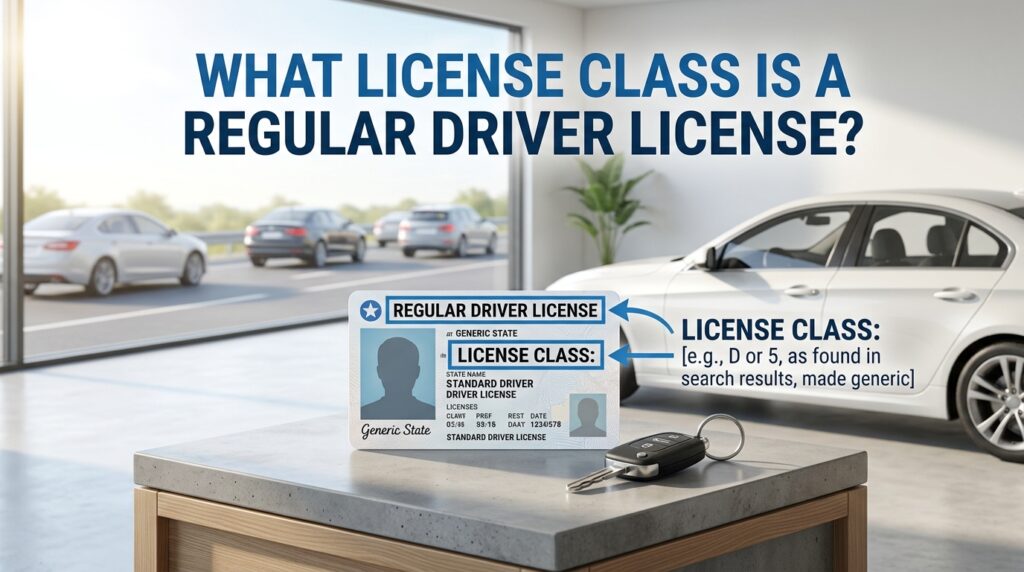
What license class is a regular driver license? This question seems straightforward, but the answer depends largely on where you obtained your license. A regular driver license—also called a standard or non-commercial license—is the credential most people use for everyday driving. However, the specific classification assigned to this license varies significantly across countries, states, and provinces.
Understanding your driver license class matters more than you might think. Whether you’re renting a vehicle, driving in a new state, traveling internationally, or simply ensuring you’re legally compliant, knowing what your license permits is essential. Different license classes carry different privileges and restrictions. Some classes allow you to operate larger vehicles, tow trailers, or drive commercially, while others limit you to standard passenger vehicles.
The confusion around license classes stems from the lack of universal standardization worldwide. While some jurisdictions use alphabetical classifications (Class A, B, C), others use numerical systems or entirely different naming conventions. This guide explores what a regular driver license actually is, what it permits you to drive, how it differs from commercial licenses, and how to identify your specific license class.
What Is a Regular Driver License?
A regular driver license, in its most basic definition, is an official document authorizing an individual to operate non-commercial motor vehicles on public roads. It’s the most common type of driver license issued to the general population and typically permits the operation of standard passenger vehicles used for personal transportation.
How It Differs From Commercial Licenses
The distinction between a regular and commercial driver license is crucial. A Commercial Driver License (CDL) authorizes the operation of large commercial vehicles—typically those designed to transport passengers or cargo for compensation. Regular licenses, by contrast, are designed exclusively for personal use.
A regular driver license holder cannot legally operate:
- Large commercial trucks (usually those exceeding 26,001 pounds)
- Buses carrying more than 15 passengers
- Vehicles transporting hazardous materials
- Commercial tractor-trailers
- Most vehicles used in for-hire services
Attempting to operate these vehicles without a proper CDL can result in fines, license suspension, and even criminal charges in some jurisdictions.
Types of Vehicles a Regular License Permits
With a standard driver license, you can typically operate:
- Sedans and compact cars
- SUVs and crossovers
- Minivans
- Pickup trucks (within weight limits)
- Station wagons
- Hatchbacks and coupe vehicles
- Motorcycles (if you hold a motorcycle endorsement)
Weight restrictions apply in many jurisdictions. For example, in the United States, most regular licenses permit operation of vehicles up to 26,000 pounds Gross Vehicle Weight Rating (GVWR). Exceeding this limit typically requires a commercial classification.
Restrictions Based on License Status
Your specific regular driver license may carry restrictions based on:
- Age: Younger drivers may face curfew or passenger limitations
- Vision or hearing: Certain corrective measures may be required
- Medical conditions: Some conditions require periodic re-evaluation
- Violations or suspensions: Previous infractions may limit driving privileges
- Endorsements and prohibitions: You may have restrictions on towing capacity or vehicle type
What License Class Is a Regular Driver License?
The answer to this central question depends entirely on your licensing jurisdiction. There is no global standard for classifying driver licenses, which creates confusion for both local and international drivers.
Most Common Classifications for Passenger Vehicles
Class C is perhaps the most universally recognized classification for regular, non-commercial driver licenses. This classification is used in many U.S. states, Canadian provinces, and other jurisdictions worldwide. A Class C license typically permits:
- Operation of standard passenger vehicles
- Light trucks under specified weight limits
- Some exceptions for agricultural or special vehicles
However, Class C is not the universal standard. Some jurisdictions use Class D, while others employ entirely different systems.
Why the Answer Varies by Jurisdiction
Different regions developed their licensing systems independently, often decades ago, without coordination. This historical development created fragmented standards that persist today.
United States variations:
- California uses Class C for regular passenger vehicles
- New York recognizes Class D for regular passenger vehicles
- Texas uses Class D for non-commercial vehicles
- Florida classifies regular licenses as Class E
International examples:
- The United Kingdom and many Commonwealth nations use categories A through F, where Category B permits standard cars
- Germany uses Classes AM, A1, A2, A, B, C1, C, D1, D, BE, C1E, CE, and DE based on vehicle weight and type
- Australia uses classifications based on vehicle weight and seating capacity
Real-World Examples of Classification Differences
A driver licensed in California with a Class C license might discover their license is called Class D in Arizona. Both permit operation of standard passenger vehicles, but the terminology differs. When traveling between jurisdictions, what matters is functional capability—what vehicles you’re legally permitted to operate—rather than the specific letter or number assigned.
What Can You Drive With a Regular Driver License?
Understanding what your regular driver license permits requires knowing both the general categories and the specific weight restrictions of your jurisdiction.
Primary Vehicle Types
Passenger Cars: All standard sedans, coupes, and compact vehicles fall squarely within the scope of a regular license. This includes luxury vehicles, sports cars, and performance vehicles, provided they don’t exceed GVWR limits.
SUVs and Crossovers: Most SUVs and crossovers are legal to operate with a regular driver license, regardless of their category or size. These typically fall within standard weight classifications.
Minivans: All standard minivans are designed for regular license holders and clearly marked with GVWR ratings that fall within regular license limits.
Light Trucks: This category is where restrictions become important. Many light trucks (commonly pickup trucks with regular or extended cabins) are within regular license parameters, but some heavier models require commercial classification. The vehicle’s GVWR is the determining factor.
Other Permitted Vehicles: Depending on your jurisdiction, regular licenses may permit:
- RVs under certain weight limits
- Motorhomes designed for personal use
- Vehicles used in educational driving programs
- Golf carts and all-terrain vehicles (in some jurisdictions)
Weight and Vehicle Restrictions
Nearly all jurisdictions establish GVWR thresholds that determine license requirements. In the United States:
- 26,000 pounds and under: Regular license acceptable
- 26,001 pounds and above: Commercial Driver License required
This distinction explains why some truck owners with specific vehicle models can drive legally with a regular license, while owners of heavier models must obtain a CDL. It’s not about the vehicle category but rather its actual rated weight capacity.
Regular Driver License vs. Commercial Driver License
Understanding these differences is essential for legal compliance and can prevent serious legal consequences.
Main Differences Explained
| Aspect | Regular License | Commercial License |
|---|---|---|
| Primary Purpose | Personal use | Professional/for-hire use |
| Vehicle Types | Passenger vehicles, light trucks | Large trucks, buses, hazmat vehicles |
| GVWR Limit | Up to 26,000 lbs (US standard) | 26,001 lbs and above |
| Testing Requirements | Written and practical exam | Extensive written exams, practical tests, and endorsement requirements |
| Medical Requirements | Standard vision/hearing | Stricter medical examination standards |
| Insurance Cost | Lower premiums | Significantly higher premiums |
| Renewal Period | Typically 4-8 years | Typically 4 years, with more frequent medical checks |
Typical Vehicle Types
Regular licenses permit standard personal transportation vehicles. Commercial licenses authorize operation of:
- Semi-trucks and tractor-trailers
- Large delivery trucks
- Transit buses
- Passenger buses
- Tanker trucks
- Hazmat transport vehicles
- Specialized commercial vehicles
When a CDL Becomes Necessary
You need a commercial driver license when:
- Your vehicle’s GVWR exceeds regulatory thresholds
- You operate vehicles designed to transport passengers for compensation
- You transport hazardous materials
- You drive a school bus
- You operate a vehicle as part of your employment (beyond limited personal-use exceptions)
Why Regular Licenses Don’t Work for Commercial Vehicles
This restriction exists for public safety. Operating large commercial vehicles requires specialized training and knowledge that a regular driver education course doesn’t provide. Commercial drivers must understand:
- Air brake systems and operation
- Large vehicle handling and weight distribution
- Hazardous materials regulations
- Hours-of-service regulations
- Load securing requirements
- Interstate commerce regulations
Regular license holders haven’t received this training, making it illegal and dangerous for them to operate these vehicles.
Common Driver License Classes Explained
While classifications vary by jurisdiction, here are the most widely recognized categories:
Class A License
Where it’s used: Many U.S. states, Canadian provinces
What it permits:
- Large tractor-trailers
- Combinations of vehicles with specific weight requirements
- Typically represents the highest commercial classification
GVWR: 26,001 pounds and above, with specific requirements for towing combinations
Requirements: Extensive testing, medical examinations, and usually Class B and C prerequisites
Class B License
Where it’s used: U.S. states and provinces using alphabetical systems
What it permits:
- Heavy straight trucks (non-articulated)
- Large buses
- Vehicles between 26,001 and 33,000+ pounds depending on jurisdiction
GVWR: Typically 26,001 pounds and above
Requirements: Commercial driver testing and licensing
Class C License
Where it’s used: California, many other U.S. states, and numerous international jurisdictions
What it permits:
- Standard passenger vehicles
- Light trucks under GVWR limits
- Motorcycles (if endorsed)
- Most personal-use vehicles
GVWR: Up to 26,000 pounds (in U.S. jurisdictions)
Requirements: Standard driver education and testing
Class D License
Where it’s used: New York, Texas, Florida, and other U.S. states
What it permits:
- Standard passenger vehicles
- Light trucks
- Essentially equivalent to Class C in functional terms
GVWR: Up to 26,000 pounds
Requirements: Standard driver education and testing
Motorcycle License/Classes
Where it’s used: All jurisdictions
What it permits:
- Motorcycles and motorized scooters
- Often subdivided by engine size or power
Classifications vary significantly:
- Some jurisdictions use M, M1, M2, M3 designations
- Others use power output thresholds (e.g., under 50cc, 50-125cc, over 125cc)
- Some require separate motorcycle endorsements rather than distinct classes
Important note: The meaning of each class varies significantly by jurisdiction. Always consult your local Department of Motor Vehicles or equivalent authority for precise definitions.
Does a Regular Driver License Work in Other Countries?
One of the most misunderstood aspects of international driving is whether a license from one country is valid in another. The answer is qualified: yes, but with important caveats.
Domestic License vs. International Driving Permit
Your regular driver license is recognized in most countries as proof of driving eligibility, provided it:
- Is currently valid (not expired)
- Is written in Roman characters, or accompanied by a certified translation
- Comes from a country with recognized licensing standards
- Is carried along with proof of identity
An International Driving Permit (IDP) is a supplementary document that translates and validates your home country license in 174 countries and territories. It’s not a replacement for your domestic license—it supplements it.
Why Travelers May Need an IDP
While many countries will accept a regular driver license, others have specific requirements:
Countries that practically require an IDP:
- Many countries in Asia require an IDP, especially if your license is in English but not English-speaking country
- Some European nations formally require it
- Rental car companies often require it as a condition of rental, even if not legally mandated
- Insurance companies may deny coverage without one
- Police may refuse to recognize your license in certain jurisdictions
Practical reasons to obtain an IDP:
- Translation services if stopped by police
- Official validation in countries with strict documentation requirements
- Insurance and rental car protection
- Serves as backup identification
- Simplifies vehicle registration and rental processes
The IDP’s Role: Supplement, Not Replacement
The IDP does not authorize driving on its own. It is always used in conjunction with your original, valid domestic driver license. Carrying an IDP without your domestic license provides no legal driving authorization. The IDP simply translates your license into multiple languages and confirms that your home country issued it according to recognized standards.
International Driving Requirements Vary by Destination
Before driving internationally, verify requirements for your specific destination:
- Contact the destination country’s embassy or consulate
- Check with your automotive association (AAA in the U.S., CAA in Canada, etc.)
- Verify rental car company requirements
- Confirm insurance coverage in the destination country
- Research local traffic laws and road signs that may differ from your home country
How to Find Your Driver License Class
Locating your specific driver license class is straightforward but essential for understanding your driving privileges.
Check the Front of Your License
Most driver licenses prominently display the license class. Look for:
- A letter designation (A, B, C, D, etc.)
- A numerical code
- A category designation
- Usually positioned in the upper right or left section of the front of the card
The exact location varies by jurisdiction, but it’s always clearly marked for official purposes.
Look for Class or Similar Designation
Your license will explicitly state the classification using terms like:
- “Class: C”
- “Category: B”
- “License Type: Regular”
- “Classification: D”
- A simple letter without additional labeling
If you can’t locate it easily, the license issuing authority’s official website typically provides visual guides showing where to find this information.
Check the Issuing Authority’s Official Website
If you’re unsure about your license’s class or need clarification:
- Visit your state/provincial DMV website (in the U.S.) or equivalent authority
- Look for “Driver License Classes” or “License Types” information
- Cross-reference your license’s designation with official descriptions
- Note any endorsements or restrictions
Official websites provide authoritative information and explain what your specific classification permits.
Review Restrictions and Endorsements
Your license back typically displays:
- Restrictions: Conditions limiting your driving (e.g., corrective lenses required, no commercial towing)
- Endorsements: Additional authorizations (e.g., motorcycle endorsement, hazmat endorsement)
- Expiration date: When your license loses validity
Understanding these details ensures you’re driving within legal parameters.
Verify Your Jurisdiction’s Standards
License classifications have different meanings depending on where they were issued. A Class D license from New York is not identical to a Class D from another state, so always reference:
- The issuing state or country’s specific definitions
- The DMV’s official materials
- Regulations that apply in any jurisdiction where you’ll be driving
This verification is especially important when driving between states or countries.
FAQ
Is a Regular Driver License Usually Class C?
Not universally. While Class C is common in many jurisdictions for regular passenger vehicle licenses, it’s not the standard everywhere. The United States alone uses multiple classifications:
- California, Colorado, and many other states use Class C
- New York, Texas, and Florida use Class D
- Some jurisdictions use Class E or other designations
The prevalence of Class C in populous states like California may create an impression that it’s universal, but this isn’t accurate. Your specific license class depends entirely on your issuing jurisdiction.
Is a Regular Driver License the Same as a Non-Commercial License?
Yes, these terms are essentially synonymous. A “regular driver license” and a “non-commercial license” refer to the same thing: a license authorizing operation of personal-use vehicles. The terms emphasize different aspects:
- “Regular” highlights that it’s the standard, common license
- “Non-commercial” emphasizes what it prohibits (for-hire or professional use)
Both terms describe licenses for everyday, personal driving. However, non-commercial restrictions can apply to commercial-class licenses as well, so the terminology isn’t perfectly interchangeable in all contexts.
Can I Drive a Truck With a Regular License?
Short answer: It depends on the truck’s GVWR.
Detailed answer:
Light trucks (pickup trucks, small commercial pickups) with a GVWR of 26,000 pounds or less can be operated with a regular driver license in the United States. Many commonly available pickup trucks fall into this category.
Heavier trucks exceeding the GVWR threshold require a commercial driver license. Some truck owners don’t realize that their specific vehicle model exceeds the limit and operate it illegally.
The vehicle’s manufacturer stamp on the driver’s side door shows the GVWR. Check this specification before assuming your license is sufficient. If unsure, consult your state’s DMV for clarification on your specific vehicle.
Does My License Class Affect Car Rental?
Yes, your license class can significantly affect rental options and costs:
Limitations:
- Some rental companies won’t rent certain vehicle types to regular license holders (though most passenger vehicles are fine)
- Insurance may not cover damage if you’re driving outside your license classification
- Age-related restrictions (young drivers may have limited availability)
- Some companies charge extra for underage drivers
Additional requirements:
- Many companies require an International Driving Permit for international rentals, regardless of your license class
- Insurance verification may be necessary
- Passport or additional ID may be required
- Credit cards for damage deposits
- Some companies require you to be a certain minimum age (often 25)
Commercial vehicle rentals:
- Renting large trucks or commercial vehicles requires appropriate license class documentation
- CDL holders may get favorable rates or access to rentals unavailable to regular license holders
- Some rentals require proof of commercial insurance
Best practice: Contact rental companies in advance to confirm they’ll rent to you and understand their specific requirements.
Do Driver License Classes Mean the Same Thing Everywhere?
Absolutely not. This is crucial to understand when driving in multiple jurisdictions:
Even within the U.S.:
- California’s Class C isn’t identical to another state’s Class C in all details
- GVWR thresholds vary slightly
- Specific endorsements and restrictions differ
- Some states have additional classes others don’t use
Internationally:
- European classifications (A, A1, A2, B, C1, C, D1, D, etc.) don’t correlate with U.S. systems
- Different countries use different weight thresholds
- Age requirements for various classes vary considerably
- Some countries recognize only domestic licenses; others require IDPs
When traveling or relocating:
- Research the specific jurisdiction’s definitions
- Your home license may be valid but permit fewer vehicles than you expected
- International driving may require different documentation
- Commercial privileges may not transfer across borders
Always consult the jurisdiction’s official standards before assuming equivalency between classifications from different regions.
Final Takeaway
The answer to “What license class is a regular driver license?” is definitively: it depends on your jurisdiction.
Many jurisdictions classify regular, non-commercial licenses with consistent designations—Class C being most common in the United States—but there is no universal standard. A regular driver license authorizes operation of standard passenger vehicles, light trucks within weight limits, and potentially motorcycles (with appropriate endorsements), but the specific classification assigned to this authority varies significantly.
Key Takeaways:
- Know your specific classification: Check your license document to identify your class or category designation.
- Understand local GVWR limits: Most regular licenses permit vehicles up to 26,000 pounds GVWR in the U.S., but verify your jurisdiction’s specific threshold.
- Verify your restrictions: Beyond the classification, note any personal restrictions (corrective lenses, medical conditions) or endorsements that affect your privileges.
- Research before traveling: When driving in a new state or country, confirm your license’s validity and any additional documentation requirements.
- Don’t assume equivalency: A Class C license in one state may carry different privileges than a Class C in another. Always reference official sources.
- Obtain an IDP for international travel: While many countries recognize domestic licenses, an International Driving Permit simplifies international driving and is often required by rental companies.
- Consult official sources: Your state/provincial DMV or equivalent authority provides authoritative information about what your specific license permits.
Regular driver licenses are the most common driving credential, but understanding exactly what your individual license permits requires knowing your jurisdiction’s specific classifications, restrictions, and requirements. This knowledge ensures you remain compliant with local laws, protects your driving record, and prevents inadvertent violations that could result in fines, license suspension, or insurance complications.
When in doubt about your license class or driving privileges, contact your local licensing authority. They can provide definitive answers about what your specific license authorizes, ensuring you drive legally and safely.